

The IAEA cannot verify whether Iran's 441 kg of 60%-enriched uranium was buried at Fordow or moved elsewhere. Rafael Grossi warns enrichment could resume in months. Trump claims victory. Doha negotiates Hormuz — not the nuclear timetable the MOU requires.
On June 17, Donald Trump signed a fourteen-point memorandum with Iran’s Masoud Pezeshkian at Versailles and told markets the nuclear file was closed. Brent crude fell below $79. Equities rallied. The MOU commits both sides to resolve the disposition of Iran’s highly enriched uranium within sixty days — with on-site downblending under International Atomic Energy Agency supervision as the minimum acceptable method.
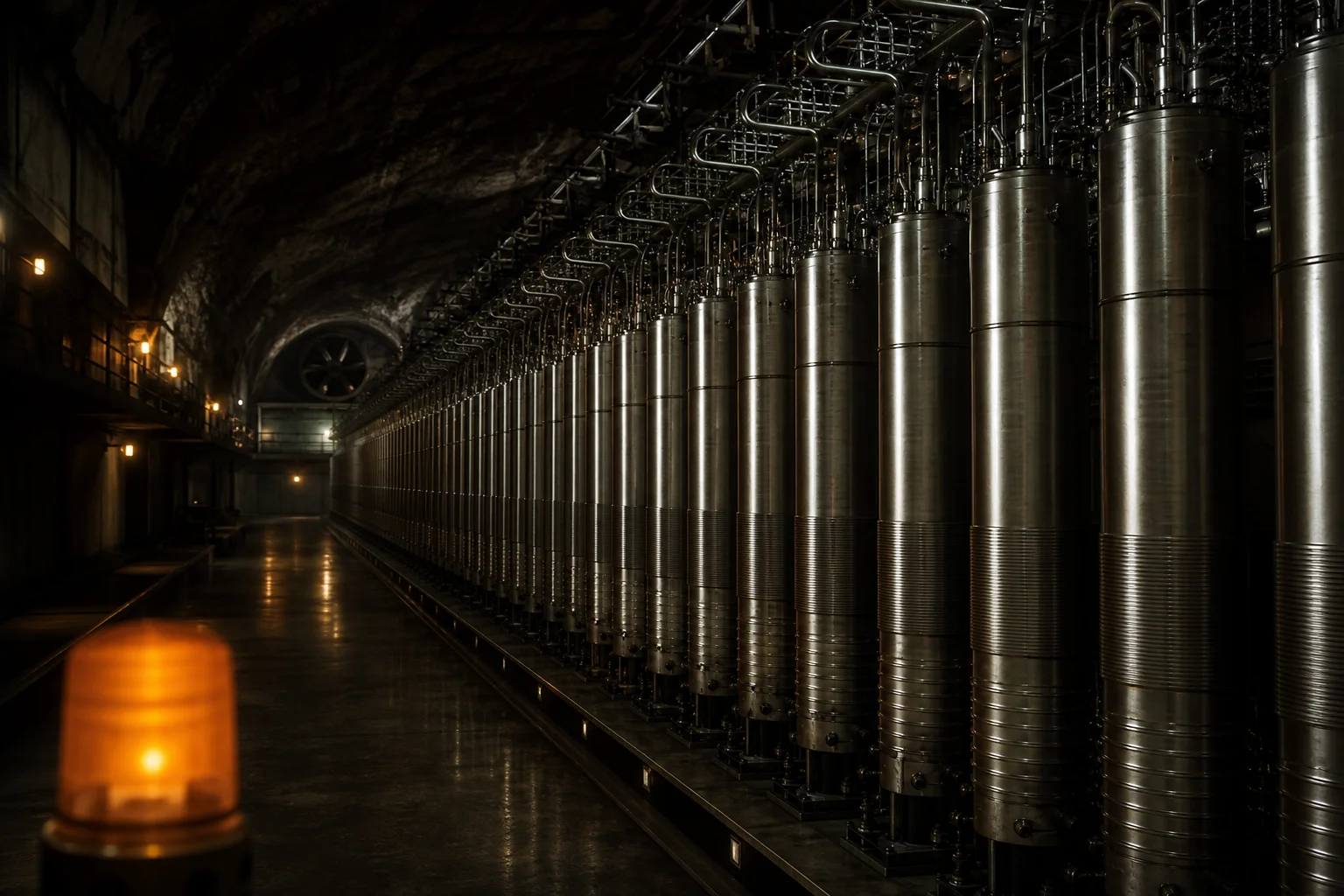
The problem is that the agency cannot yet supervise what it cannot locate. The IAEA’s June 2026 safeguards report states that aside from a single visit to the Bushehr power plant, inspectors have received no information from Iran about the status of declared nuclear facilities bombed in June 2025 — and have had no access for in-field verification. The entire nine-tonne enriched uranium stockpile, including 441 kilograms at 60% purity, exists on paper. Its physical whereabouts do not.
Grossi’s Months and the Buried Stockpile
Before the June 2025 strikes, Iran had accumulated 440.9 kg of uranium enriched to 60% — enough, by IAEA yardsticks, to fuel roughly ten nuclear weapons after a short additional enrichment cycle. That material was distributed across Esfahan’s tunnel complex, Natanz, and Fordow. When Israel and the United States bombed all three enrichment sites, the tunnels at Fordow were buried and the agency lost its accounting thread.
Rafael Grossi told CBS in June 2025 that Iran retained the industrial capacity to resume enrichment “in a matter of months” — a few cascades of centrifuges spinning, or less. He contradicted Trump’s claim that the facilities were “totally obliterated.” A leaked Pentagon assessment reached a similar conclusion: the programme was set back by months, not years. Grossi added the line that haunts the current diplomacy: “We don’t know where this material could be. Some could have been destroyed. Some could have been moved.”
The June 2026 report confirms the blind spot has not closed. Satellite imagery analyzed by the Institute for Science and International Security shows trucks moving blue barrels — possibly uranium in overpack containers — into Esfahan’s tunnel complex as recently as June 9. Up to eighty kilograms may remain inside Fordow’s buried underground chambers. Whether the rest sits at Natanz, Esfahan, or an undeclared site is, in Grossi’s phrase, unknown.
What the MOU Promises — and Cannot Deliver Yet
Point eight of the memorandum is where the celebration meets the physics. Iran reaffirms it shall not develop nuclear weapons. Both sides agree the fate of stockpiled enriched uranium will be “immediately addressed” in a final agreement negotiated within sixty days. The minimum methodology: downblending on site under IAEA supervision.
Downblending sounds technical and therefore safe. It is neither simple nor possible without first excavating, inventorying, and securing material that may be entombed under bombed mountain complexes. Who digs it out, who dilutes it, and where the resulting low-enriched product goes remain unsettled. Trump told reporters Iran would work with Washington to turn over uranium “buried in the rubble.” Grossi, speaking in Fukushima days after the signing, said inspections “are going to happen” — whether in one week or ten days is “important, but not essential.”
Iran’s parliament passed a law in June 2025 suspending cooperation with the IAEA. Any future inspection requires approval from the Supreme National Security Council. Tehran has permitted case-by-case access to operational sites like Bushehr but rejected Grossi’s requests to visit bombed enrichment plants. Foreign Ministry spokesperson Esmaeil Baghaei said Monday that cooperation continues “under the existing framework” — which is precisely the framework that excludes the sites where the uranium actually is.
Doha Talks the Wrong File
While the downblending clock ticks, diplomacy has drifted to Doha. Steve Witkoff and Jared Kushner arrived in Qatar this week. Trump’s Truth Social post claimed Iran “requested” talks. Qatar’s foreign ministry clarified that no direct U.S.-Iran meetings are scheduled. Tehran sent a technical delegation Wednesday to discuss frozen assets and Hormuz implementation — not the nuclear material disposition that Point eight requires.
The sequencing is the story. Markets priced peace on the MOU’s Hormuz reopening and sanctions relief. Brent’s collapse reflects a supply-shock ending, not a verification ending. Article 5 of the memorandum — who controls strait transit and on what terms — has consumed the diplomatic oxygen that the uranium question needs. With less than sixty days to negotiate a permanent end to the war, the most dangerous file is the one nobody in Doha is scheduled to open.

The Loop That Closes on Verification
Trump’s victory lap assumes the June 2025 strikes solved the problem Grossi says could recur in months. The MOU assumes downblending can proceed on a timetable markets have already spent. The IAEA report assumes none of this works without access it does not have — and that Iran’s parliament has legislated against granting freely.
Three clocks run in parallel and none synchronize. The sixty-day MOU window for a permanent deal. Grossi’s “matter of months” for centrifuges to spin again if Iran chooses. The unknown interval required to locate, excavate, and downblend material that may be buried, moved, or both. Until the first clock waits on the third, the rally is priced on a nuclear outcome the inspectors cannot yet certify.
The blind spot is not a footnote to the peace deal. It is the deal’s load-bearing wall — and Doha is negotiating the windows while the foundation remains unexamined.
Continue reading


Sources
IAEA Board of Governors June 2026 safeguards report, ISIS analysis of IAEA Iran reports, AP and The Hill on MOU downblending terms, Reuters and Presstv on Doha mediation, BBC and CBS on Grossi enrichment timeline, Fox News on nuclear blind spot, Euronews on Grossi inspection pledge


