

Supreme Leader Mojtaba Khamenei has installed former IRGC commander Mohsen Rezaei as secretary of the Supreme National Security Council. The post puts a hardline Hormuz skeptic at the apex of Tehran's security state just as markets and Oman talks price possible reopening. Institution, not theater, now prices blockade duration and second-corridor bets.
On Sunday, Iran’s supreme leader Ayatollah Mojtaba Khamenei formally appointed Major General Mohsen Rezaei as his representative on—and, by presidential decree, secretary of—the Supreme National Security Council. The post replaces Mohammad Bagher Zolghadr, who had filled the vacuum left when Ali Larijani was killed in U.S.-Israeli strikes in March. The résumé is not subtle: Rezaei commanded the IRGC from 1981 to 1997, sat on the Expediency Council, and has spent the past week as the public face of a hard line on any U.S.-proposed “second corridor” through Hormuz.
For oil, freights, and the equities that still treat every diplomatic rumor as a reopening, the relevant fact is institutional. The SNSC is where threat assessments become doctrine. Planting Rezaei there is how wartime leverage hardens into peacetime pricing power.
The Appointment Is Not Optics—It Is the Control Surface
Markets are trained to trade communiqués. They are less practiced at pricing who sits in the chair that co-ordinates the military, intelligence, and foreign-policy apparatus formally chaired by President Masoud Pezeshkian. As secretary and Khamenei’s representative, Rezaei is not a cable-channel hardliner; he is the routing layer for what “best efforts” on commercial passage is allowed to mean operationally.
That matters because the diplomatic surface still looks busy. Foreign Minister Abbas Araghchi says Iran and Oman are near a framework for managing inbound and outbound lanes. Washington still refuses any toll-and-permit model for an international strait. Rezaei’s recent line—“We will never allow a second corridor to be opened in the Strait of Hormuz”—is less naval geometry than a refusal to let the United States freelance a southern bypass around Iranian enforcement. Process risk now has a named principal.
This is the same fracture Culled has tracked since the Versailles MOU moved Brent and indices while Hormuz traffic stayed cautious, since markets priced peace that shipping never fully confirmed, and since Bürgenstock talks jolted oil on process failure rather than pure barrels. Paper still moves faster than fixtures. Rezaei’s chair is how Tehran slows the paper.
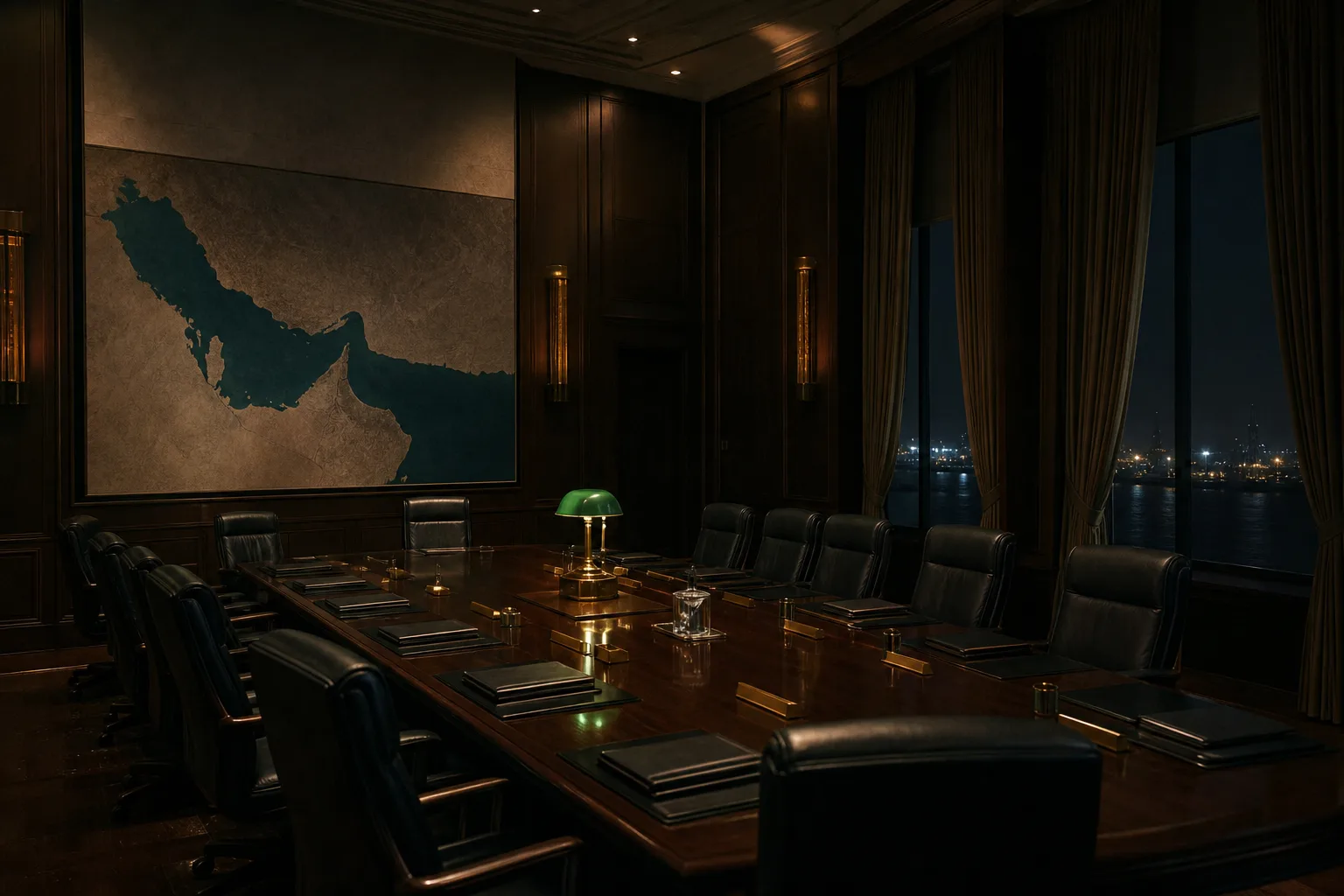
Why Blockade Risk Gets Harder to Hedge, Not Louder
A pure spike in missile rhetoric is, perversely, tradeable: buy the rumor, fade the evening tape. An SNSC hardline consolidation is a duration problem. Duration is what wrecks systematic hedges built for event risk.
Reopen trades assumed a convergence: Oman coordinates lanes, Washington drops selective blockade pressure, P&I clubs reprice war risk, and stranded Gulf tonnage clears. Each step requires someone in Tehran to treat commercial restoration as a security good, not residual wartime leverage. Rezaei’s public posture—and the wartime pedigree that justified his elevation—signal the opposite hierarchy. Leverage over fifth-fleet politics and sanctions sequencing outranks throughput. Until that hierarchy flips, the curve markets want—steep contango giving way to prompt softness—keeps colliding with an authority structure that profits from optionality on every VLCC.
Physical memory reinforces the political one. When seven P&I clubs cancelled Hormuz war-risk cover, the strait froze without a minefield; insurance was the enforcement layer that mattered. A corridor on paper does not re-mint that cover if underwriters read the SNSC secretary as someone who may reimpose selective stop-and-inspect theater next week. Capital learns through freight, not from state TV.
The secondary spillover is already in the system: forced conservation and fuel switching under prolonged choke-point stress still function as an accidental climate lever nobody requested. That does not substitute for a bankable strait. It only means prolonged blockade is multi-asset, not single-strip oil beta.
How Capital Should Price the Pivot
Treat Rezaei’s elevation as a state-capacity upgrade of the choke, not as an escalation headline. Equities will still whip on “talks resume” ticks; the sober book prices who can bind IRGC maritime behavior. Observable transit without selective IRGC enforcement is the only non-falsifiable data. Until then, reopen rallies are duration of hope, not restoration of flow.
The residual is short enough for a morning brief. Iran just staffed the SNSC with a commander-turned-doctrinaire who treats second corridors as red lines and reopenings as bargains, not defaults. Markets that keep answering Hormuz with a binary—closed or open—will mis-size a regime that has made conditional metering the plan. The actionable principle: buy insurance and optionality priced for who holds the chair, not for the last diplomatic press cycle. Like policy turns that reprice entire debt complexes, the binding variable is institutional succession inside a state that still owns the world’s oil artery—not the cheer on the tape.
Continue reading


Sources
The National and Iran International on Rezaei SNSC appointment (Aug 9, 2026); Mehr / IRNA framing of second-corridor refusal; prior Culled reporting on the June MOU, Bürgenstock process risk, insurance freezes, and market pricing of incomplete peace


