

President Donald Trump said the United States will build two major military bases in Greenland under the new Arctic security pact. Permanent control over security was already reported last week. The residual is what the bases would actually do.
President Donald Trump said this week that the United States will build two major military bases in Greenland under the Arctic security agreement signed with Denmark and Greenland’s leaders at the United Nations. He again claimed permanent control over security, said adversaries would need U.S. approval for sensitive investment, and treated the island as a hemispheric picket. That control line was already reported Friday and blanketed by wire desks. The usable residual is narrower: what would the two bases be for?
Reuters, citing people familiar with the talks, has reported the likely footprints as Narsarsuaq in the south — the old Cold War Bluie West One airfield whose settlement has shrunk to a few dozen people — and Mestersvig on the east coast, now used by Denmark’s Sirius Dog Sled Patrol. They would sit beside Pituffik Space Base, the Pentagon’s northernmost installation and, until now, the only active U.S. base on the island. Geography, not the sovereignty wording, decides their jobs.
Beyond Pituffik’s Radar Horizon
Pituffik already answers the missile-warning question. The Space Force’s 12th Space Warning Squadron runs an Upgraded Early Warning Radar that detects and assesses intercontinental and sea-launched ballistic trajectories over the Arctic, supports missile-defense cueing, and feeds space-domain awareness — the same lattice Culled mapped when Arctic antennae became a China–U.S. control-room race. A second and third site do not automatically mean second and third giant radars. They more often mean dispersion: airlift, tanker and fighter pads, logistics depots, and sensors that watch approaches Pituffik cannot cover alone.
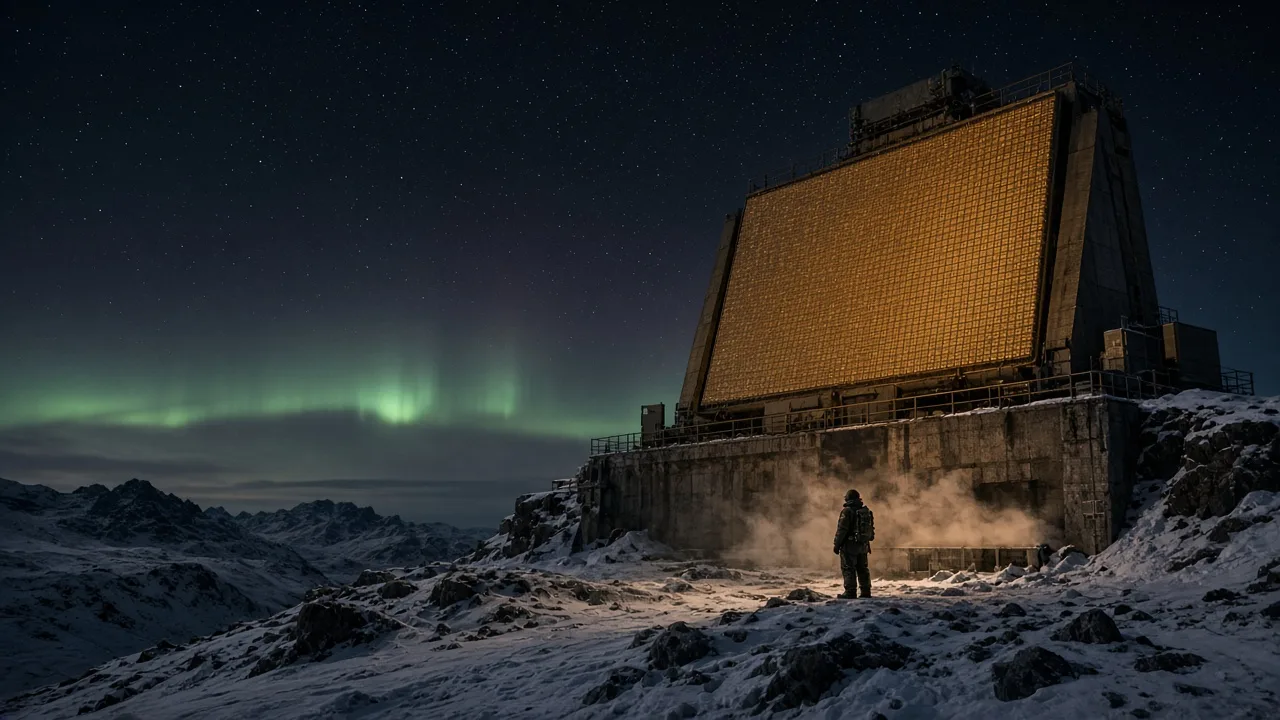
A southern airfield like Narsarsuaq is a classic Arctic air and naval access node: runway length for heavy lift into the North Atlantic, staging for search-and-rescue and sovereignty flights, a logistics bridge when weather closes the northwest. An east-coast outpost like Mestersvig sits nearer the western hinge of the GIUK gap — Greenland–Iceland–UK — the choke through which Russian Northern Fleet submarines and surface groups historically press toward Atlantic reinforcement lanes. Bases there are less about claiming ice and more about hours of warning and persistence in a region where infrastructure is scarce and Chinese dual-use research has already tested Western nerves.
The Mission Stack Washington Is Buying
STATE is buying a presence map. PLATFORM — radars, satellite ground stations, undersea arrays if they come later — will decide how much of that map becomes a kill chain versus a political flag. Trump has tied Greenland to his Golden Dome missile-defense concept; planners care more about early track quality over polar routes than about branding. Logistics is the unglamorous binding constraint: fuel, housing, ice-capable ports, and year-round runway maintenance decide whether “major bases” mean continuous squadrons or seasonal camps with a plaque. Cold War Greenland once hosted roughly seventeen U.S. installations and more than ten thousand personnel. Today’s ~150 at Pituffik is a skeleton. Two new sites are how Washington grows the skeleton without re-fighting last week’s sovereignty headline — the same alliance-friction terrain Culled tracked when Greenland diplomacy strained the compass it needed.
Two bases are not a restated security clause. They are a bet on airfields and sensors that make Pituffik’s warning useful farther south and east.
Test three things. Watch whether published facility plans emphasize early-warning radars, runway length, or dual-use ports. Watch whether Narsarsuaq and Mestersvig are named in Danish or Greenlandic parliamentary texts, or only in anonymous briefings. Watch whether Russian Northern Fleet and Chinese Arctic research patterns shift once concrete is poured — or whether the pact’s investment veto does more work than the hangars. The deal language is crowded. The searchable question is what the runways are for.
Continue reading


Sources
Trump UN/Arctic signing week Sept. 22, 2026: two major bases; permanent security control / adversary approval for bases and sensitive investment (Truth Social Friday; AP/CBS/WaPo). Reuters exclusive Sept. 21–22: reported sites Narsarsuaq (former Bluie West One / Cold War airbase) and Mestersvig (Sirius Dog Sled Patrol outpost); plus existing Pituffik Space Base (~150 U.S. personnel). Space Force: 12 SWS Upgraded Early Warning Radar — missile warning, missile defense support, space-domain awareness; Det-7 Satellite Control Network tracking. Cold War history: ~17 U.S. installations / 10,000+ personnel vs one base today. Golden Dome / Arctic approaches; GIUK gap ASW and reinforcement lanes; Culled Arctic antennae, Greenland diplomacy friction, NATO tariffs coverage


