

Iraq ordered Iranian flights to Baghdad suspended from Wednesday after the United States threatened airport service providers with secondary sanctions. Officials are discussing a diversion to Najaf. That makes Iraq the first practical test of whether an Iranian carrier can reroute around Washington’s airline pressure one airport at a time.
Iraq has ordered its civil aviation authority to suspend Iranian flights to Baghdad from Wednesday, according to two sources cited by Reuters. The decision came after Treasury Secretary Scott Bessent warned that airports and companies providing fuel, landing services, or ticket sales to Iranian carriers risk being cut out of the dollar system.
Then came the more revealing detail. Iraqi officials are discussing diverting Baghdad-bound Iranian flights to Najaf instead. The move is still a discussion, not a settled operating arrangement. But it changes the story from an abstract claim of worldwide shutdown to a live test at two airports separated by a short domestic flight.
Najaf is not an incidental alternative. It is a major destination for Iranian religious travelers and sits inside an Iraqi political economy with every reason to preserve that traffic. The question is whether shifting a flight’s destination also shifts the risk that Washington has put on the people who make a landing usable.
Baghdad’s closure is the first operational response
The U.S. warning was designed to reach beyond the aircraft. Bessent’s formulation was blunt: a foreign airport may not fuel an Iranian carrier, provide landing services, or sell tickets without risking its access to the dollar system. That is not an airspace ban. It is a threat against the commercial chain beneath an open sky.
Baghdad’s reported suspension is the first concrete sign that the threat can alter behavior before Washington publicly designates a foreign airport or service provider. The decision also gives Iraq a narrow political escape hatch: restrict the capital’s airport without declaring an end to all Iranian air links.
That distinction matters because Najaf could offer a path that is economically and politically easier for Baghdad to defend. Pilgrimage traffic is not an abstract cross-border flow. It fills hotels, transport operators, restaurants, and the smaller businesses that accumulate around a holy city. A diversion would preserve part of that system while moving the immediate decision away from the capital.
But it would not, by itself, answer the U.S. threat.
A new airport does not create a new service chain
For an Iranian flight, changing its destination means changing the local airport operator, fuel supplier, ground handler, payment arrangements, and ticketing relationships. It does not mean escaping those functions. If Washington enforces its warning consistently, Najaf’s providers face the same question Baghdad’s did: is servicing an Iranian carrier worth the risk to dollar clearing, correspondent banking, insurance, or suppliers with U.S. exposure?
That is the mechanism behind Washington’s attempt to ground Iranian airlines without closing airspace. The aircraft can move. The indispensable services cannot disappear; they merely acquire a new address.
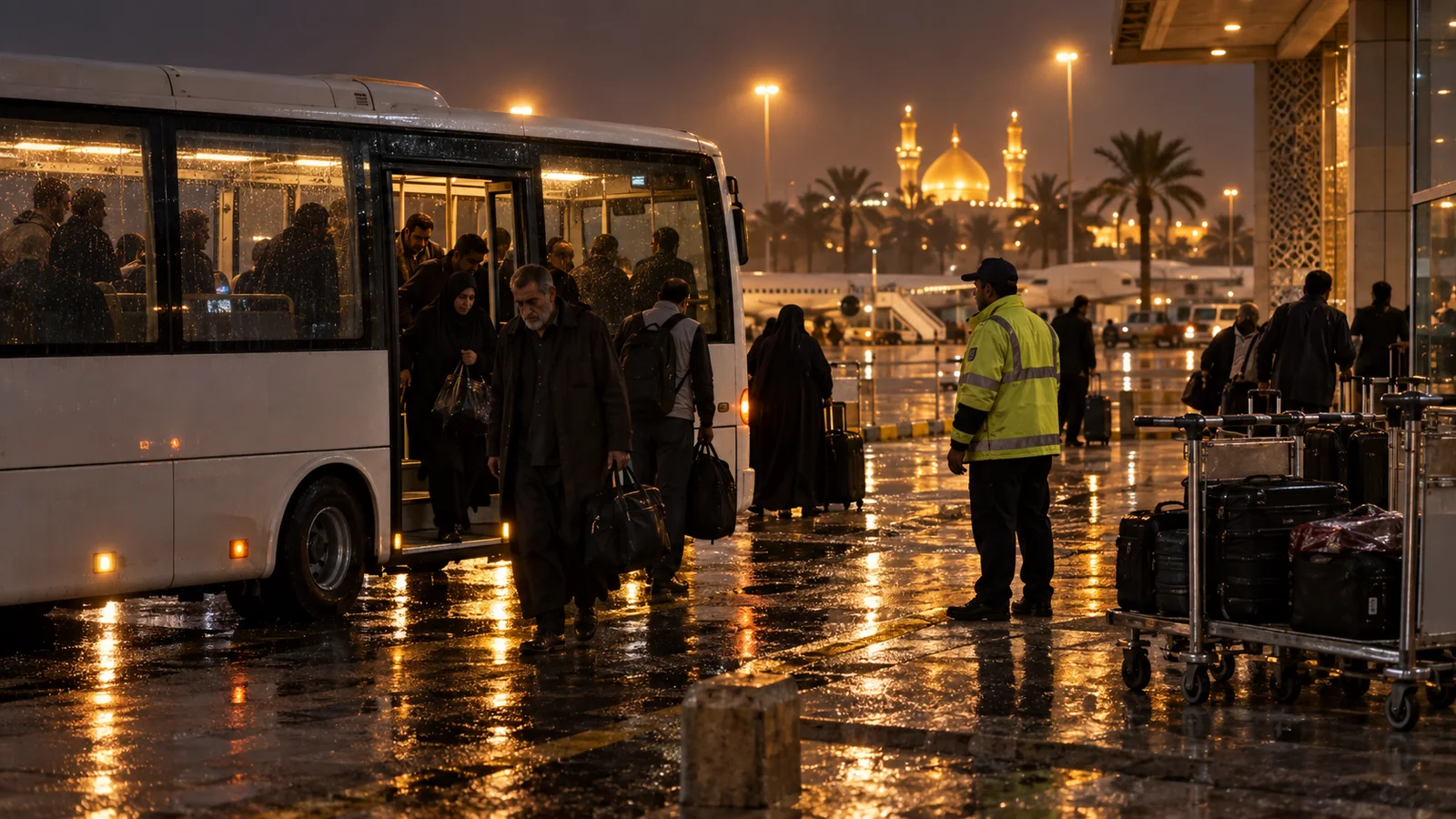
The proposed diversion therefore produces a clean enforcement test. If Iranian carriers land in Najaf with fuel, ground services, ticket sales, and payments functioning normally, it would suggest that enforcement is selective, delayed, or constrained by the cost of confronting Iraq’s religious and commercial ties to Iran. If those services become costly, intermittent, or unavailable, then a diversion will prove to be a route change rather than a workaround.
A flight can move from Baghdad to Najaf. Its exposure to the service chain moves with it.
Najaf makes the claim measurable
This is the useful thing about the Iraqi case: it turns an enormous claim — that Iranian airlines can be shut out worldwide — into a small set of observable facts. Watch whether Najaf publishes operating guidance; whether Iranian schedules reappear there; whether fuel and ground-handling contracts change; and whether ticket sales or payment channels are restricted. A flight’s departure board will reveal more than a week of official rhetoric.
The distinction between a formal ban and a compliance chill is especially important. Baghdad may be complying with Washington’s warning. Najaf may attempt to continue traffic while its providers quietly reassess exposure. Those are not opposite outcomes; they can be sequential stages of the same sanctions design.
Iraq is already familiar with the leverage of dollar access in its dealings with Washington. Aviation simply makes the infrastructure visible: a jet on wet tarmac, a fuel truck, a baggage loader, a bank transfer behind the ticket. The Treasury campaign Bessent pressed on Iran’s oil buyers at the G20 meeting in Asheville now has an airport-scale laboratory.
China’s response shows the other side of that formula. Beijing can reject the sanctions as illegitimate while its companies decide, transaction by transaction, how much risk to tolerate; its airports and banks face the same public-private split. Iraq’s version is more immediate because the choice is now geographic: Baghdad has stepped back, and Najaf may be asked to step in.
The likely lesson will not be that American sanctions are omnipotent or useless. It will be narrower and more useful. A sanctions regime that works through service providers can be evaded only when the replacement provider can also bear the financial and political cost. Najaf is about to show whether that cost travels with the aircraft — or stops at Baghdad’s perimeter.
Continue reading


Sources
Reuters reporting on Sept. 22, 2026, citing Iraqi sources on the Baghdad suspension and discussions of Najaf diversion; Iranian Civil Aviation Organization statements reported by Tasnim and Iraqi media; U.S. Treasury Secretary Scott Bessent’s Sept. 21 warning on fuel, landing services, and ticket sales for Iranian carriers; U.S. Treasury aviation sanctions release.


