

President Donald Trump told the UN General Assembly that the United States and Venezuela signed what he called the largest oil deal in history, covering 65 billion barrels, and that “to the victor belong the spoils.” The residual is what that figure actually measures—and what it does not.
President Donald Trump told the United Nations General Assembly on Tuesday that the United States and Venezuela had signed what he called the largest oil deal in history — covering 65 billion barrels — and that “to the victor belong the spoils.” He cast the arrangement as evidence that U.S. military power will secure American interests in the Western Hemisphere. The quote travels. The number does more work if you ask what it is.
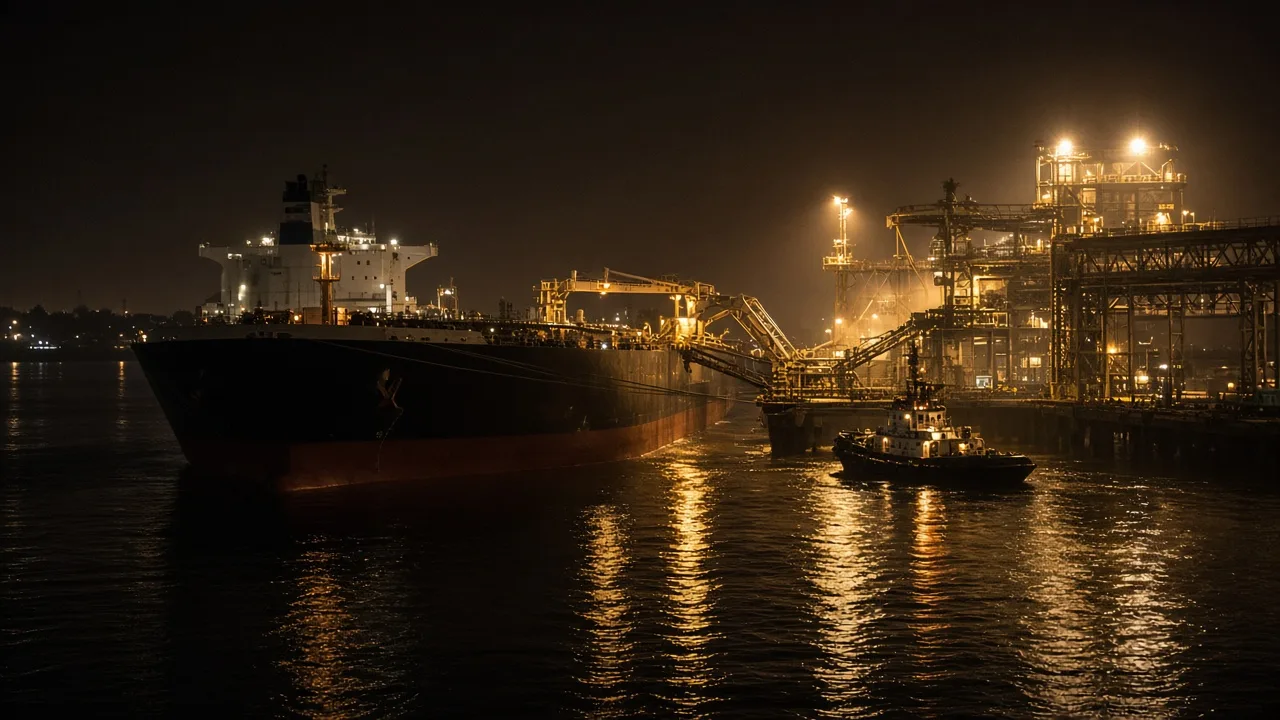
It is not a claim that 65 billion barrels will soon load onto tankers. On the White House’s own August 31 fact sheet, 65 billion is the approximate proven oil reserves attached to seventeen fields granted as 100-year concessions to North American Blue Energy Partners (NABEP). That is roughly a fifth of Venezuela’s world-leading proved stock — and larger, on paper, than the United States’ own ~46 billion barrels of territorial proven reserves. Proven reserves are an inventory estimate. They are not annual production, not recoverable volume under today’s prices and upgraders, and not a delivery schedule.
The Structure Beneath the Spoils Line
The deal the administration describes is a stack of rights, not a single cargo contract. Venezuelan interim authorities under Delcy Rodríguez granted NABEP the field concessions. NABEP, in turn, granted the U.S. Department of War’s Office of Strategic Capital a 35 percent equity stake in its corporate parent, and gave the State Department a guaranteed 20 percent of offtake at production cost plus a right of first refusal on the remaining 80 percent. Washington claims board veto power and a requirement that a majority of directors be U.S. citizens; the NABEP agreement is said to be governed by U.S. law. Rubio and Hegseth signed for the United States. Trump’s “spoils” framing — first aired loudly in Las Vegas in August — is the political caption on that stack: military removal of Nicolás Maduro in January, then preferential title to the Orinoco and Maracaibo acreage once controlled by Maduro-era operators and foreign partners.
That is also where CAPITAL enters. NABEP’s plan, per the fact sheet, contemplates up to $100 billion in infrastructure investment and roughly $200 billion in royalties and taxes over the first twenty-five years. Chevron’s separate September expansion — more than $7 billion aimed at roughly doubling its Venezuelan output toward 600,000 barrels a day — sits beside NABEP, not inside it. Confusing the two inflates the near-term barrel count. Analysts already warn that heavy Orinoco crude means recoverable barrels from those seventeen fields may be a fraction of the booked 65 billion; Foreign Policy’s recovery skepticism puts the practical haul nearer 20 billion even before politics and cash flow.
What the Number Does Not Settle
STATE can write majority control into a fact sheet. It cannot mint light sweet crude from extra-heavy bitumen without upgraders, diluent, power, and security. The same hemisphere logic Culled mapped in the Caribbean triad of Orinoco, lanes, and frontiers still binds any spoils claim: geography and processing capacity decide how fast paper reserves become product. Interim authority to grant century-long concessions will be contested — by Venezuelan politics, by future U.S. administrations, and by the gap between Maduro’s capture and the financial afterlife of the old regime. Debt and reconstruction math still run through whatever cash actually clears PDVSA’s successors, as Culled tracked when policy transition repriced Venezuelan paper.
Sixty-five billion barrels is the size of the ledger entry. The deal is equity, offtake, and a hundred-year concession clock — and the spoils line is the admission of how that clock was set.
Test three things. Watch whether NABEP filings and Venezuelan hydrocarbons law publish field-by-field reserve audits that match 65 billion. Watch whether OSC’s 35 percent stake and the 20 percent cost offtake appear in audited production, not only in White House bullets. Watch whether pump rates and Gulf Coast refining runs rise on a timetable that could move prices — or whether the UN number remains a stock of proven barrels used to narrate victory. The searchable question is not whether Trump said 65 billion. It is what kind of barrel he was counting.
Continue reading


Sources
Trump UNGA Sept. 22, 2026: 65B-barrel deal / “to the victor belong the spoils” / Western Hemisphere military-power framing; White House fact sheet Aug. 31, 2026 (Rubio–Hegseth): NABEP 100-year concessions on 17 fields ~ 65B proven barrels; OSC 35% equity in parent; State 20% offtake at cost + ROFR on 80%; board veto / U.S.-citizen majority; ~$100B NABEP capex plan; $200B royalties/taxes over 25 years; U.S. proven reserves ~46B contrast; Venezuela ~303B proved (EIA-class); Aug. Las Vegas spoils speech; The Week / Foreign Policy recoverable skepticism (~20B from those fields); Chevron separate $7B Orinoco expansion to ~600kbd; Maduro capture Jan. 2026 / interim Delcy Rodríguez; Culled Venezuela Bitcoin, Caribbean triad, debt rebound coverage


