

The Costa Serena is serving as a floating accommodation hub during the Aichi-Nagoya Asian Games, which run from 19 September to 4 October. Its planned Nagoya port stay is 15 September–6 October, with capacity for up to 4,000 athletes and officials in 1,500 cabins. The organising committee's contract specifies ¥4,487,256,042 including tax, with JTB's Nagoya division, for securing the vessel and coordinating hotel-ship operations.
On 15 September, the Olympic Council of Asia reported that the Costa Serena had berthed at Nagoya as the Aichi-Nagoya 2026 floating athletes’ village — a visible answer to a familiar host-city problem: how to house thousands of competitors for three weeks without committing to permanent dormitories that may sit half-empty afterward. The ship’s scheduled stay runs 15 September through 6 October, bracketing competition from 19 September to 4 October, with published capacity of up to 4,000 athletes and officials in roughly 1,500 cabins.
The procurement number that matters is not a back-of-the-envelope “per day” figure scraped from cruise brochures. The organising committee’s contract addendum, filed with its materials, lists ¥4,487,256,042 including tax payable to JTB Corporation’s Nagoya division for securing the vessel and coordinating hotel-ship operations. That wording is the tell: the line item buys an operating arrangement — berthing, hotel management, and the event logistics wrapped around both — not a naked hull charter priced like a leisure sailing.
Why the daily-rate headline misleads
Trade press has already run arithmetic comparing implied daily costs with ordinary cruise revenue. Cruise Industry News, on 25 September, noted that the Serena deal’s calculated daily rate exceeds rates cited for other recent hotel-ship charters. Those comparisons are useful as order-of-magnitude gossip, but they risk treating ¥4.49 billion as if it were fungible with ticketed passenger days at sea.
Mega-event accommodation contracts typically bundle scope that a cruise P&L separates across departments: security perimeters at the gangway, meal service aligned with athlete nutrition rules, shuttle timing to venues, medical and doping-control access, waste handling under port authority rules, and staffing for a population that is working, not vacationing. Which of those sit inside JTB’s contract — and which remain separate municipal or federation costs — is the due-diligence question a simple “charter rate” cannot answer.
The inference is still worth stating plainly: a temporary mega-event can purchase deployable capacity without retaining a large residential asset after the flame goes out. Nagoya substitutes movable beds for part of what would have been a permanent village footprint. Counterevidence is equally plain: one contract does not prove savings against a fully costed land-based alternative that includes construction finance, legacy use, and post-Games maintenance. Transport from port to competition sites, waterfront security, and the opportunity cost of berth space during peak industrial traffic all belong in any honest comparison — and none of them appear in a headline divided by twenty-one days.
What the market is actually trading
The scarce goods here are not cabins alone. They are deployable accommodation at scale, event-grade hotel operations, and procurement expertise that can stand up a village in weeks. That is a model worth studying for other constrained host cities — port access, hotel shortages, or political resistance to new permanent housing — but it is not evidence that every idle cruise ship can profitably flip into a Games hotel. Ships need compatible power and waste hookups, gangway security that satisfies both port police and federation protocols, and crew trained for dormitory density rather than buffet turnover.
For investors, the durable angle is indirect: who captures recurring demand for hotel-ship brokers, specialized insurers, and port retrofit contractors when sports calendars stack more regional games into dense Asian schedules. The Serena invoice is a single data point, not a sector thesis.
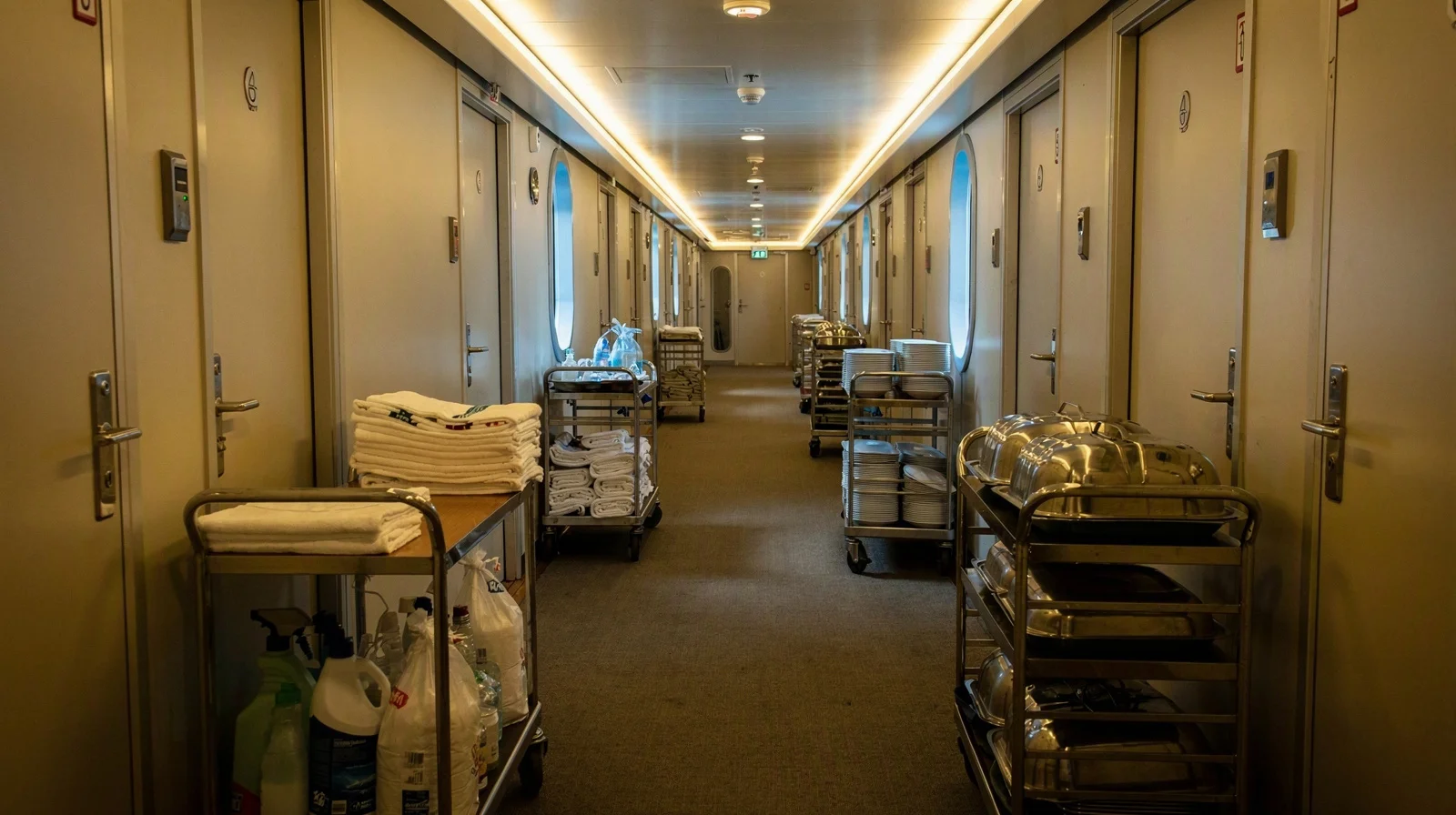
Questions that survive the berth photo
Operational transparency will determine whether Nagoya’s experiment reads as innovation or expensive optics. Which meals, staffing, security and transport costs are inside the ¥4.49 billion contract — and which invoices sit elsewhere in the organising committee’s books? What is the independently costed land-based alternative, including the post-Games value of any permanent accommodation that was not built?
If the floating village clears those audits — athletes housed safely, venues served on schedule, no port disruption that triggers industrial claims — the lesson is procurement design: rent the operating stack, not just the steel. If costs migrate into opaque line items after the ship sails, the lesson is familiar: mega-events excel at moving scarcity off the balance sheet and onto the waterfront, where it photographs well and accounts poorly.
Continue reading


Sources
Olympic Council of Asia arrival notice (15 Sep 2026); Aichi-Nagoya organising committee hotel-ship contract addendum (berth 15 Sep–6 Oct 2026); Cruise Industry News cost comparison (25 Sep 2026)


