

Reuters obtained an invitation showing U.S. and Japanese officials met on September 10 to address Chinese licensing bottlenecks on yttrium and permanent magnets. The silvery rare earth has no easy substitute in thermal-barrier coatings. Beijing's April 2025 controls still pinch aerospace, power, and semiconductor supply chains as summit optics obscure an opaque market.
The Trump–Xi summit arrived with the usual theater: tarmac ceremony, trade extensions, agricultural pledges. Underneath that noise, Reuters published a quieter document — an emailed invitation to a September 10 meeting at the U.S. Department of Energy where American and Japanese government officials, alongside company representatives, were asked to discuss “strategic supply chain bottlenecks” with “a specific focus on permanent magnet and yttrium supply chains.”
Yttrium is not neodymium. It does not headline EV motor debates. It is the kind of element procurement teams file under specialty chemicals until a license queue turns it into a production risk. Processed into oxide, it feeds yttria-stabilized zirconia and related thermal-barrier coatings that keep jet-engine turbine blades, gas-turbine hot sections, and some semiconductor manufacturing hardware from melting in their own exhaust. Substitutes exist on paper. Qualifying them across a fleet of engines or a fab line is another matter entirely.
The market is tiny; the machines are not
That asymmetry is the whole story. The global yttrium trade is measured in hundreds of tons, not millions. The U.S. imported an estimated 470 tons of yttrium products in 2024, according to the U.S. Geological Survey, with about 93% arriving directly from China and most of the remainder passing through Chinese processing anyway. A single wide-body engine program or a gas-turbine backlog can absorb material that looks trivial on a commodity spreadsheet.
Beijing’s April 2025 licensing regime — introduced alongside controls on several other rare earths after U.S. tariff escalation — turned that small market into a policy lever. Reuters reported in November that European yttrium oxide prices had risen roughly 4,400% since January to about $270 per kilogram on Argus assessments, while Chinese domestic prices stayed near single digits per kilogram. Traders described licenses issued in small lots and long delivery delays. One trader told Reuters stocks had fallen from 200 tons to five; another said they were out entirely. Outside estimates of Western inventories ranged from one to twelve months of consumption, varying sharply by company.
Customs data tell a jurisdictional story. U.S.-bound Chinese yttrium exports slowed early in 2025, then stalled after April; Reuters counted zero shipments in January, May, and June. Flows partially recovered later in the year but remained well below 2024 levels even as other destinations received more volume — a pattern that fits the wider rare-earth friction we mapped ahead of Xi’s visit, where magnets rebound faster than the most sensitive defense- and fab-adjacent inputs.
Japan’s position is tighter still. Reuters linked the post-November collapse in controlled-metal exports to Prime Minister Sanae Takaichi’s remarks about a hypothetical Chinese attack on Taiwan — diplomacy and mineral paperwork moving in the same week. The September 10 meeting, hosted with Japan’s Ministry of Economy, Trade and Industry, was explicitly framed as a search for “U.S.-Japan collaboration to strengthen supply chain resilience.” That is alliance language for: we cannot assume Beijing will license our next shipment.
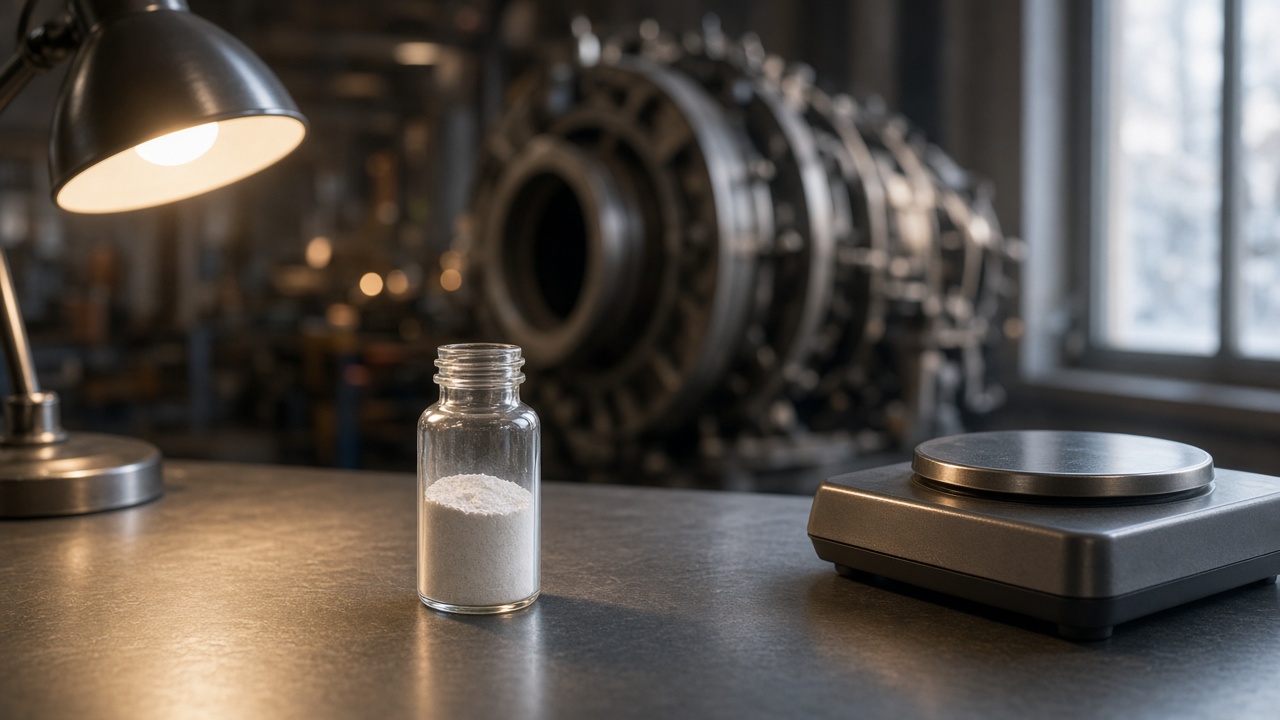
A gram-scale input becomes strategic when the thing it protects costs eight figures and cannot be swapped in a quarter.
Why jet engines and fabs feel it before headlines do
Aerospace and chip equipment move slowly enough that shortages surface first as cost and lead-time stress, not grounded fleets. The Aerospace Industries Association told Reuters in November that yttrium was essential to advanced jet engines and that the industry remained heavily import-dependent. Gulfstream’s president said exposure sat on the “perimeter” of deliveries. Semiconductor executives rated severity higher — one source called the shortage a “nine out of ten” for equipment makers, with Great Lakes Semiconductor’s CEO warning that delays would stretch build times and raise tool costs even if fabs kept running.
The industrial rhyme with AI’s migration into turbine metallurgy is uncomfortable. Data-center operators are racing to secure gas turbines and casting capacity; yttrium sits one layer above the nickel superalloy, in the coating that lets those blades survive combustion temperatures. Siemens Energy’s chief executive said in November that diversifying away from Chinese rare earths would take time; Mitsubishi Heavy reported no immediate gas-turbine impact. “Manageable for now” is engineer-speak for monitoring a curve that can steepen quickly when oxide stocks are thin.
Washington’s response is beginning, but scale matters. Indiana-based ReElement Technologies told Reuters it planned to produce yttrium oxide at 200 tons per year by December 2025, rising toward 400 tons by March — meaningful against U.S. import volumes, but only if qualification timelines cooperate. Europe’s magnet diversification in Narva offers a parallel lesson: first commercial output helps; it does not erase a decade of processing know-how overnight.
What to watch after the summit cameras leave
Treat yttrium as a licensing and inventory indicator, not a ticker symbol. The operational questions are whether U.S. and Japanese buyers receive predictable oxide shipments, how long export approvals take, and whether traders outside China will redirect material to American customers without fear of retaliation. Price spreads between Chinese and European oxide are already a stress gauge: when they blow out, someone in the coating chain is paying for political risk in cash.
Summits can pause escalation; they rarely dissolve a bottleneck baked into qualification cycles. China’s controls on yttrium remain on the books even as other rare-earth flows normalize. The West’s practical test is whether a metal most people cannot pronounce becomes as legible to planners as lithium or HBM — not because the market is large, but because the machines it unlocks are. In strategic materials, the binding constraint often hides in the smallest line item on the bill of materials.
Continue reading


Sources
Reuters Sept. 24, 2026 reporting on a Sept. 10 U.S. Department of Energy meeting invitation; Reuters Nov. 2025 yttrium shortage reporting and Argus price data; Reuters Sept. 2026 rare-earth shipment coverage; U.S. Geological Survey 2025 yttrium trade note; China customs export statistics cited in Reuters.


