

The attack on MV Cape Dao off Oman killed an Indian seafarer and forced the question that freight markets tend to postpone: who bears the risk when a commercial route remains open only in theory?
Dubai — One Indian seafarer was killed after MV Cape Dao was attacked off Oman’s Musandam governorate on Wednesday. Oman’s Maritime Security Centre said the incident caused an engine-room fire and that 27 crew members were evacuated. India’s external-affairs ministry said 19 of the vessel’s 20 Indian seafarers were rescued. The basic facts are enough to change the frame: a chokepoint is not merely a route whose risk can be converted into a freight rate.
The public record still has limits. Gulf News reported the Forward Seamen’s Union of India said the vessel had been hit by two torpedoes; that is a union account, not an official attribution. The available official statements describe the attack, evacuation and fatality, but do not establish responsibility or a weapon. That distinction matters in a conflict zone, where a premature label can become a market signal of its own.
The crew is the first constraint
Insurance can assign a price to a hull, cargo or delay. It cannot compel a crew to accept a transit, or erase an operator’s duty of care after a fatality. The Cape Dao attack puts that human constraint in the foreground. Owners, charterers and flag states will have to weigh a route against the safety of the people who make the voyage possible—not only against the value of the cargo.
That does not justify treating every transit as impossible, nor does it prove a blanket closure of the strait. It does mean that a shipowner’s choice is no longer adequately described as a bet on fuel, distance and insurance. It is a decision about exposure for a crew operating in a zone where commercial vessels have been attacked.
Workarounds relieve pressure; they do not replace a route
The alternatives are real but bounded. Reuters reported this week that Saudi Arabia restarted its East-West Pipeline at a reduced rate after attacks had interrupted the line and Yanbu loadings. The pipeline gives Saudi crude a path to the Red Sea that avoids Hormuz; it is a partial buffer, not an unlimited substitute for normal Gulf shipping.
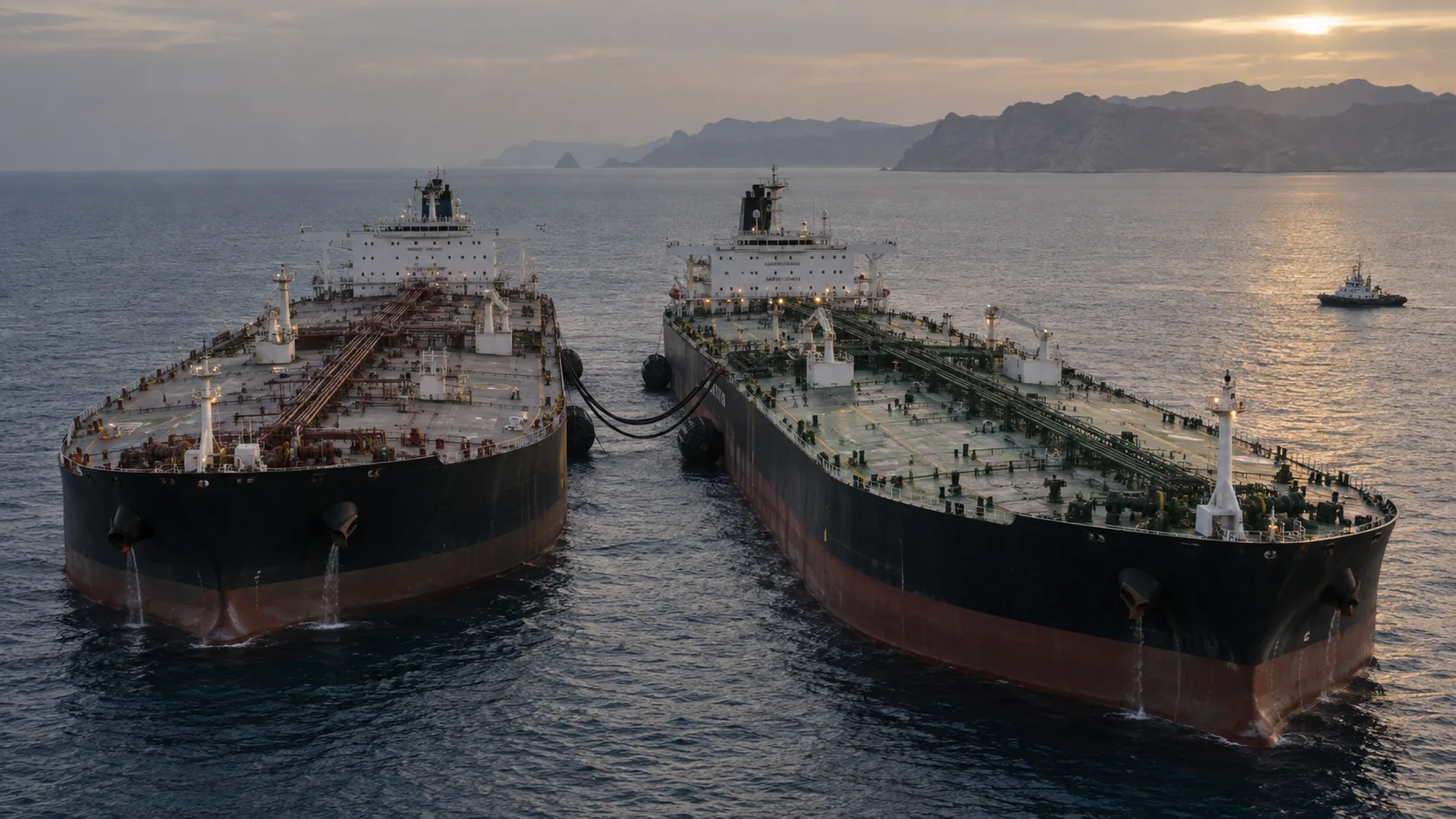
Ship-to-ship transfers can also move some cargoes beyond the highest-risk part of a journey. Reporting on Saudi flows has described shuttle tankers carrying crude through Hormuz for transfer off Oman, where long-haul VLCCs can take it on. But that arrangement adds handoffs, time and coordination. It redistributes risk and congestion; it does not make either disappear.
Do not let the market language hide the event
The useful question now is not whether a risk premium is “high enough.” It is what the premium leaves out. It cannot restore a family after a fatality. It cannot guarantee a crew’s consent, an evacuation capability, a berth, a pipeline slot or a transfer window. Those are operational limits, and they can bind well before a trade becomes uneconomic on paper.
The next confirmed facts to watch are the investigation into the attack, the condition of the vessel, the treatment and repatriation of the crew, and any changes to navigation or insurance guidance. Until then, the defensible reading is narrow: commercial shipping near Hormuz remains exposed, and the cost is already being carried by people as well as balance sheets.
Internal links: see our earlier reporting on how markets and capital have been responding to Hormuz disruptions: /articles/hormuz-40-billion-experiment-money-cant-fix/ and /articles/saudi-arabia-bypass-around-bypass-oil/.
Sources
- Gulf News: https://gulfnews.com/world/asia/india/indian-seafarer-killed-as-mv-cape-dao-torpedoed-near-strait-of-hormuz-embassy-union-demands-accountability-1.500685432
- Khaleej Times: https://www.khaleejtimes.com/world/gulf/indian-killed-attack-on-vessel-embassy-in-oman
- Reuters, via MarketScreener: https://ca.marketscreener.com/news/saudi-arabia-restarts-east-west-oil-pipeline-to-resume-exports-from-yanbu-sources-say-ce785ad8db81f327
- The National: https://www.thenationalnews.com/business/energy/2026/09/22/oil-falls-below-100-on-hormuz-reopening-hopes-and-saudi-pipeline-restarting/
Caveat: attribution, the weapon used and any subsequent insurance response remain unconfirmed. This piece distinguishes those open questions from the reported attack, evacuation and fatality.
Continue reading


Sources
Indian Embassy in Muscat and Oman's Maritime Security Centre statements, reported by Gulf News and Khaleej Times, on the MV Cape Dao attack, crew evacuation and fatality; Reuters reporting on Saudi Arabia's East-West Pipeline restart, oil flows and the reduced role of Hormuz alternatives.


