

Hong Kong’s autumn previews close into three live marquees: Sotheby’s on 28 September, Christie’s on 29–30 September and Phillips on 30 September. The catalogues lean on fresh provenance — Nara’s room-scale crate installation, Basquiat’s Ancient Scientist, Rothko and twin Kusama pumpkins — while the market still lacks proof that liquidity has returned below the trophy band.
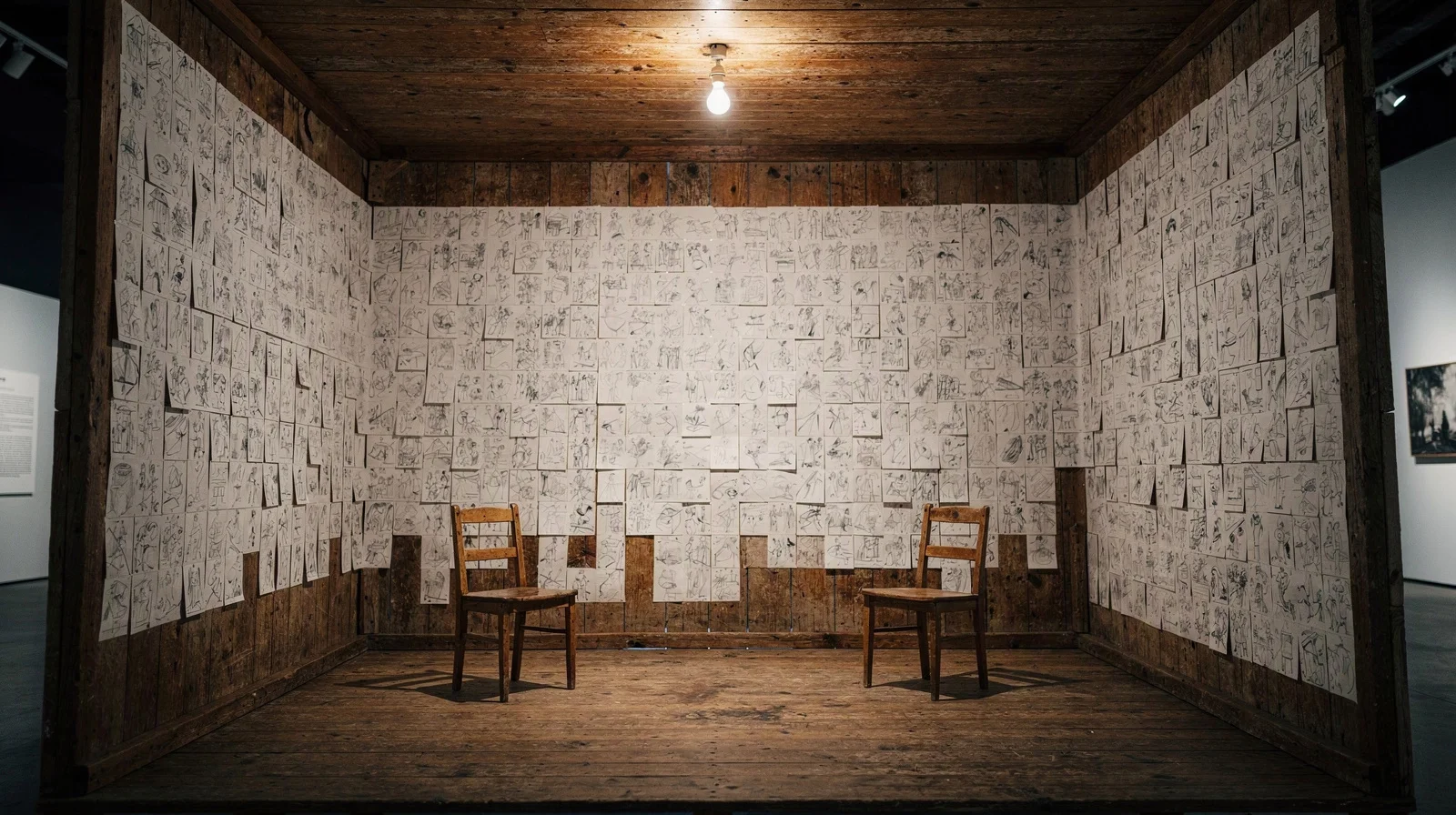
Hong Kong’s saleroom calendar this week is built like a stress test for trophy liquidity. Public previews at Sotheby’s Maison and Christie’s Henderson stack into evening sales that read, on paper, like a recovery advertisement: blue-chip Western names, Asian modern masters, and enough eight-figure estimates to keep the harbor city in the same conversation as New York and London. The more interesting supply, though, is not another cropped canvas. It is Yoshitomo Nara’s room-scale installation The Crated Room in Iceland / Drawing Room — returning to view after more than fifteen years, making its auction debut with a HK$45 million–HK$65 million estimate on Sotheby’s 28 September evening sale.
The work is logistics turned into biography: a shipping-crate enclosure roughly two meters tall, ninety-seven works on paper, child-sized chairs, a CD player, extension cord and light bulbs — the kind of object that forces the viewer to stand inside scale rather than admire a lot from the aisle. Sotheby’s has paired it with a curated PSYCHO preview exhibition through 27 September, a marketing frame that nonetheless clarifies the mechanism: scarcity of experience sold alongside scarcity of pigment.
Three houses, one calendar
Christie’s follows on 29–30 September at The Henderson. Its 29 September evening sale is led by Jean-Michel Basquiat’s Ancient Scientist (HK$56 million–HK$76 million), a 1984 skull motif on canvas with Xerox collage, and a debut Yayoi Kusama pumpkin painting (HK$48 million–HK$68 million). The Asian modern lane includes Zao Wou-Ki’s Voie Lactée – 09.11.56 (HK$45 million–HK$75 million) from the Oracle Bone period — the sort of cross-border mix that turns Hong Kong into a switch for collectors already running a multi-hub balance sheet across property, banking and movable assets.
Sotheby’s tops the estimate ladder with Mark Rothko’s Untitled (Plum and Dark Brown) (HK$78 million–HK$128 million), a Chapel-era scale canvas, plus a second Nara painting, Present (HK$50 million–HK$70 million), and Kusama’s golden-orange pumpkin (HK$48 million–HK$68 million). Phillips closes the week on 30 September with a twenty-lot evening sale anchored by Gerhard Richter (HK$18 million–HK$25 million) and Zeng Fanzhi — smaller in lot count, still priced for the same clientele.
All of these numbers are pre-sale estimates, not prices achieved. The honest comparison starts after the hammer, on a consistent pre-premium basis, and only then against prior seasons in the same city.
For art-backed lending and collections, liquidity by artist and price band matters more than an evening-sale headline.
What the catalogue proves — and what it cannot
The inference is straightforward: auction houses can assemble desirable supply before the market’s recovery is established. A rare object may pull bidders back into the room without demonstrating that mid-tier lots clear, that new collectors replace exited ones, or that the house’s lending book is growing because collateral quality improved rather than because credit terms did.
Counterevidence is equally familiar. Guarantees, irrevocable bids and withdrawn lots can flatter aggregate totals; a handful of trophy passes can print a “strong season” while unsold material stacks in the day sales. None of that appears in a press release, which is why the due-diligence questions are operational: how many independent bidders chase the leading lots, and from which regions; which works sell below the low estimate; which carry third-party guarantees disclosed only in the conditions of sale.
Hong Kong’s super-prime property tape has already shown how a top band can recover while breadth lags — the same pattern the Art Basel and UBS data describe globally for works above $10 million. This week’s catalogs are the art-market version: exceptional objects offered into a city that remains a liquidity leg for Asia, not yet proof that the leg is strong at every rung.
The falsifier
A genuine turn would show up as competitive bidding depth on non-guaranteed lots, rising clearance in day sales, and hammer prices that hold without heavy post-sale “private” negotiation. A false positive looks like three headline passes, thin participation elsewhere, and aggregate totals carried by finance rather than demand.
Wait for the hammers. Hong Kong is offering scarcity first; confidence still has to bid.
Continue reading


Sources
Sotheby's Hong Kong Modern & Contemporary Evening catalogue (HK1745, Sep 2026); Christie's Hong Kong 20th/21st Century Autumn press release (9 Sep 2026); Phillips Hong Kong evening sale overview (30 Sep 2026); The Art Newspaper coverage (18 Sep 2026)


