

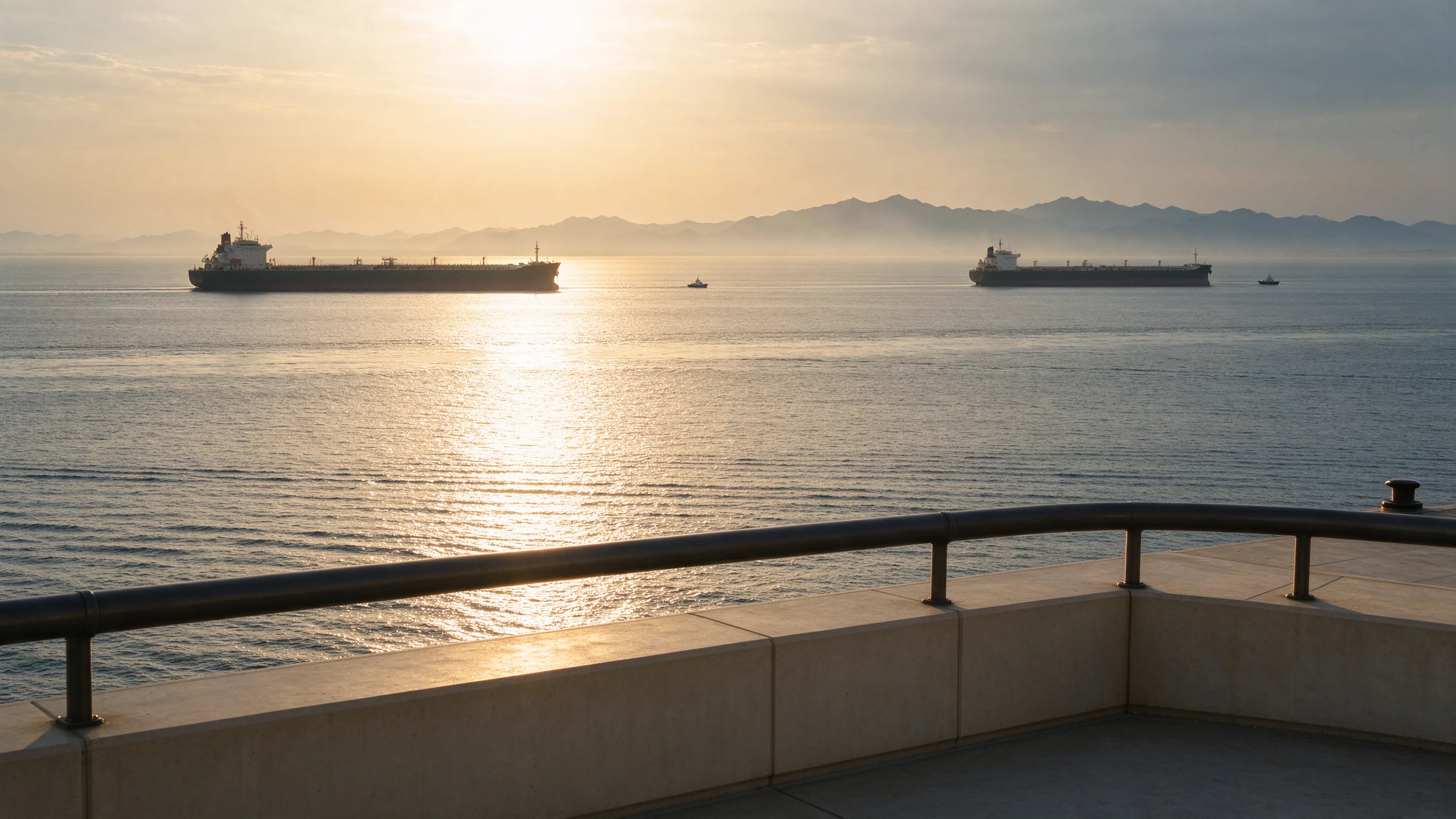
Persian Gulf oil is moving again in headline terms, but the chokepoint is clearing only through a stacked bill: tanker captains reportedly earning about $100,000 a month plus $50,000 per Hormuz transit on top of roughly $15,000 ordinary pay; war-risk insurance quoted at 6%–10% of vessel value; and strait freight rates that Fortune said hit a record near $1.3 million per day. The International Maritime Organization counts at least 93 ships hit and 24 seafarers killed since the war began on February 28. Former Australian naval officer Jennifer Parker told the ABC on October 10 that crew willingness—not insurance alone—may be the binding constraint. Hormuz is functioning as an expensive labor-and-logistics workaround, not a return to prewar economics.
Mumbai — The Strait of Hormuz debate still defaults to barrels and Brent. October’s reporting suggests the tighter bottleneck may be who agrees to sail. Gulf producers, charterers, and navies have stitched together shuttle runs, ship-to-ship transfers off Oman, pipeline bypasses, and U.S. escort corridors so crude can leave the region in something like prewar volumes. Each workaround adds a line item—and for many crews, a personal wager.
Fortune’s October 10 summary of Financial Times reporting puts numbers on that wager: tanker captains can earn about $100,000 a month for transiting Hormuz plus $50,000 per trip, against ordinary pay near $15,000. Rank-and-file sailors who might make as little as $1,500 monthly can see Hormuz passages lift earnings four to six times, with smaller hazard multiples in the southern Red Sea and Gulf of Oman where post-shuttle transfers cluster. An industry source told the FT that mariners willing to absorb near-constant attack risk are “almost being viewed as mercenaries”—while other crew members are reportedly pressured to stay aboard.
That labor market sits inside the permission regime Culled described when attacks, blockades, and fee legislation turned Hormuz into a cargo-by-cargo clearance problem. Permission without people is an empty spreadsheet.
One invoice, three ledgers
Crew. The ABC’s October 11 report corroborates the pay spiral from Indian unions and engineers: Facebook ads offer double or triple wages plus “danger money”; the Forward Seamen’s Union of India cites fivefold uplifts for some Hormuz transits. India’s external affairs ministry counts more than 4,500 Indian seafarers on commercial vessels in the Persian Gulf—a deep bench, but not an unlimited supply of volunteers. Manoj Yadav, general secretary of the Forward Seamen’s Union, told the ABC that unwilling crews face pressure to sail or bear repatriation charges if replaced.
Insurance. Fortune cites war-risk cover at 6%–10% of vessel value—up to roughly $20 million for a supertanker Gulf voyage on top of hazard wages. Premiums cap losses; they do not stop projectiles.
Freight. The same FT-sourced chain puts Hormuz freight near $1.3 million per day, against $20,000–$50,000 daily rates a year earlier. Brokers have compared a U.S.–China tanker hire to the sticker price of a SpaceX Falcon 9 launch. Dedicated shuttle tonnage tightens the global fleet and lifts rates far from the Gulf.
Refiners feel the stack downstream. Fortune noted European refiner Repsol’s margin falling from about $36 per barrel in the third quarter toward $15 in October in RBC’s framing—illustrating how logistics can erode processing economics before the wellhead looks tight.
Availability, not only price
Jennifer Parker, a former Australian naval officer, told the ABC on October 10 that the chokepoint’s limit is “less [to do with] insurance and more availability of crews that are willing to make that hazardous transit” given sustained attacks. UKMTO logged nine tanker incidents in the strait in October alone in the ABC’s accounting; the IMO reports at least 93 ships hit and 24 seafarers killed since the war began—figures that align with Fortune’s IMO citation.
The competing read—that money clears the market—is half true. Double and triple pay does attract some Indian and Filipino officers; shuttle crews stacking bonuses per run can earn extraordinary annualized income. Yet transit counts remain below the prewar norm of more than 100 commercial vessels daily, and diplomatic claims still diverge: U.S. officials say flows nearly match prewar levels; Iranian advisers cite roughly 10 transits a day in October against 125 before the war. Both can be “true” inside different corridors, escort rules, and counting methods—another reason to treat volume headlines skeptically.
What would break the workaround
The thesis—that Hormuz is clearing through a durable risk labor market—weakens if attack rates fall and war-risk premiums, captain bonuses, and daily freight deflate together while qualified mariners sign on at ordinary wages without union-documented coercion. It strengthens if near-daily strikes persist, shuttle tonnage stays trapped in the Gulf, and refiners trim runs because delivered crude costs more than margin can bear.
The fatal attack on MV Cape Dao in September already showed how quickly abstraction becomes a casualty list; Culled’s crew-list piece treated that event as the human floor under the freight quote. October’s wage and insurance reporting adds the market mechanism: owners are buying consent—or substituting pressure—at prices that look less like shipping economics than hazard procurement.
Watch October’s attack cadence against tanker availability, union repatriation cases, and whether producers’ owned-tonnage bets stabilize costs or merely nationalize the premium. Hormuz is not closed. It is staffed through a labor market for risk—fragile, expensive, and only partly visible in the oil price.
Continue reading


Sources
Fortune Oct. 10, 2026 summary of Financial Times reporting on captain pay, insurance and freight; ABC News Oct. 11, 2026 on Indian union accounts, Jennifer Parker interview, IMO casualty counts and disputed transit statistics; prior Culled Hormuz permission-market and crew-safety coverage.


