

On October 7 the Reserve Bank of India raised its repo rate by 25 basis points to 5.50%, the first hike in nearly four years. Binding shocks are West Asia oil and a monsoon 13% short of normal—not soft domestic demand. A Reuters poll sees September CPI at 5.4% with the rupee about 7% weaker.
On October 7 the Reserve Bank of India raised its repo rate by 25 basis points to 5.50%—the first hike since February 2023.
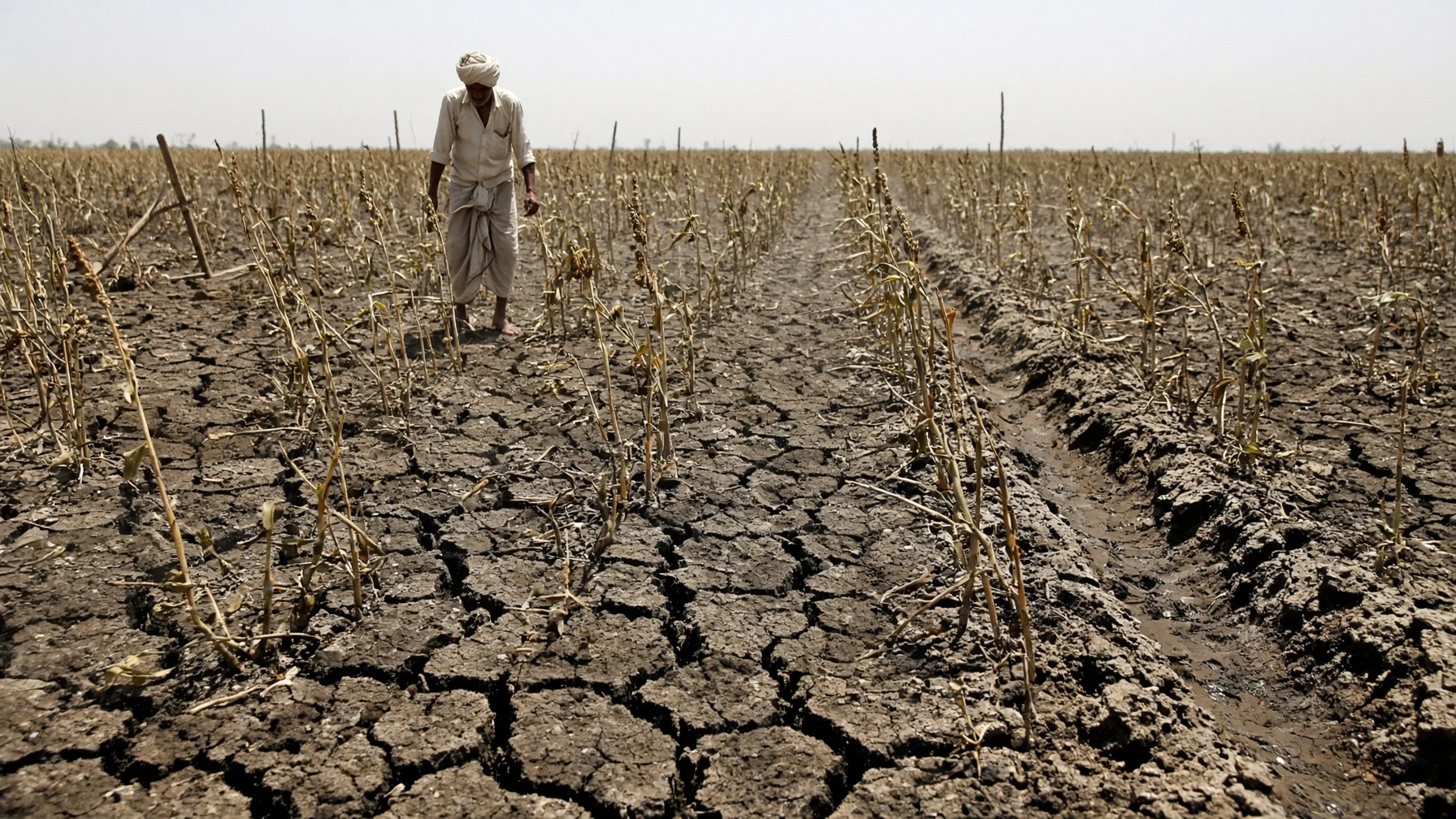
Governor Sanjay Malhotra’s Monetary Policy Committee also shifted stance to calibrated tightening and put rate cuts “off the table” for the near term. The residual is not that every central bank is hiking. It is that India is being hit by two forces it cannot write a domestic policy memo to fix: oil priced through West Asia, and rain that did not arrive.
Two Shocks, One CPI Basket
The causal chain is blunt enough for a kitchen table.
West Asia conflict risk—visible in Culled’s map of Hormuz as a permission market—lifts crude. India’s import bill rises. The rupee, already about 7% weaker against the dollar this year and near record lows, makes every barrel and every other dollar-priced input more expensive in local currency. Food and beverages are roughly 40% of the CPI basket, so a monsoon miss does not stay in the farm ledger; it prints in the headline.
The RBI’s own statement named the same pair: a Southwest monsoon 13% below the long-period average as of September 30, El Niño, and high volatility in international oil—Brent’s front-month average up 22% and 15% over July and August levels in September alone. The Indian crude basket, per policy-day reporting, averaged about $116 a barrel in September after roughly $82 in July.
Oil and rain are not metaphors here. They are the two inputs the RBI cannot print.
August CPI was already 4.8%, with food and fuel driving the move and core up to 4.2%. A Reuters poll of 41 economists (October 5–7) puts September at 5.4%—closer to the top of the 2–6% target band—before the official print due around October 12. That is the same pass-through logic Culled tracked when U.S. fuel surcharges hit groceries on a lag: energy arrives first as a bill, then as a shelf price.
What the Forecast Admits
The cleanest tell is the RBI’s own path, not the 25 bp move. CPI for 2026–27 is now projected at 5.2%, with Q3 at 6.0% and Q4 at 5.7%—and Q1 2027–28 at 5.6%. Headline inflation is expected to average almost 5.8% across the next three quarters. Growth was raised to 7.1%, which only sharpens the bind: the economy is strong enough that supply shocks do not self-erase through soft demand.
Malhotra was explicit that monetary policy’s job here is second-round effects—expectations and firm pricing—not inventing monsoon rainfall or reopening Hormuz. That is why the stance change matters as much as the hike: the next move is framed as hike or pause, not a path back to cuts.
The same Brent band that collides with secular AI growth narratives in the U.S. and nearshoring energy tests in Mexico lands in India as a household CPI problem because the import share and food weight leave less room to look away.
The Easy Levers Are Gone
India’s recent policy comfort was a soft inflation print and room to cut. That room is closed. Buffers of food grains and fiscal measures can blunt extremes; they cannot unwind a simultaneous oil spike and a deficient monsoon while the exchange rate transmits import costs.
The falsifier is clean: if September CPI undershoots the 5.4% consensus, monsoon recovery rebuilds kharif and early rabi supply, and West Asia oil volatility collapses toward the July crude basket, the RBI’s “hike or pause” frame softens. Until then, India’s story is not a footnote to global rates. It is a country paying for weather and the Strait at the same time—and raising the price of money because those are the levers left.
Continue reading


Sources
RBI Governor’s Statement and MPC decision, Oct. 7, 2026 (repo to 5.50%, calibrated tightening, FY27 CPI 5.2% with Q3 6.0% and Q4 5.7%, monsoon 13% below LPA, Brent volatility notes); Reuters poll of 41 economists (Oct. 5–7) on September CPI at 5.4% and ~7% rupee decline; Moneycontrol / Hindu / Business Standard coverage of the same policy day.


