

Only about 8% of Chinese blast furnaces were profitable in mid-September, according to Shanghai Metals Market data cited in Monday's market reporting. The China Iron and Steel Association is urging mills to stop buying fresh iron ore and run down inventories instead. Dalian futures hit a five-week low while port stocks sit near 152 million tonnes — demand weakness colliding with supply that Brazil's weather may still disrupt.
For two decades, the iron ore trade trained itself on a single question: how fast could China absorb the next tonne? Mills expanded, ports swelled, and Brazilian and Australian miners sized their output to a construction economy that could seemingly digest any pile. Monday’s price action flipped the question. With blast-furnace economics in collapse and official voices telling mills to stop bringing in fresh ore, the market is being asked how fast China can not buy — and what happens to the 152 million tonnes already sitting on the coast.
Margin, not mandate
The profitability number is the shock absorber. Shanghai Metals Market data, cited in Monday’s reporting, put only about 8% of Chinese blast furnaces in the black in mid-September. That is not a cyclical dip; it is a industry-wide margin failure at the heart of the world’s largest steel complex.
The China Iron and Steel Association’s response is practical: urge mills to halt new ore purchases and draw down inventories already in the system. Guidance from a producers’ body is not the same as a government order, but in a sector where banks, local governments, and power tariffs already lean on steel, association language moves procurement desks. Traders read it as confirmation that the demand side will voluntarily starve the spot market even if ports are full.
Dalian iron ore futures touched a five-week low in Monday’s session. The move is consistent with a buyer strike — not because ore is scarce at the gate, but because converting it to steel loses money for most furnaces online.
Inventory at the wrong moment
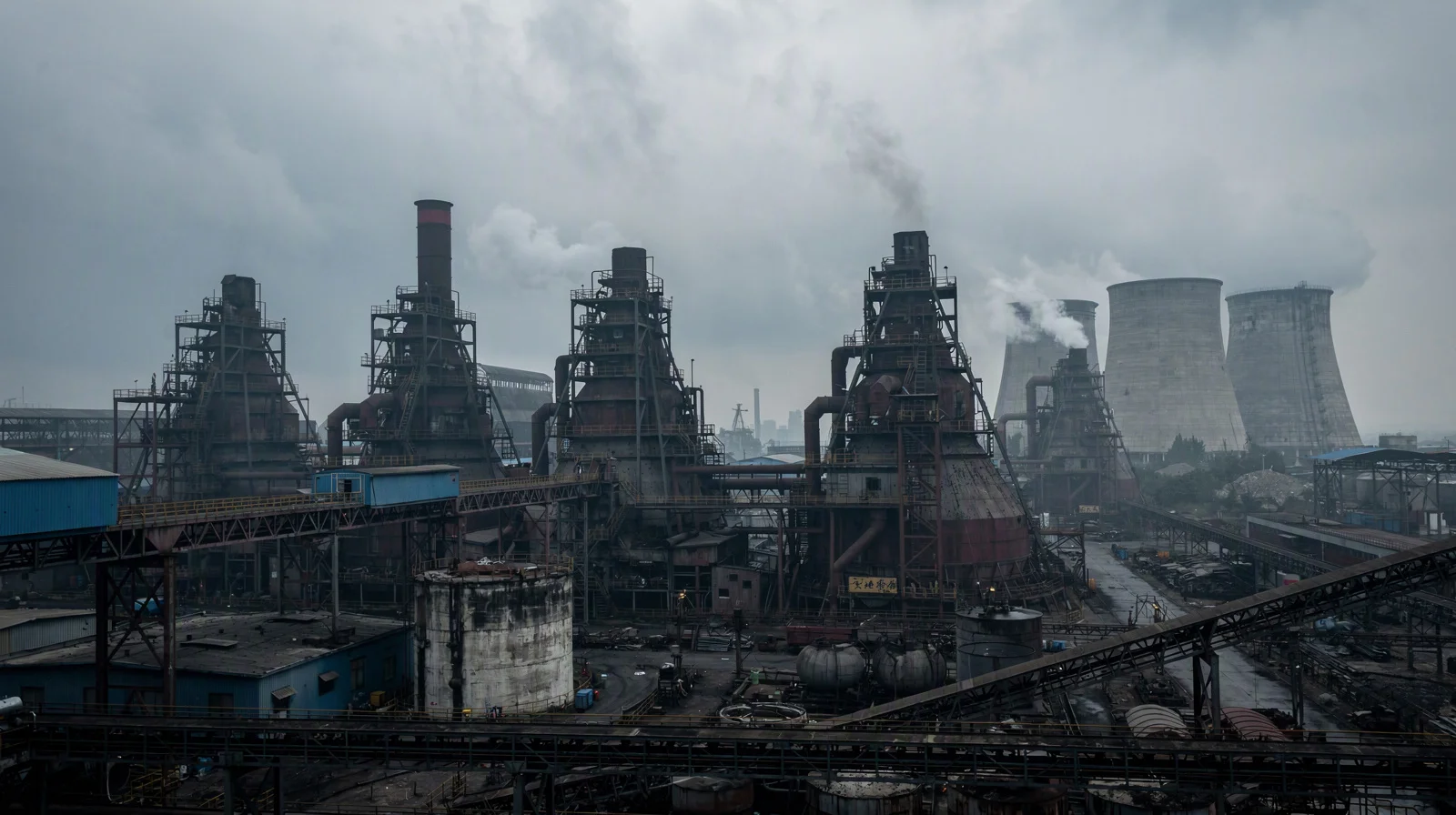
Chinese port inventories near 152 million tonnes are the physical echo of the old demand model. Ore arrived when mills still believed they could run hot through property-linked steel demand. China’s prolonged manufacturing softness has already threaded through commodity forecasts as a measurable drag on metals and energy. Iron ore is the blunt version: the raw material is present, the downstream margin to justify melting it is not.
Property construction remains the unspoken weight. Finished steel prices have not kept pace with ore when apartment starts and infrastructure appetite cool. Mills that cannot pass costs through to builders do not negotiate harder with Vale or Rio Tinto; they idle, cut shifts, or lean on inventory rather than import parity. Vacancy and completion data have been signaling a slower Chinese building cycle for years. The port stockpile is what that slowdown looks like in red dirt form.
The ore is already in China. The problem is that melting it is a losing trade for nine out of ten furnaces.
The supply-side counterweight
The bearish demand story is not the only force in the market. Brazil supplies a large share of seaborne iron ore, and El Niño-linked weather risk has been a recurring worry in trade press — heavy rains that disrupt mining roads, berths, and grade consistency. ABC News and commodity desks have paired Monday’s Chinese demand headlines with that supply angle for a reason: a buyer strike meets a curve that can still kink upward if Brazilian tonnes miss their sailing window.
That tension is what separates a simple “China slow” narrative from a tradable iron ore market. If mills obey inventory guidance and construction steel stays weak, port draws can lag while futures bleed. If Brazilian disruptions bite at the same time, the same 152 million tonnes can look less like oversupply and more like stranded liquidity — ore in the wrong place while fresh cargoes price dear.
What to watch
Three signals falsify the “inventory diet” story quickly: a rebound in blast-furnace profitability above a sustained 30–40% threshold, a policy shock that restarts property-linked steel demand, or a Brazilian supply outage that forces mills back into the import market despite weak margins.
Until one of those breaks, the dominant logic is domestic: China built the world’s greatest ore-import machine, and its steel association is now asking that machine to run in reverse — consume the piles, don’t enlarge them. For iron ore, that is a harder problem than any single five-week low in Dalian can capture, because it ties mine economics in Minas Gerais to apartment cranes that are not moving fast enough in China’s cities.
Continue reading


Sources
Market reporting citing Shanghai Metals Market profitability survey (mid-September 2026, ~8% of blast furnaces profitable); China Iron and Steel Association guidance to mills to curb fresh ore purchases and consume inventories; Dalian iron ore contract at a five-week low; Chinese port iron ore inventories near 152 million tonnes; ABC News and trade press on Brazilian supply and El Niño-related weather risk.


