

On November 20, 2026, MSCI's Asia-Pacific index was down 8.5 percent for the week—its worst since March 2020—after Taiwan equities fell 17.5 percent on the week, Japan's Nikkei dropped 7.7 percent, and South Korea's Kospi lost 8 percent as Anthropic's U.S. listing failed to stabilize AI sentiment; in New York, AMD shares fell more than 7 percent following Hunterbrook Media's short report on China firmware links, alongside House Foreign Affairs Committee releases showing a Commerce subagency approved sales of more than 879,000 AI chips to Chinese companies, so STATE export politics rather than ANT's premium close now price the global semiconductor complex ahead of European chip opens.
When **New York** could not rally on the biggest **AI** IPO on record, **Taipei** and **Seoul** did not wait for excuses—they marked down memory, foundry, and platform names in one session. **STATE** is the channel: export approvals, short reports, and committee document drops now move faster than **Huang's** succession headlines.
Hong Kong, Nov. 20 — Asia did not need New York to confirm the AI trade was fragile. It needed one night and a doc drop.
MSCI’s broad Asia-Pacific gauge outside Japan fell 3.3 percent Friday and 8.5 percent on the week—its worst weekly performance since March 2020, Reuters reported. Taiwan shares were down 6.2 percent on the day and 17.5 percent for the week, their largest weekly decline since 1990. Japan’s Nikkei fell 5 percent Friday for a 7.7 percent weekly loss to a seven-month closing low. South Korea’s Kospi dropped 5.2 percent and 8 percent on the week as memory and AI-proxy names led the slide.
The catalyst list is long; the binding constraint is short. Anthropic’s $97.17 debut close—detailed in Culled’s IPO-versus-index piece—failed to lift regional sentiment. Nvidia’s blowout earnings earlier in the week were not the reset allocators priced. Instead, STATE channels moved faster: export paperwork, committee releases, and activist media tied to known short funds.
Washington’s document day meets Seoul’s price wall
Advanced Micro Devices fell more than 7 percent Thursday after Hunterbrook Capital disclosed a short position and Hunterbrook Media published allegations that firmware tied to AMD products appeared in entities linked to U.S.-blacklisted Chinese firms. AMD told CNBC it complies with U.S. law—a necessary line, not a market-clearing one when committees are simultaneously releasing approval ledgers.
The House Foreign Affairs Committee published documents showing a Commerce Department subagency approved sales of more than 879,000 AI chips to Chinese companies, highlighting how much volume moved through existing licensing channels before the current crackdown narrative hardened. Every figure becomes a senator’s question; every question becomes duration risk for SOX holders who thought earnings would dominate the week.
Asia sells first when Washington prints lists. New York sells second when shorts attach names to those lists.
Citi analyst Preston Pagli summarized the mood as intensifying risk aversion and unwinds of crowded AI positioning. Goldman Sachs echoed the confusion in its Friday note: no single headline owned the roll, but liquidity remained poor enough that Asia’s gap became Europe’s open. ASML and Infineon fell more than 4 percent at the London bridge, Investing.com reported—proof the complex trades as one book even when country indexes diverge.
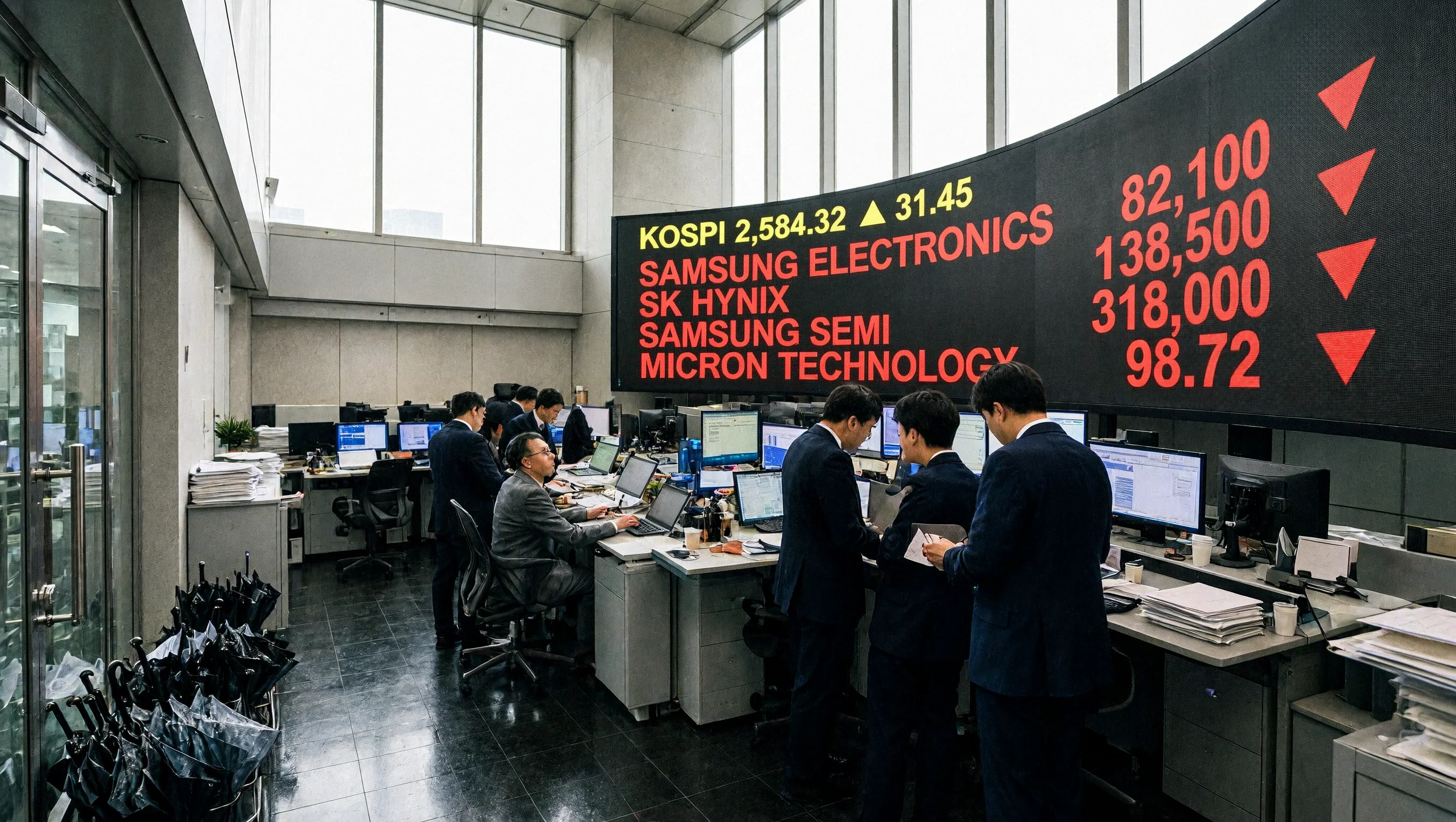
Geography still matters
Taiwan and Korea absorb the convexity of foundry and memory demand. Culled’s TSMC concentration frame is not abstract when a 17.5 percent weekly drop hits an economy whose equity market is effectively an AI capital chart. Japan combines yen weakness with chip supply chains; Europe offers lower mega-cap tech weight but still imports the shock through equipment makers.
CAPITAL flows reinforced the safety bid: the dollar index held near multi-month highs as fed-funds futures priced a December hike as increasingly locked in, per CME FedWatch snapshots in desk wraps—a different policy story than midweek doves hoped, and a headwind for non-yielding risk assets already carrying stretched multiples.
Read-through for U.S. holders
For U.S. investors waking to red futures, the lesson is sequencing. STATE set the overnight narrative; CAPITAL will decide whether AMD is a one-day short attack or a procurement freeze that spills into 2027 backlog conversations. Watch whether Commerce comments on the 879,000-chip ledger and whether Tokyo and Taipei central banks jawbone FX—not because intervention is imminent, but because volatility is now cross-asset.
The residual: Asia’s worst week since the pandemic arrived while a frontier AI company celebrated a premium IPO in New York. That juxtaposition is the trade—two markets, one supply chain, and Washington holding the stamp that still clears the lots.
Continue reading


Sources
Reuters and Yonhap Asia wraps; Nikkei Asia and Mainichi on Japan close; CNBC on AMD response and committee documents; Ajupress on Hunterbrook disclosure; Investing.com Europe open; Culled FMP digest Nov. 20.


