

Oman’s manufacturing output rose 16.1% in the first half at current prices, led by refined petroleum and chemicals. Yet official constant-price data show real manufacturing value added fell 4.3%, while petroleum activity carried GDP growth—an important distinction for the country’s diversification strategy.
Oman’s manufacturing output rose 16.1% year on year to RO2.188 billion in the first half of 2026. It is an attractive diversification headline: basic chemicals rose 22.7%, refined petroleum products rose 40%, foreign investment in manufacturing increased, and non-oil exports advanced.
It is not yet proof that manufacturing has become an independent growth engine. The distinction is in the price basis. The 16.1% figure is measured at current prices. The National Centre for Statistics and Information’s constant-price accounts show real manufacturing value added fell 4.3% in the first half. Oman is making more industrial value in rials at prevailing prices; that does not establish an expanding real manufacturing economy.
Refined petroleum is doing much of the visible work
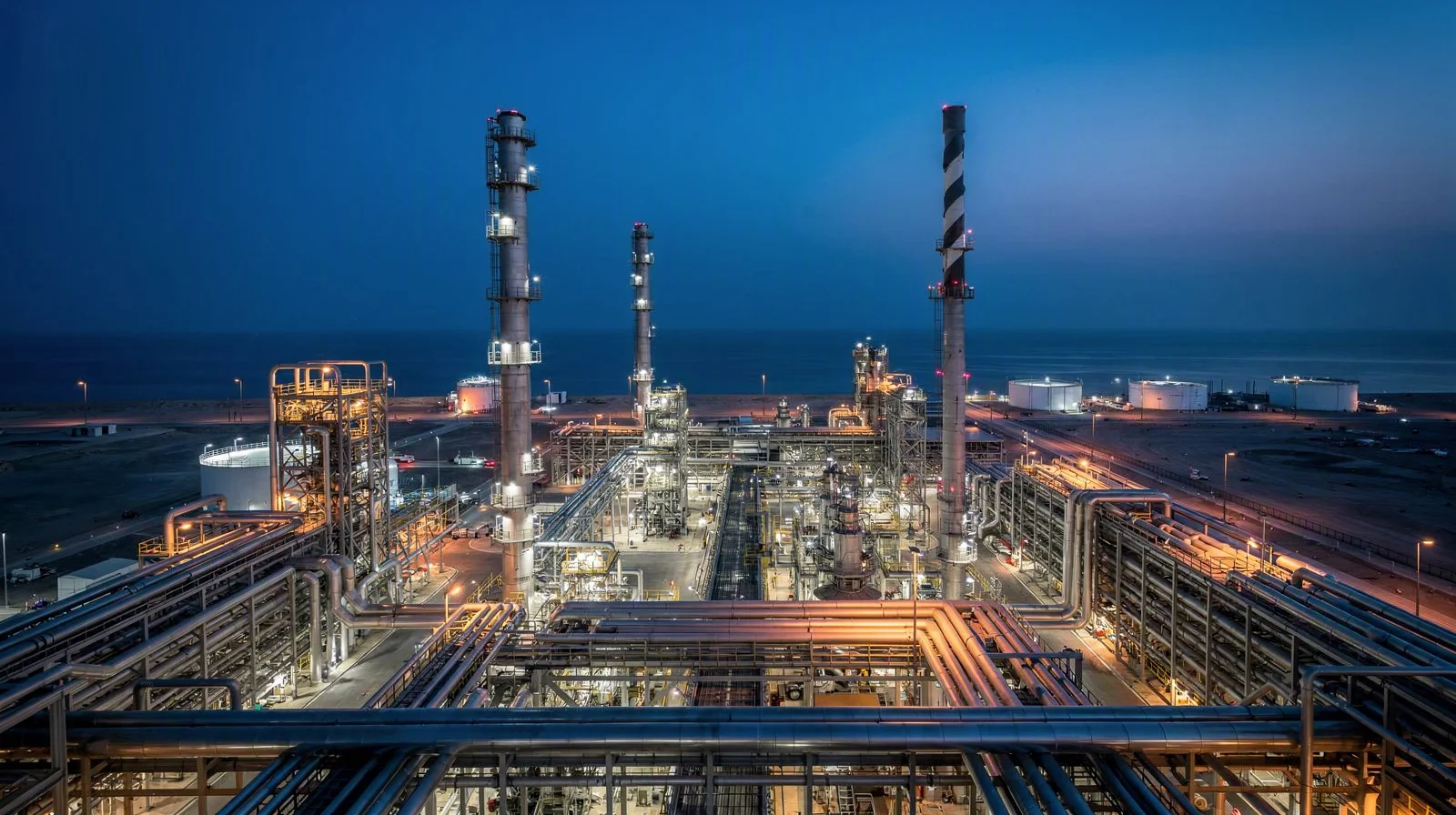
The source of the nominal gain matters. Basic chemicals reached RO659.6 million and refined petroleum products RO397.2 million. Those are legitimate industrial activities, and they create export revenue, investment and technical capacity. But they are also tightly coupled to the hydrocarbon complex that diversification is supposed to make less decisive.
The broader GDP record makes the connection clearer. Oman’s real economy grew 3.8% in the first half, but petroleum output rose 9.7% while non-oil GDP expanded just 1.3%. Oil’s share of GDP reached 35% in the second quarter, from 32% a year earlier. This is not a story of an oil economy being displaced by industry. It is a story of an oil economy adding more downstream processing while crude and gas still set the pace.
Diversification succeeds when an industrial sector can grow in real terms without requiring the hydrocarbon complex to carry the macroeconomy.
The real-economy scorecard is mixed
The divergence is not limited to manufacturing. Construction contracted 3.2% in real terms in the first half. Accommodation and food services fell 3.3%; transport and storage fell 1.9%. Financial and insurance services were the conspicuous non-oil exception, growing 9.5%.
That mix complicates the usual Gulf growth narrative. Oman has ports outside the Strait of Hormuz, a geography that gives Muscat strategic importance in a regional route contest. Duqm and Salalah can support logistics, processing and trade. But geography is a channel, not an economic model. It does not by itself turn refinery-linked output into a self-sustaining base of competitive manufacturing, construction demand or tourism receipts.
Exports are evidence, but not the verdict
Non-oil exports of national origin rose, and chemicals, base metals, plastics and rubber were among the main contributors. That is more consequential than a domestic output statistic: export markets test whether a sector can compete outside an investment cycle.
But “non-oil” is not synonymous with hydrocarbon-independent. Refined products and petrochemicals can be recorded outside crude exports while still relying on hydrocarbons for feedstock, energy, fiscal capacity and the capital programs around them. The correct question is not whether Oman can label more exports as non-oil. It is whether those exports are diversified by product, customer and input base enough to hold up through an oil-price or regional-logistics shock.
Oman’s Industrial Strategy 2040 sets a goal of RO5.44 billion in manufacturing contribution by 2030 and RO10.702 billion by 2040. The plan is directionally sensible: value added, local supply chains, technology and skills are more durable than adding plant capacity alone. But the distance between the target and the latest number is visible in the deflator. Current-price industrial growth can coexist with declining real output.
What would make the diversification claim stronger
The next data releases should be read against four tests. First, real—not nominal—manufacturing value added must turn positive and stay there. Second, growth must broaden beyond refining and basic chemicals. Third, non-oil exports need to gain customers and products that are not simply extensions of the petroleum chain. Fourth, construction, transport and hospitality need to recover if industrial investment is to diffuse through the domestic economy.
Oil-linked manufacturing is not a failure of diversification; it can be its first rung. But it is still a rung on the hydrocarbon ladder. As oil prices continue to constrain Gulf macro choices, Oman’s test is whether that ladder eventually reaches a different roof.
Continue reading


Sources
Oman National Centre for Statistics and Information constant-price GDP data; reporting on first-half manufacturing output, NCSI data and Industrial Strategy 2040.


