

The sales pitch is humane: send robots so soldiers come home. The ledger is messier. Uncrewed systems have already closed straits, sunk hulls, and emptied trenches of massed infantry while humans still die at sea, in cities, and in maintenance bays—and the wars that follow may turn on factory output and magazine depth, not whose public will break first.
Western defense marketing has settled on a comforting sentence: robots absorb risk so people do not have to. The hardware on display at trade shows—quadrupeds with rifle mounts, loitering munitions the size of model aircraft, containerized launchers—makes the future feel cleaner than the archive of twentieth-century film reels. Investors hear the same story in a different dialect: recurring software revenue, platform lock-in, and margins that look more like enterprise SaaS than shipyard steel.
That story is not false. It is incomplete in a way that matters for policy, portfolios, and anyone trying to guess how the next war ends.
Where the money actually goes
The obvious winners are not the humanoid demos on conference stages. They are the layers that turn attrition into a subscription.
Consumables sit at the center. A single-use attack drone priced like a used car can still destroy a platform worth hundreds of millions if it finds the right pixel on a hull. Margins on the airframe may be thin; margins on volume, spares, and reload kits are not. Defense planners increasingly budget wars as burn rates—drones per week, missiles per salvo—not as one-off capital programs.
Software and sensor fusion capture the narrative premium. Firms that stitch together targeting data, fleet telemetry, and command interfaces sell the part voters cannot see but commanders cannot lose. When the Pentagon or allied ministries talk about “decision advantage,” they are often buying workflow, not wingspan.
Industrial robotics skills bleed back into uniformed logistics. Field teams that swap rotors, patch carbon fiber, and flash firmware at forward depots look less like Band of Brothers and more like a high-turnover fab line. Toyota’s factory-automation math—hundreds of thousands of machines, trillion-yen annual modernization—is civilian. The military rhyme is the same: whoever keeps units returning to service faster owns the tempo.
Capital markets reward dual-use supply chains: batteries dense enough for loitering flight, rad-hard chips, secure mesh radios, jamming-resistant links. Private equity has learned to underwrite production capacity, not just IP, because the binding constraint in a drone-heavy theater is often how many units you can ship next month, not how clever the autopilot is.
None of that eliminates humans from the bill. Pilots still fly contested corridors. Merchant crews still die when a cheap munition hits amidships. Technicians still work within range of counter-battery fire. Civilians still occupy the grid squares algorithms classify as valid. The economic shift is that political accounting can separate “our casualties” from “our losses” in a way that body bags never allowed.
The body-bag constraint—and what changed it
Modern democratic theory, simplified to a bruising degree, treated casualty sensitivity as a strategic fact. High losses without visible progress drain legitimacy. Tet Offensive footage did not need to win battles to reshape American willingness to continue. Soviet losses in Afghanistan corroded a different kind of mandate. Even authoritarian states watch demographic ledgers when wars drag: Russia’s 2022 mobilization gamble only works if society accepts the trade.
Uncrewed systems attack that mechanism from two directions.
First, they lower the visible price of escalation. A government can lose dozens of airframes in a week and keep parliamentary majorities if the morgues stay quiet at home. That does not make war costless; it makes war easier to continue past the point where earlier generations would have forced a settlement.
Second, they relocate risk onto people who do not vote in your capital. Insurers cancel policies when drones skim tanker lanes; crews from the Global South still sail. Autonomous trucks may drive supply routes; local labor still unloads under shelling. The moral distance is geographic and contractual, not technological.
So the naive hope—no more loss of human life—fails twice. Life is still lost, often out of frame. And the kind of loss that used to force political reversals—flag-draped transfers at Dover—can be partially decoupled from the kind of loss that still decides campaigns: ruined radars, empty magazines, severed fiber backhaul.
Historians who argue that casualty tolls “changed the tides of war” are describing home-front physics, not battlefield physics. Robots do not repeal home-front physics. They re-weight it toward procurement scandals, inflation in defense stocks, and satellite imagery of smoldering refineries—signals that move markets before they move elections.
Beating up robots: what kinetic war becomes
Mock combat against a humanoid on a test range—punching, tipping, stress-testing joints—makes for viral video. It is also a category error for state-on-state fighting.
You do not break a drone’s will. You break its supply chain.
The operational picture that already emerged in Ukraine and in maritime lanes near Hormuz looks like this:
- Mass replaces morale. Swarms exist to force defenders to spend interceptors faster than factories replenish them.
- Electronic warfare becomes the midfield. Jamming and spoofing are cheaper than dogfights; the prize is to make the enemy’s autonomy stupid for long enough to strike the human-held node behind it.
- Repair beats heroism. A legged platform dragged back to a tent and welded before dawn is worth more than a flawless demo that cannot be field-serviced.
- Deep strikes target industry, not parade grounds. If robots are the teeth, fabs, power substations, and rare-earth refineries are the gums. “Beating up robots” in the field without touching production is a treadmill.
Attrition, in this frame, is inventory mathematics. The side that treats war like a sporting knockout—one decisive battle, one surrender ceremony—loses to the side that treats war like throughput management: sortie rates, mean time between failure, shipping manifests.
That is why the humane promise and the grim promise converge. War without soldiers on the front line can still be war without an off-ramp, because neither capital nor algorithm faces the moral veto that a draft card once imposed.
What investors and voters should watch
If you are tracing capital, follow unit economics of expendability: bill of materials trends, export controls on motors and optics, allied stockpile targets, and whether primes are buying capacity or merely licensing software.
If you are tracing politics, watch whether legislatures treat robot losses as operational trivia while human deaths abroad still trigger crises—or whether a new norm emerges where long, low-casualty-at-home wars become politically sustainable in ways Vietnam was not.
If you are tracing strategy, ask who wins when victory is defined as out-producing the adversary’s magazine rather than out-suffering their population. That question predates robotics—World War II answered it with shipyards. Robotics makes the answer faster, cheaper, and more deniable.
The photograph worth keeping in mind is not a soldier charging a trench. It is a depot at blue hour: sparks from a weld, mud on boots, a crate of rotors waiting for dawn. The future of war looks like maintenance—because the machine that returns to the fight is the one that counted, and the human story is whether we still know how to stop when the shelves go empty.
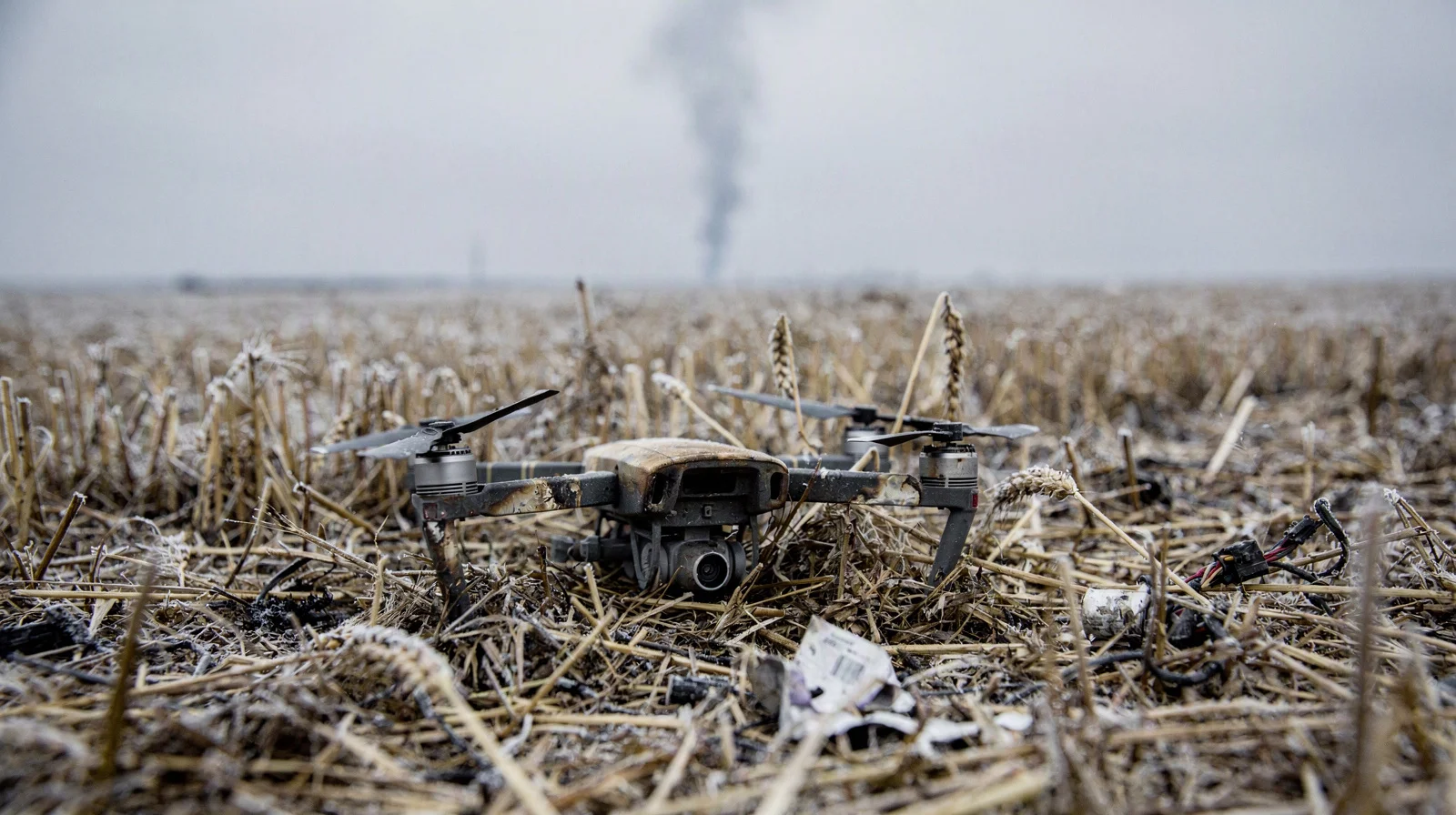
The hull in the wheat—plastic charred, no name to etch on stone—is the other half of the ledger. Territory still changes hands when metal stops moving. Expendable machines do not make war humane. They make it easier to mistake industrial stamina for justice, and to forget that someone still pays, even when the casualty report lists only serial numbers.
Continue reading


Sources
Open reporting on Ukraine uncrewed systems, 2026 Hormuz and Gulf maritime drone strikes, U.S. and allied defense procurement trends, historical casualty-politics literature on Vietnam and democratic war fighting.


