

U.S. retail sales rose 1.2% in August, well above expectations, while the GDP-relevant control group climbed 1.4%. The consumer just weakened the case for a Fed hold, but softer oil and long-term yields are cushioning the shock—and making today’s decision less straightforward than the headline suggests.
The American consumer just took away the Federal Reserve’s best excuse to wait.
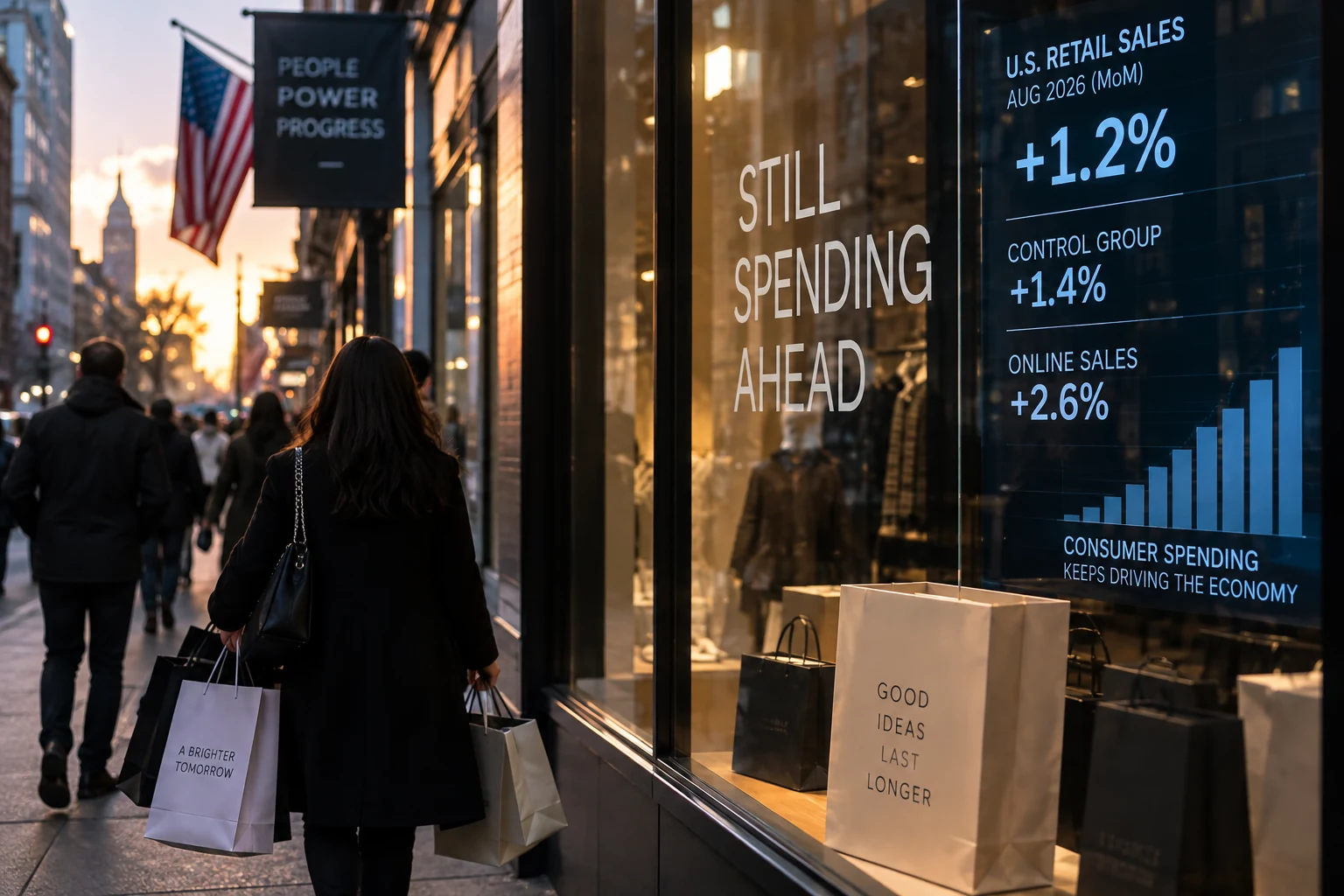
Retail sales rose 1.2% in August, nearly twice the 0.7% increase economists expected. July’s decline was revised to 0.5%. Strip out gas stations and sales still rose 1.1%. The GDP-relevant control group climbed 1.4%, while online sales jumped 2.6%.
That is not the demand picture a reluctant central bank would normally use to justify patience.
Only a month ago, the story looked different. July retail sales had fallen 0.6% while consumer sentiment sank, giving the Fed evidence that households might finally be bending under higher prices and borrowing costs. August has now reversed that signal emphatically.
The Consumer Did Not Give the Fed a Clean Exit
The complication is that retail sales are reported in dollars, not inflation-adjusted volumes. Some of August’s strength may therefore reflect higher prices rather than more goods moving through checkout lines.
But the breadth matters. Furniture, clothing, autos and online retail all gained. The control group excludes autos, gasoline, building materials and food services, which makes its 1.4% rise harder to dismiss as simply consumers paying more at the pump.
Gasoline itself is still a tax on household budgets. The average U.S. price of regular gasoline reached about $4.37 Wednesday, roughly 47% above its pre-war level. Diesel is up even more. That was the danger Culled flagged when Hormuz risk collided with July’s weak sales: the Fed could face softening demand and supply-driven inflation at the same time.
August says demand has not softened enough to solve that problem for policymakers.
Yet Markets Are Not Trading the Report Like a Hawkish Shock
This is the more interesting part of the morning.
Brent crude is down about 1.1% near $107.59. The 10-year Treasury yield has slipped back to roughly 4.97% after crossing 5% earlier this week. Stocks are broadly steady to higher.
In other words, consumers delivered a stronger demand signal while two of the market’s biggest inflation and financial-condition gauges moved in the opposite direction.
That matters because today’s Fed decision does not arrive in isolation. Warsh’s September decision was always going to be conditioned by the incoming data, but the Committee also has to judge how much tightening is already being imposed by long-term borrowing costs and the oil shock.
A consumer spending 1.2% more gives the Fed confidence the economy can probably absorb a quarter-point hike. A falling 10-year and softer crude reduce the immediate cost of delivering one.
The retail report weakened the case for waiting without creating the market conditions that would make a hike obviously painful.
The Surprise Hold Just Became Harder to Explain
Markets entered Wednesday treating a 25-basis-point increase as close to certain. Before 8:30, there was still a coherent argument for a hold: oil had tightened household budgets, the long end had already pushed borrowing costs sharply higher, and July’s retail report suggested consumers were tiring.
August removed the cleanest piece of that argument.
If the Fed still holds at 2 p.m., the decision will now carry more information than it did yesterday. Policymakers would be choosing patience despite resilient consumption, persistent inflation and a market already prepared for a hike.
That does not make a hold impossible. It makes the explanation more important.
For the next four hours, the useful dashboard is simple: watch whether Brent keeps falling, whether the 10-year stays below 5%, and whether equities can absorb the consumer beat without a renewed bond selloff.
If all three hold, the market is effectively telling the Fed something unusual: demand is strong enough to hike into, while the surrounding financial conditions are giving it room to do so.
That is a much harder setup for the Fed to ignore than the one it woke up with this morning.
Sources
- U.S. Census Bureau, Advance Monthly Sales for Retail and Food Services, August 2026 release schedule.
- Associated Press, Sept. 16, 2026: retail sales rose 1.2% in August; control group +1.4%; online sales +2.6%.
- Associated Press, Sept. 16, 2026: Brent crude near $107.59 and the 10-year Treasury yield near 4.97% in morning trade.
More in Economy & Labor


Sources
U.S. Census retail-sales release calendar; Associated Press reporting on the August retail-sales report and the September 16 market reaction; prior Culled coverage of July retail weakness, Hormuz inflation risk and the September FOMC setup.
