

SpaceX agreed to buy Grain Management's nationwide 800 MHz portfolio for roughly $8 billion in cash, the last low-band block it needs to pair Starlink's satellite constellation with a terrestrial cellular layer. U.S. mobile incumbents and European telecoms sold off on October 9; American Tower, Crown Castle, and SBA Communications moved the other way. Until the FCC clears the transfer, the competitive threat stays prospective—but the market is already pricing Starlink as a facilities-based wireless rival, not a broadband add-on.
Grain Management said Thursday that SpaceX will acquire its nationwide 800 MHz spectrum portfolio—up to 14 MHz of paired low-band licenses—subject to Federal Communications Commission approval and customary closing conditions. Reporting pegged the price near $8 billion in cash. Elon Musk framed the block as the “last critical piece” of spectrum needed for complete U.S. phone coverage; SpaceX described a flexible architecture that blends its satellite-to-mobile constellation with an advanced terrestrial deployment.
That wording matters. Starlink has long been sold as connectivity layered on top of someone else’s mobile network. Owning nationwide low-band rights is the move toward a facilities-based wireless competitor—one that can push signal into buildings and urban canyons where satellite links thin out, then backhaul through orbit where terrestrial economics fail.
The tape read regulation before revenue
Markets treated the announcement as a structural shift, not a one-day headline.
AT&T, Verizon, and T-Mobile reportedly shed on the order of $36 billion in combined market value as investors repriced the risk that Starlink Mobile stops at broadband. SpaceX shares moved the other way in pre-market trade. European telecoms followed on Friday: Deutsche Telekom fell about 8%, Vodafone roughly 4.5%, and Orange about 3.4%, extending the read-through that a U.S. spectrum owner could export competitive pressure through roaming economics and investor sentiment even before a single new macro cell goes live.
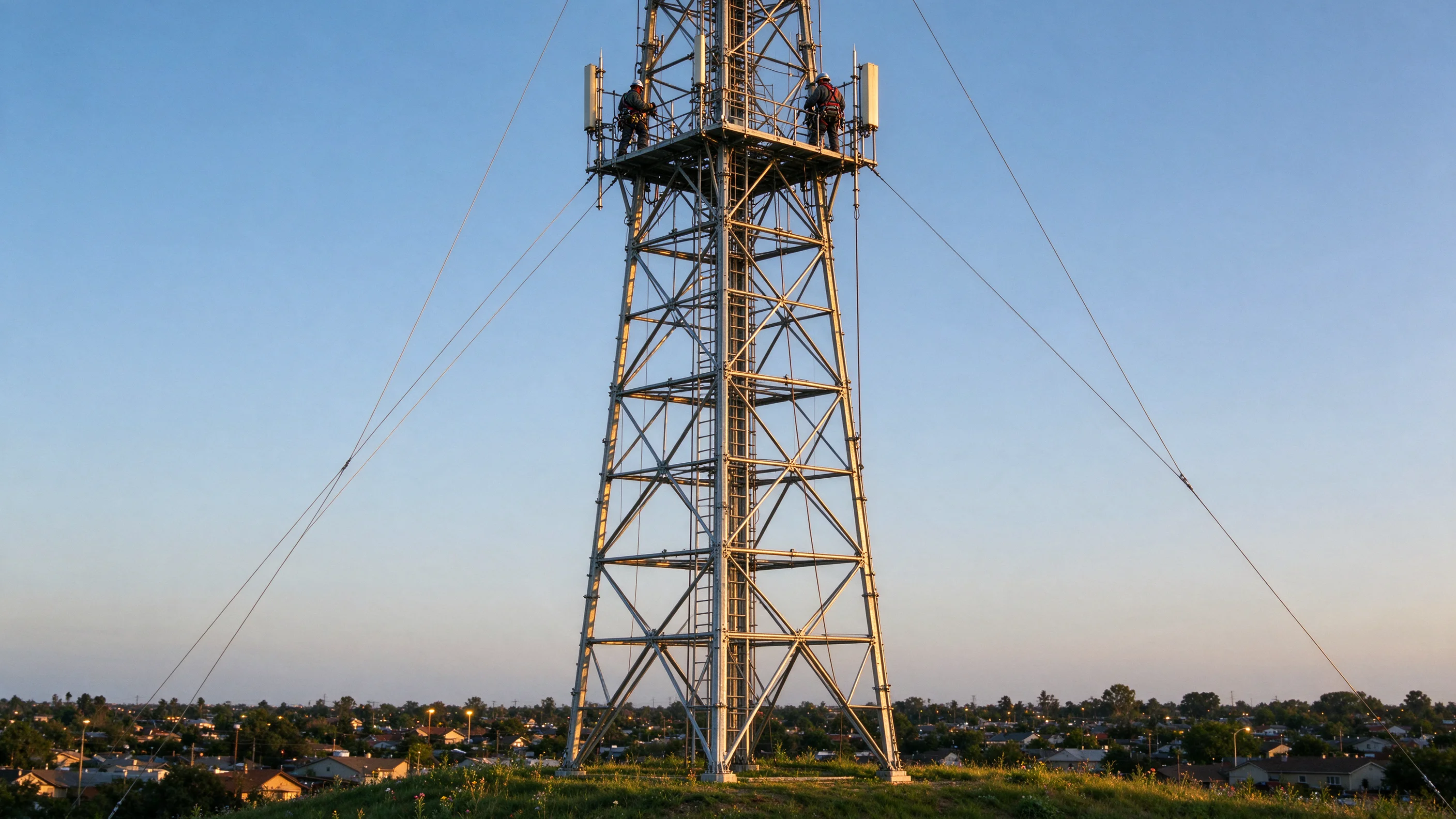
The split screen was sharper among infrastructure landlords. American Tower, Crown Castle, and SBA Communications rallied as traders weighed whether a credible terrestrial Starlink layer would eventually lease colocation—femtocells, small cells, and macro sites—rather than erase demand for towers outright. Bernstein and other sell-side notes cited depressed tower multiples after the 5G build-out slowdown; the deal offered a rare bid for assets that benefit from someone else spending capex on ground radio.
None of that is guaranteed cash flow. It is a bet that hybrid networks still need steel in the ground.
Why 800 MHz, and why now
Low-band spectrum is scarce precisely because it propagates. The 800 MHz band penetrates structures and covers geography with fewer sites than mid-band 5G—useful for a company that already markets direct-to-device service from orbit but cannot rely on satellite alone indoors.
Grain had only recently assembled the portfolio from T-Mobile in a swap involving 600 MHz holdings, then pursued FCC pathways for direct-to-device use. SpaceX’s purchase lands after a run of commission actions on supplemental coverage from space, including a 15,000-satellite direct-to-device authorization and leasing waivers on earlier EchoStar spectrum. The Grain transaction would stack additional terrestrial low-band under the same owner that already controls the space segment.
Analysts noted the reported $8 billion price—roughly $1.73 per MHz-POP in New Street’s framing—cleared whisper numbers near $6 billion. Paying up signals urgency: Musk is buying optionality on the regulated asset, not waiting for a distressed sale.
The binding constraint is still the commission
Investors can mark down Verizon in the afternoon. SpaceX cannot light the licenses until the FCC signs the assignment. Grain’s release explicitly ties the deal to the commission’s July 2026 order on its T-Mobile acquisition—a competitive selection process and conditional pathway for direct-to-device deployment. Transfer review will ask whether a single company should hold both the satellite service rules and nationwide low-band terrestrial rights, and on what build-out or interoperability conditions.
Until that record closes, competitive consequences stay prospective. SpaceX could still pursue an MVNO truce, a phased build, or leverage rather than a full national duplicate of the Big Three’s macro grid. RCR’s infrastructure desk put the capex bar in the tens of billions even with spectrum in hand—coverage is not capacity, and a hybrid network still has to pass the same congestion tests subscribers already run on incumbents.
That is the narrow story next to recent Culled coverage that treated SpaceX as a vertically integrated launch, connectivity, and AI-infrastructure stack. The public valuation narrative in post-IPO earnings and the Starship-as-capital-equipment rally assumed Starlink scales through satellites and hosted compute. This event adds a regulated terrestrial choke point: who holds the MHz, and who approves the use.
What changes for readers watching the sector
Three watch items survive the one-day selloff.
FCC docket and conditions. Assignment approval, build-out milestones, and any roaming or interoperability mandates will determine whether the threat is wholesale competition or negotiated coexistence.
Terrestrial capex signals. Femtocell trials, small-cell leases, and tower backhaul contracts will show whether the spectrum purchase is inventory or posture.
Cross-border sentiment. European telecom moves without local license exposure suggest investors are modeling Starlink as a template for satellite-terrestrial convergence elsewhere—not merely a U.S. eccentricity.
SpaceX did not buy another rocket factory Thursday. It bought the regulatory keys to behave like a carrier. The market reacted on October 9 as if those keys might turn; the commission still decides whether they do.
Continue reading


Sources
Grain Management press release; Axios and Wall Street Journal reporting on deal terms; Fierce Wireless and RCR Wireless on market reaction; European midday market reports on telecom share moves.


