

CoreWeave reported $2.58 billion of second-quarter revenue and a $626 million net loss while lifting 2026 capital spending to as much as $39 billion. Dell booked $24.4 billion of AI orders last quarter and recognized $16.1 billion, as gross margin fell to 17.8 percent from 21.1 percent. Demand is converting. Profit is converting later.
CoreWeave reported $2.58 billion of second-quarter revenue and a $626 million net loss. It also raised 2026 capital spending to a range of $35 billion to $39 billion. Dell Technologies, heading into fiscal-second-quarter results on September 1, last printed $24.4 billion of AI orders against $16.1 billion of recognized AI-server revenue, a $51.3 billion backlog, and a 17.8 percent gross margin, down from 21.1 percent a year earlier.
The dominant story is demand. Jeff Clarke raised Dell’s fiscal-2027 AI-server outlook to about $60 billion after a 757 percent jump in that line. CoreWeave’s revenue backlog sits at $104 billion, with more than $25 billion of additional commitments sitting outside that figure. Dell has shipped the first NVIDIA Vera Rubin NVL72 PowerRack systems to CoreWeave. Sell-side notes fold SpaceX — via xAI — into the same handful of giant buyers. Evercore has estimated that CoreWeave, xAI, and IREN could account for roughly 70 percent of Dell’s AI-server guide. That is the rocket. It is not the residual.
Demand Is Not the Constraint. Conversion Is.
If strong AI demand is translating into large customer commitments and higher Dell forecasts, why are CoreWeave’s higher sales still accompanied by larger-than-expected losses, and why is Dell facing margin pressure?
The conversion mechanism is sequential. Large commitments force capacity purchases and construction before revenue is fully recognized. Financing, components, deployment, and power therefore rise ahead of utilization. CoreWeave’s quarter makes the lag visible on a single income statement: operating loss was $49 million; net interest expense was $640 million; net loss was $626 million. Adjusted EBITDA was $1.51 billion. The GAAP hole is the cost of borrowing the factory, not the absence of customers. Third-quarter interest guidance of $860 million to $940 million says the factory is still being financed.
Dell’s version of the same lag is mix plus a missing input. Management said demand continues to exceed supply, with memory as the primary constraint. Orders of $24.4 billion against $16.1 billion of shipments is not a demand failure. It is a recognition schedule waiting on DRAM, HBM, and the rest of the rack. AI-server operating income is targeted in the mid-single digits. Gross margin compressed almost entirely because that mix crowded higher-margin traditional gear. Giant buyers extract price. Volume does not automatically become leverage.
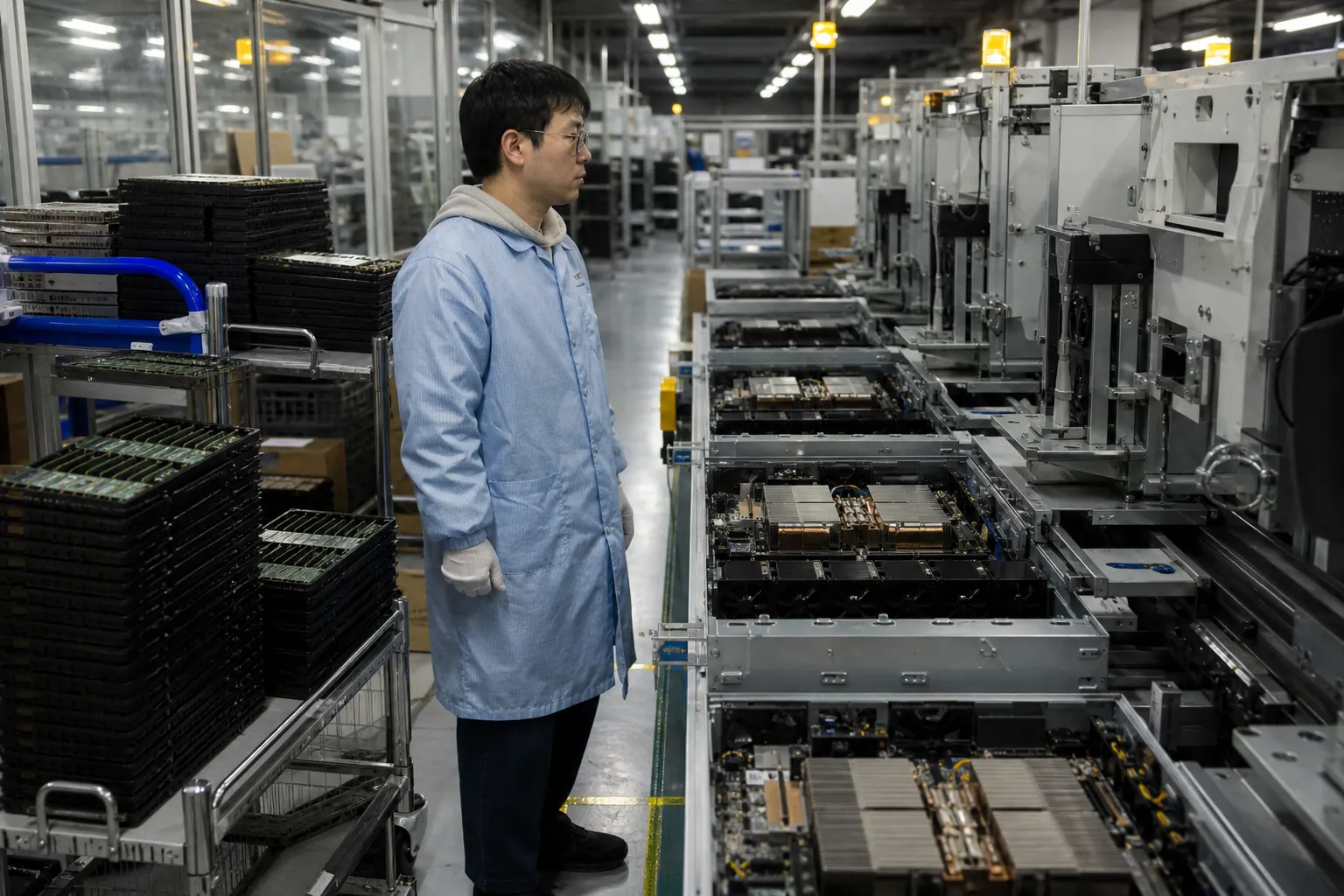
A second mismatch can strand the hardware even after it ships. Revenue converts only when accelerators, power, networking, software, and customer utilization arrive together. CoreWeave ended the quarter with 1.5 gigawatts of active power and a year-end target above 1.85 gigawatts. A rack without a megawatt is inventory with a coolant loop. That is the same stranded-capacity risk we mapped when asking whether AI apps can justify the buildout, and why Nvidia’s record quarter still got shrugged. TSMC’s $56 billion AI commitment does not relax Dell’s memory gate on its own.
Names Are Not a Filing
The SpaceX line needs a narrower claim. Dell has disclosed CoreWeave as a Vera Rubin recipient. It has not, in the Q1 FY27 release, broken out SpaceX or xAI as a reportable customer. xAI now sits inside the SpaceX listing complex. Analyst models can put those logos on 70 percent of the AI-server guide. Dell’s own customer count is “surpassed 5,000,” across neoclouds, sovereigns, and enterprise. Concentration may be real. Attribution without a 10-Q line is still an extrapolation — and custom silicon gives the largest buyers a path off merchant racks.
Markets still price the order book as if it were a margin book. Dell at roughly 24 times forward earnings after a 247 percent year-to-date run is a conversion multiple, not a hardware multiple. CoreWeave’s raised sales guide is being read as operating leverage while interest expense is the line that actually scaled. The dot-com echo was never that demand was fake. It was that capex arrived before cash returns.
The residual is answered only if September 1 shows AI-server gross margins expanding after mix, or if CoreWeave’s next print shows the net loss shrinking without a one-time accounting story.
Watch three numbers. Dell’s AI-server gross-margin and backlog-conversion print on September 1. CoreWeave’s interest expense against adjusted operating income. Named-customer concentration in Dell’s next 10-Q, not in an Evercore slide. If those stay on the current path, demand was never the mystery. The cost cycle was.
Continue reading


Sources
Dell Q1 FY27 earnings release and 8-K (May 28, 2026); CoreWeave Q2 2026 results and 10-Q; CoreWeave August 2026 earnings call; Dell Vera Rubin shipment announcement to CoreWeave; Evercore customer-concentration commentary via secondary reports


