

For a decade the India–South Korea partnership under-delivered: Hallyu soared, Samsung and Hyundai dominated Indian consumer life, yet the 2010 CEPA left a $15.35 billion trade deficit by 2025–26. April–May 2026 changed the architecture — VOYAGES shipbuilding, a Digital Bridge on chips and AI, UPI–KFTC payment rails, and a Joint Strategic Vision through 2030 — as Act East met New Southern Policy in a fragmented world order.
When South Korean President Lee Jae Myung arrived in New Delhi on April 19, 2026 — the first presidential visit in eight years — the optics were cultural. Lee, an avowed admirer of Indian cinema, stood beside Prime Minister Narendra Modi as both leaders invoked K-pop, Bollywood, and a “futuristic partnership.” The substance was harder: 25 outcomes, 15 memoranda, a $50 billion bilateral trade target by 2030, and a five-year Joint Strategic Vision that finally synchronized India’s Act East Policy with Seoul’s New Southern Policy.
The hook landed again six weeks later. From May 25 to 27, negotiators concluded the 12th round of CEPA upgrade talks in New Delhi, agreeing to address India’s swelling trade deficit within the existing pact framework rather than start from scratch. Sub-groups on digital trade, supply chain resilience, and strategic industrial cooperation will report back as both sides race to conclude the upgrade by year-end. The corridor is no longer aspirational rhetoric. It is institutional machinery.
Selective De-Risking Without a Bloc
Neither India nor South Korea wants a rigid anti-China containment alliance. Both want reduced strategic exposure — and they are building parallel resilience rather than joining one camp.
For India, that means maritime manufacturing at home instead of dependency on Chinese port logistics and vessel supply chains disrupted by Gulf instability. For South Korea, it means a massive, stable market and industrial partner outside Beijing’s immediate economic coercion radius — especially as Seoul pours trillions into domestic memory fabs while managing concentrated KOSPI exposure to chip cycles.
The Joint Strategic Vision (2026–2030) codifies the political layer. Annual leader-level reviews, an inaugural Defence and Foreign Affairs 2+2 at vice-minister level, an Economic Security Dialogue on critical technologies, and South Korea’s accession to India’s Indo-Pacific Oceans Initiative. India and Korea are not forming a NATO for Asia. They are stitching a middle-power axis: keep shipping lanes open, diversify supply chains, coordinate on defence industry cooperation without demanding ideological alignment.
Modi framed the message for a fragmented order: “In this period of global tensions, India and Korea together convey a message of peace and stability.” Lee called the two nations “most ideal partners for comprehensive cooperation.” The language is diplomatic. The engineering is selective de-risking — bilateral, modular, and scalable.
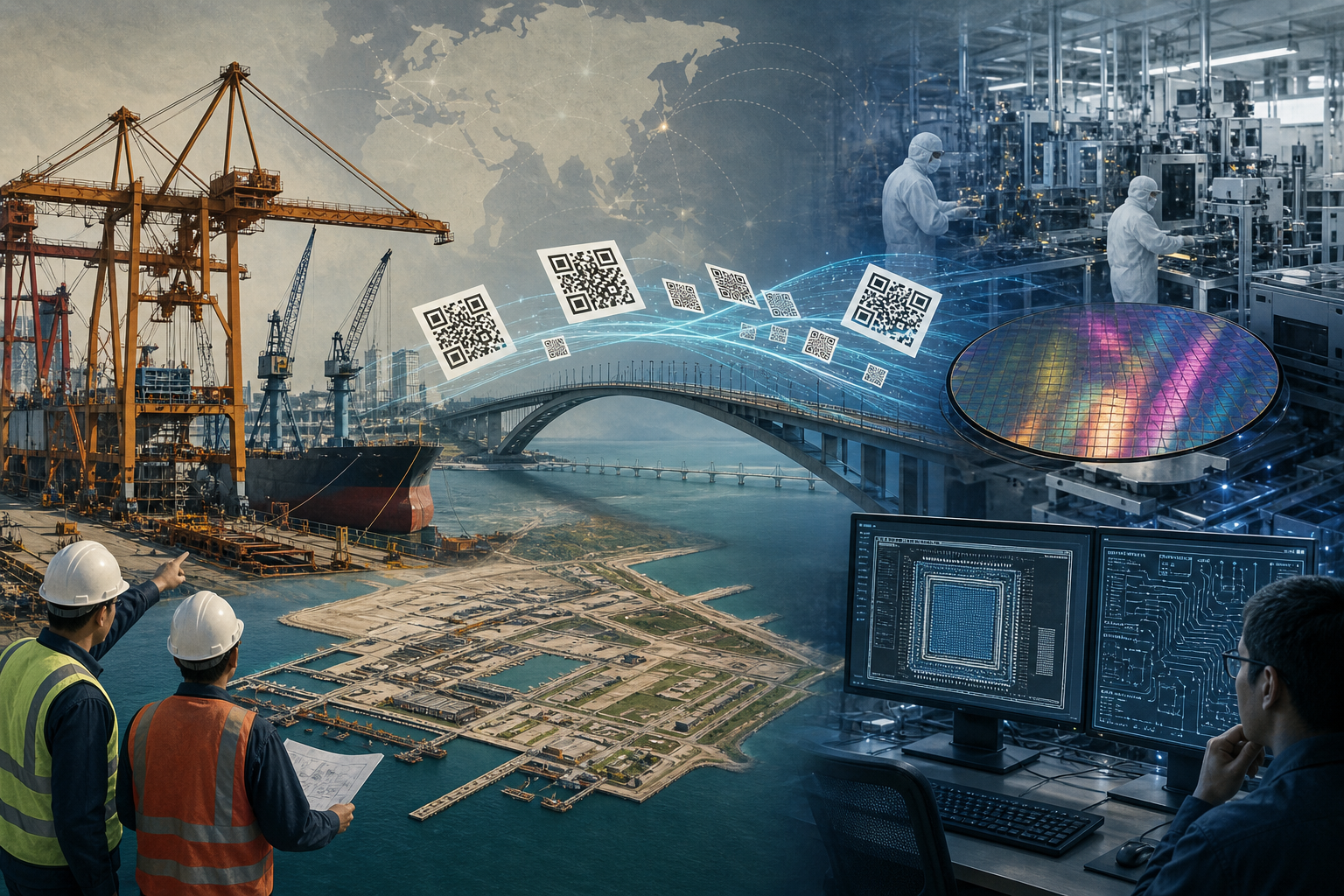
The Ships-to-Chips Doctrine
Modi’s April formulation — “from chips to ships, talent to technology” — is not sloganeering. It is an industrial stack.
Ships: The VOYAGES framework (Vision for Operation of Yard Assisted Growth with Efficiency and Scale) anchors the maritime pillar. India has announced a pipeline of more than 400 vessels worth roughly ₹2.2 lakh crore ($25 billion) for public-sector procurement alone. South Korea, home to three of the world’s five largest shipbuilders, is invited as technical anchor. HD Korea Shipbuilding & Offshore Engineering signed a non-binding MOU for a greenfield yard in southern India — building on prior agreements with Cochin Shipyard and Tamil Nadu. Port infrastructure projects worth an estimated $13.3 billion over five years — Vadhavan, Bahuda, Deendayal expansions — pair with BEML–HD Hyundai crane co-manufacturing for India’s ₹90,000 crore port modernization program. KOICA will train Indian shipyard workers. KOMEA opens in Mumbai.
Chips: The India–Korea Digital Bridge targets AI governance, data policy, chip design, and fabrication cooperation — complementing Modi’s semiconductor incentive schemes and Seoul’s own Honam-scale domestic expansion. India wants design and packaging capacity; Korea wants market depth and talent pipelines. Neither pretends to replace TSMC or Samsung’s Yongin clusters overnight. Both treat semiconductors as strategic infrastructure, not consumer electronics alone.
Manufacturing asymmetry: To narrow the deficit, India announced a dedicated Korean Industrial Township — plug-and-play infrastructure for SMEs that have struggled to penetrate a market dominated by conglomerate champions. An Industrial Cooperation Committee, chaired by industry ministers, will hold its first meeting in 2026. The CEPA upgrade sub-group on strategic industrial cooperation exists precisely because Hyundai cars and Samsung phones were never enough to balance the ledger.
Digital Rails and the $50 Billion Target
Bilateral trade reached $27 billion before the April summit. Doubling to $50 billion by 2030 requires more than tariff lines — it requires payment infrastructure that MSMEs can actually use.
On April 20, NPCI International and Korea’s Financial Telecommunications and Clearings Institute signed an MOU to integrate India’s Unified Payments Interface with Korean retail payment rails. The framework envisions reciprocal QR-based scan-and-pay: Indian tourists debiting rupees at Seoul merchants, Korean visitors eventually scanning UPI codes in India — bypassing forex counters and credit-card interchange for everyday transactions. Financial Services Commission chairman Lee Eog-weon pledged launch within 2026, following Japan’s UPI merchant acceptance earlier that month. A parallel FSC–IFSCA agreement opens a bridge to India’s GIFT City financial hub.
This is digital diplomacy with balance-sheet consequences. Nearly 200,000 Indians visited South Korea in 2025, up 13 percent year-on-year. MSME MoUs signed the same week aim to let small exporters ride those rails into cross-border trade without correspondent-banking friction. The India–Korea Financial Forum and capital-markets cooperation sessions — including pathways for Korean investors into Indian equities — sit atop the retail layer.
The CEPA upgrade is the macro wrapper. Commerce ministers Goyal and Yeo Han-koo accelerated negotiations in April; the May round addressed goods, services, rules of origin, investment, and sanitary standards while acknowledging the deficit that widened from roughly $5–6 billion in 2010 to $15.35 billion in 2025–26. Seoul agreed to address the imbalance within the pact — a concession that keeps the relationship inside one legal architecture rather than fracturing it into a fresh FTA debate.
Culture as Institutional Grease
Hallyu did not wait for a government program. K-dramas, cuisine, and K-pop penetrated Indian metros years before diplomats filed the paperwork. The April summit institutionalized what culture had already proven: soft power lowers the friction for hard commitments.
The Cultural Exchange Programme extends through 2030. 2028–2029 is officially the Year of India–ROK Friendship — Modi announced an India–Korea Friendship Festival — with expanded cooperation in film, animation, VFX, and sports. A Mumbai Korea Centre will anchor K-culture programming. Indian cinema’s rising recognition in Korea closes the loop Lee celebrated personally.
Culture does not fix trade deficits. It builds the constituency that tolerates decade-long shipyard investments and semiconductor fab timelines — the political patience industrial corridors require. When Gulf shipping insurance spikes and memory cycles turn, festivals do not move freight. They keep publics from treating the partnership as purely transactional.

The Corridor Thesis
The India–South Korea relationship spent a decade as an underachiever: enormous cultural warmth, widening trade asymmetry, thin strategic depth. Mid-2026 compresses a paradigm shift into three months — Lee’s state visit, VOYAGES and Digital Bridge launches, UPI integration, the 12th CEPA round — because both governments read the same global memo. Fragmentation rewards localized webs of interdependence. Middle powers that build their own corridors need not choose between Washington and Beijing if they can choose each other.
Ships address India’s maritime Amrit Kaal 2047 ambition and Gulf-exposed logistics risk. Chips address Seoul’s need for markets and talent beyond Northeast Asia’s chokepoints. UPI–KFTC linkage addresses the last mile of trade — the tourist, the MSME, the scan-and-pay transaction that makes $50 billion feel real. Culture addresses the decade-scale patience both require.
The Honam gamble pours concrete in Gwangju. The India–Korea corridor pours policy in New Delhi and Seoul. Neither is a verdict on whether DRAM or container ships define the Asian century. Both are bets that in a fragmented world, resilient middle powers manufacture their own gravity — one yard, one fab, one QR code, and one friendship festival at a time.
Continue reading


Sources
Prime Minister of India Joint Strategic Vision and VOYAGES framework, PIB releases, Hindu and Financial Express on 12th CEPA round May 25–27 2026, National Maritime Foundation on VOYAGES, NPCI-KFTC MoU reporting, Yonhap and Seoul Economic Daily on QR payment linkage, DD India and India's World on April 2026 Lee state visit outcomes


