

The Qatar Prix de l'Arc de Triomphe returns to ParisLongchamp on October 3 and 4 with a €5 million purse, 35,000 expected spectators and hospitality tiers ranging from course-edge viewing to private enclosures. The weekend exposes the capital, labor and access system behind elite thoroughbred racing.
At ParisLongchamp this weekend, a mile and a half of turf will carry more than a race. The Qatar Prix de l’Arc de Triomphe returns October 3 and 4 with a €5 million purse—the largest in French racing—and an event structure that turns a sporting championship into a market for proximity. The public comes for the horses; the business is organized around who can see them from where, with whom, and under what terms.
France Galop expects roughly 35,000 spectators across the weekend. It also expects 50 nationalities, 2,600 people working on site and 200 occupations in play. Those figures are a useful correction to the romantic version of the Arc. The race is a breeding and training contest, but its economic unit is a temporary city: stable staff, grounds crews, jockeys, broadcasters, caterers, security, hospitality workers, owners, bookmakers and guests all attached to one afternoon of maximum attention.
The public ticket is an entry point, not the whole product
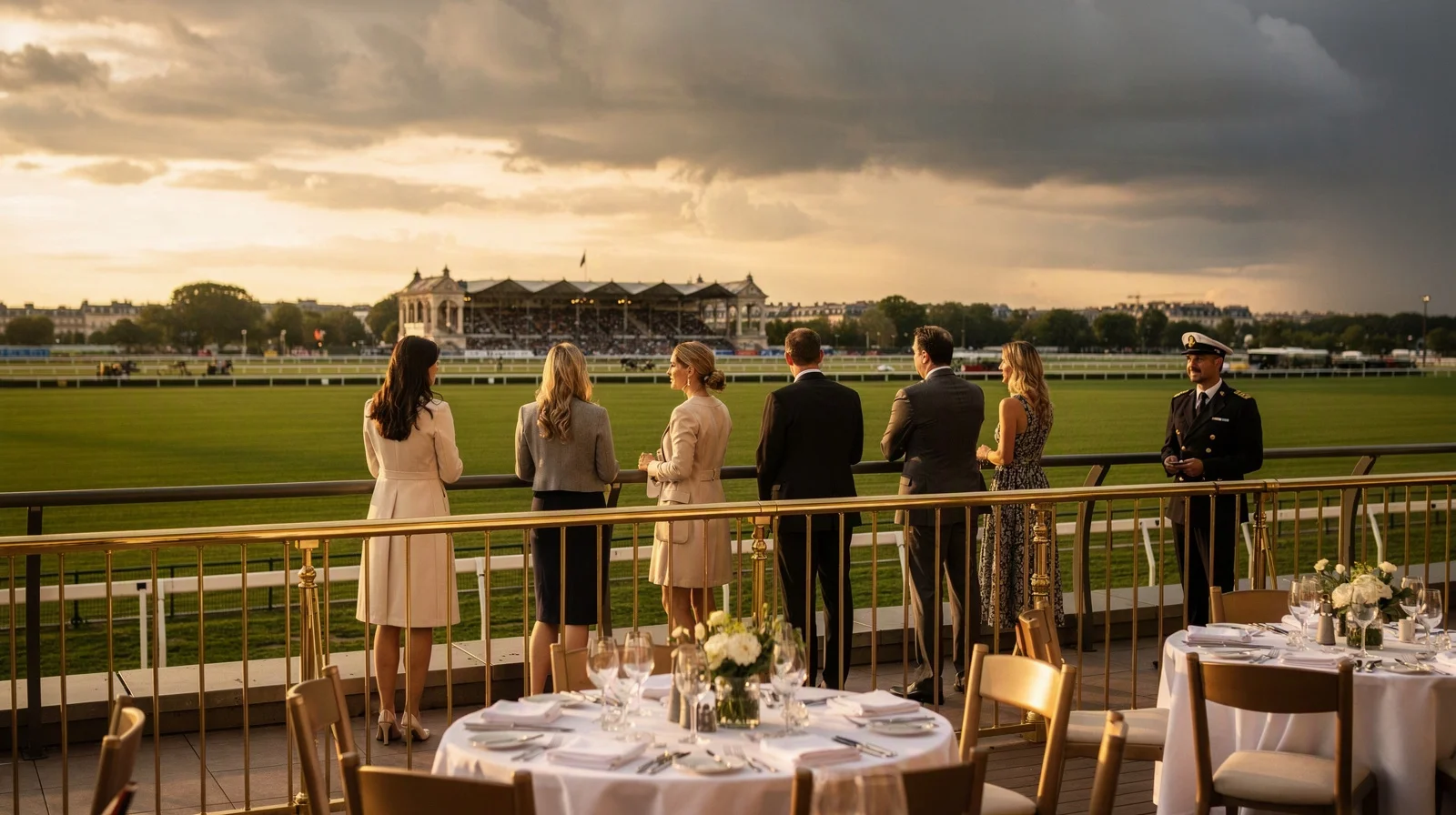
The ticketing menu makes the hierarchy unusually explicit. There are general racecourse experiences and Arc Village access. There are numbered grandstand seats on the finish straight with a private paid bar. There are restaurants beside the parade ring, semi-private lunch and rooftop access, premium cocktails by the track and a private enclosure near the winning post. One Saturday Brasserie ParisLongchamp package begins at €239.
None of that is peripheral to the event. Hospitality is the mechanism that lets a racecourse package an identical sporting moment into distinct economic products. The horses pass the same finish line for everyone. The vantage, service and social density around that finish line are what get priced.
That is the same access logic we saw at Paris Fashion Week: a broad public image, then a limited number of high-value rooms. At Longchamp, the television audience can watch the decisive stride from anywhere. The owners’ and clients’ market is made from what happens before the gates open, beside the paddock, on the terrace and after the result.
Elite racing does not merely sell a seat at the track. It sells a place in the chain of people who can turn a horse’s performance into future value.
The purse sits on top of a longer asset cycle
The Arc is billed as a de facto world championship of thoroughbred racing, broadcast in more than 60 countries. France Galop says the race has been named Best Race in the World five times in the last decade. Those credentials matter because the winner’s value does not end with the prize money. A top performance can alter the perceived value of a horse’s future breeding career, the standing of its trainer and jockey, and the demand for related bloodstock.
That does not mean every winning horse becomes a straightforward financial instrument. Training, health, pedigrees, ownership agreements and the uncertainty of future offspring all remain binding constraints. But the Arc concentrates the evidence that the market uses to make those judgments. The €5 million purse is a headline; the reputational transfer can run longer.
The Festival of Nations gives the weekend a more public grammar, asking racegoers to identify the countries that drive the global industry. It is a clever framing because the internationalism is real: the Arc’s history has winners trained in France, England, Ireland, Italy and Germany, and the 2026 card is designed around a global audience. Yet that global theater rests on extraordinarily local work: France Galop lists 80 people caring for the course, 17 tonnes of stable straw and 10-centimeter grass on the track.
Watch the weekend with that split in mind. The public sees the gallop and the finish. The capital market sees a pedigree, a future breeding prospect, a hospitality client and an international broadcast asset. ParisLongchamp sells both views at once.
Continue reading


Sources
France Galop's official 2026 Qatar Prix de l'Arc de Triomphe ticketing page, including dates, ParisLongchamp hospitality products, €5 million purse, spectator, workforce and international-viewing figures.


