

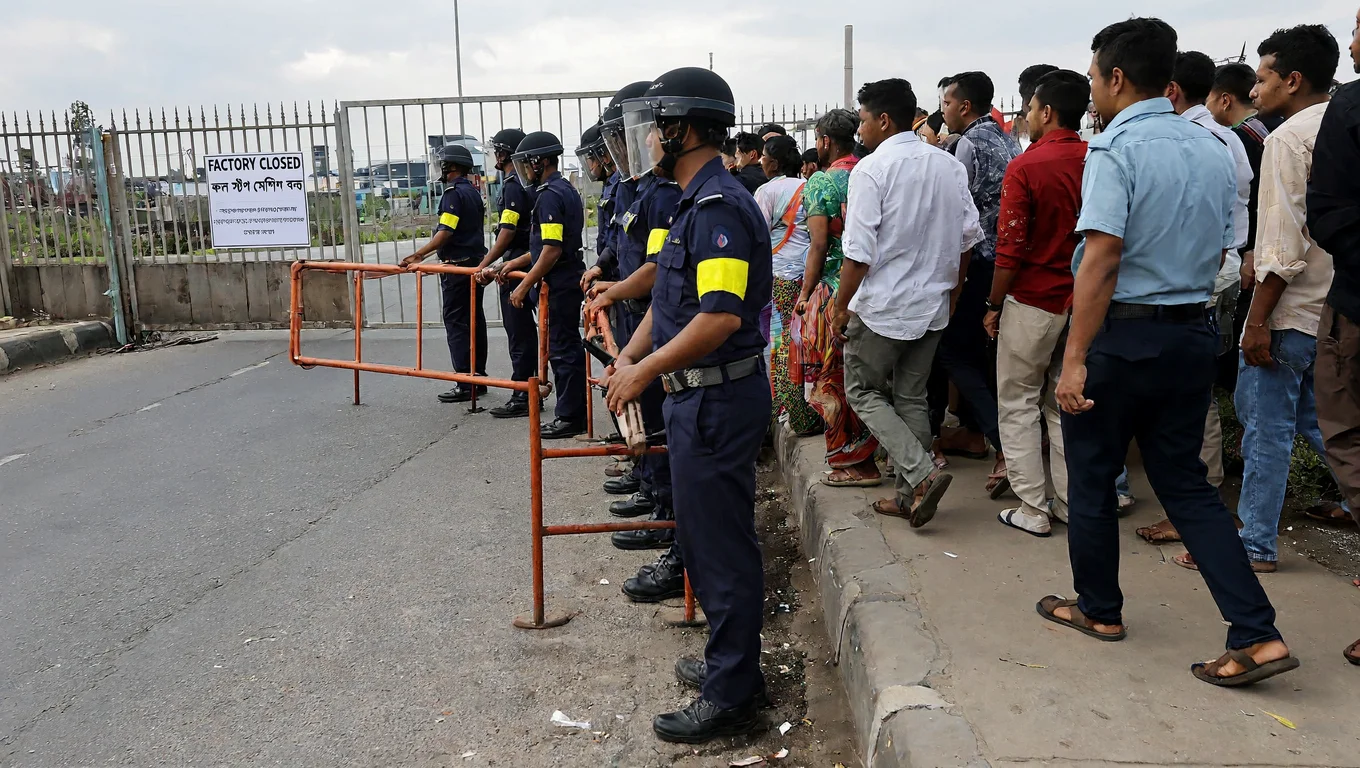
Bangladesh's apparel belt moved from bargaining-table rhetoric to padlocked gates on Nov. 15, when industrial police confirmed thirteen garment factories in Gazipur closed indefinitely and workers clashed with law enforcement on the Dhaka–Tangail highway. Prothom Alo reported tear-gas volleys near Konabari, protest marches in Kaliakair, and closure notices citing vandalism at Far East Knitting and Dyeing Industries. The binding constraint is no longer macro stress alone—LABOR unrest is now a production and logistics risk for an export model that global brands treat as just-in-time.
Culled's recent Bangladesh coverage tracked banking stress and machinery imports. Sunday's closures are a labor-and-supply-chain shock: indefinite stoppages at export plants, police on industrial arteries, and owners signaling they may walk out of wage negotiations. Until shipment data arrive, the open risk is whether unrest converts into missed delivery windows—not another NPL ratio on a spreadsheet.
Gazipur, Nov. 15 — Bangladesh’s export-apparel map is no longer a background macro story. It is a padlock story. Industrial police confirmed to Prothom Alo that thirteen garment factories in Gazipur were declared closed indefinitely on Sunday, while five others announced a holiday-only shutdown. Workers opened the morning with protests near Konabari at about 8:30 a.m., according to the same report; police responded with tear gas and sound grenades. By 9:00 a.m., a march in Kaliakair’s Mouchak belt moved toward the Dhaka–Tangail highway, where protesters attempted to block traffic before law enforcement cleared the road.
The episode lands atop a banking and investment freeze Culled already traced when machinery imports collapsed and when private credit growth stalled near 33 percent non-performing loans. Those fractures constrained who could finance the next line upgrade. Sunday’s closures constrain who can ship this week’s orders.
Closure notices as bargaining weapons
Far East Knitting and Dyeing Industries in East Chandra posted an indefinite closure from Nov. 15, Prothom Alo reported, citing vandalism and attacks on officials amid unrest over minimum-wage demands. The notice argued that despite statements from the government and Bangladesh Garment Manufacturers and Exporters Association (BGMEA) on wage approval and implementation, outside workers demanding an announcement had turned destructive—a framing that shifts blame from the floor to agitators while keeping the factory dark.
At least twelve other units joined the indefinite list in the same cluster, including Ecotex Limited, Ahsan Composite, Apex Holding Limited in Chandra Palli Bidyut, and Moazzuddin Textile Limited in Mouchak, according to Prothom Alo’s tally. Superintendent Mohammad Amjad Hossain of Gazipur Industrial Police told the paper that forces were deployed at key industrial points after workers tried to gather at separate locations in the morning.
The immediate economic question is not the wage percentage on paper; it is whether owners can restart lines without conceding bargaining control—and whether brands can still treat Gazipur as a reliable node in their delivery calendar.
International wires have reported that manufacturer associations floated leaving formal wage negotiations if unrest continued, and that owners sought authority for no work, no pay rules while highways near industrial zones saw intermittent disruption. Culled has not independently verified duration metrics, export-tonnage loss, or buyer-level advisories; those are the falsifiers that would upgrade this from labor politics to a supply-chain event global procurement desks cannot ignore.
Why brands should watch a district, not a headline index
Gazipur and neighboring Ashulia corridors are not abstract GDP inputs. They are the physical layer behind H&M, Zara, and Walmart purchase orders—cut-make-trim clusters where a shutdown measured in days can cascade into air-freight premiums and chargeback clauses long before Dhaka publishes monthly export tables. LABOR is the primary locus because worker collective action—not ministerial press releases—forced gates shut and highways contested. STATE appears through police dispersion and wage-policy signaling. CAPITAL enters when owners choose indefinite idling over wage acceleration that would compress margins already squeezed by energy costs and a domestic credit channel Culled documented in October.
What would prove the supply-chain thesis
Three readings would confirm that unrest is migrating from wages to order books: BGMEA or factory-level advisories to buyers; customs or port data showing knit and woven export shortfalls in the Nov. 15–30 window; and named brand statements on delayed shipments. Absent those, the risk stays elevated but unquantified—similar to the early phase of POSCO’s Korean steel strike, where ballot math moved before tonnage registers.
Sunday ended with highways cleared in Kaliakair and gates chained in Chandra. The wage fight has reached the factory entrance. The test for Bangladesh’s apparel model—and for the brands sourcing from it—is whether those entrances reopen before delivery promises do.
Continue reading


Sources
Prothom Alo Nov. 15, 2026 reporting on thirteen indefinite Gazipur closures, tear-gas dispersal, and Far East Knitting closure notice; regional context from Culled's Bangladesh banking coverage.


