

Patek Philippe's free Watch Art Grand Exhibition runs at Milan's CityOval from October 2 to 18, placing rare handcrafts, new watches and manufacturing demonstrations before a public audience. The event widens the brand's cultural reach while keeping the actual market governed by scarcity, allocation and relationships.
Patek Philippe has opened the doors of Milan’s CityOval and, for seventeen days, put an unusually private form of value creation on display. The Watch Art Grand Exhibition runs from October 2 through October 18 in the former Palazzo delle Scintille at Piazza Sei Febbraio. Admission is free and reservations are recommended. That sounds like hospitality. It is also distribution.
The Geneva manufacturer calls itself the last independent, family-owned watchmaker in Geneva. At CityOval it has built rooms for its current collection, museum pieces, production stages, chiming watches and rare handcrafts. Visitors can watch artisans at work and see pieces inspired by Italian culture. The public gets access to the process; it does not receive an allocation number.
That distinction is the point. A high-watchmaking brand has to grow its audience without making its core product feel ordinary. The exhibition solves the problem elegantly. It converts the workshop—normally a credential, a waiting-list story and a private-client talking point—into a public cultural object. Thousands can absorb the labor and history. Very few will be able to buy the most desired output on the same terms.
Free entry widens the audience, not the supply
CityOval is an unusually useful setting for the exercise. The exhibition occupies a large former fair building inside CityLife, not a boutique or a salon. Patek can invite the interested public into a monumental setting, then let physical scale make the contrast legible: one movement may take months of specialized work; the room around it can hold a crowd.
The hours reinforce the civic posture. The exhibition is open from 10 a.m. on weekdays, until 10 p.m. on Fridays through Sundays, with a final 8 p.m. close on October 18. Nearby M5 stops and public parking make it easier to reach than the private appointment architecture that usually governs this category. But accessibility here is interpretive, not transactional. The open door explains why scarcity has a price; it does not dissolve scarcity.
That makes Watch Art a better read on luxury than a product launch. The new watch is only one output. The larger product is confidence in the chain of custody: family control, accumulated technical knowledge, an artisan’s hand, a historic archive, and the patience to keep supply below the audience’s appetite.
Patek is selling a public encounter with craftsmanship while preserving a market built on private allocation.
The artisan is the scarce asset
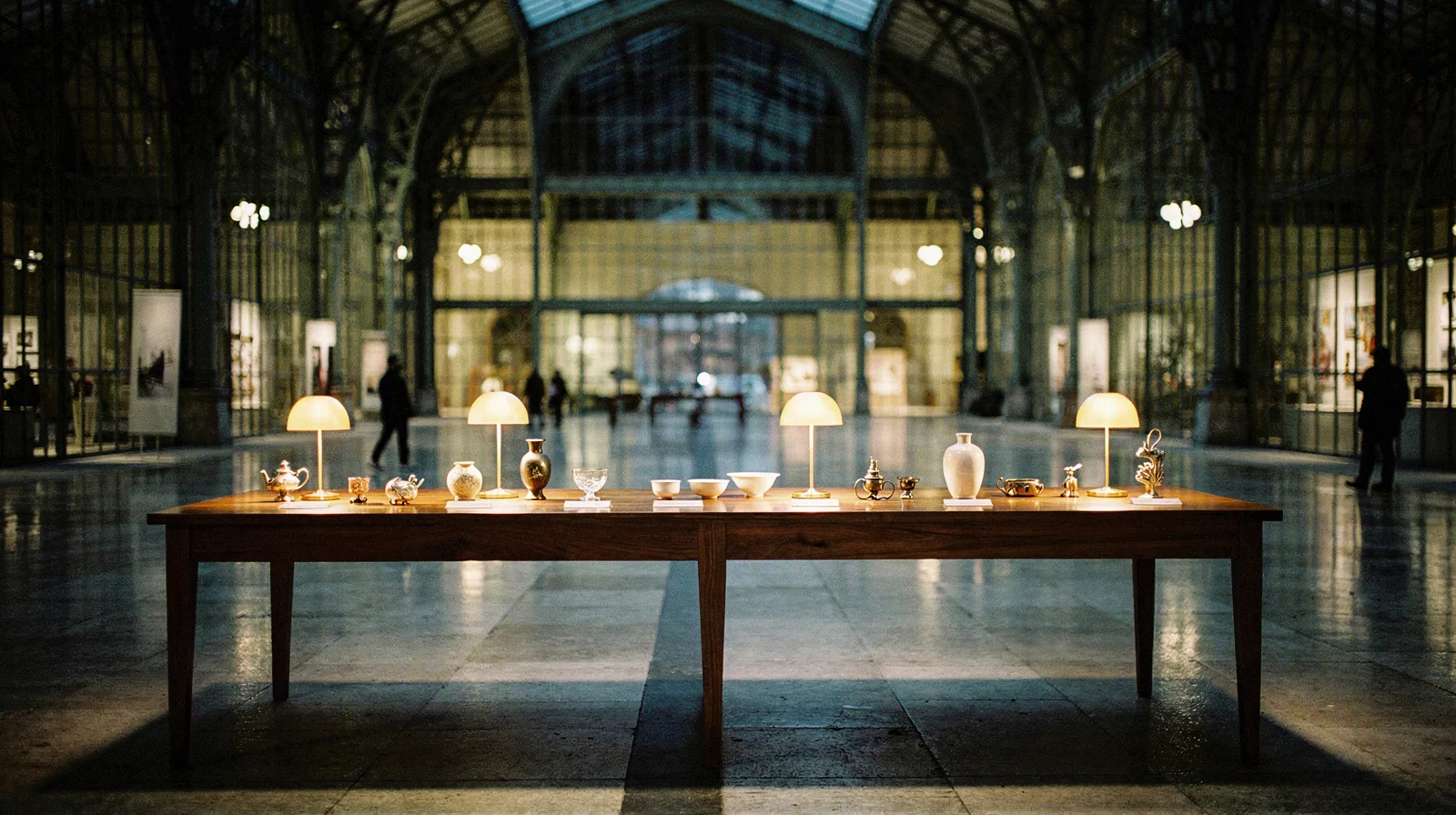
The rare-handcrafts room is the clearest expression of that strategy. Enameling, engraving, marquetry and related techniques are compelling because they resist easy scaling. They turn hours into a visible surface. A large exhibition makes that labor legible to people who may never own the resulting piece, which is precisely why it matters to the brand: the buyer is no longer asked simply to accept a premium; the buyer has an experience to attach to it.
The mechanism resembles the luxury hospitality stack around the Laver Cup, where the event is not merely a seat but a dense bundle of access, service and story. Patek’s version is quieter and more durable. It uses craft as the proof that the object deserves to sit apart from mass luxury.
There is also a labor question behind the polish. A manufacture can add machines, improve throughput and expand a showroom network. It cannot instantly create master artisans with the judgment to execute rare techniques at the expected standard. Those skills are not a decorative annex to the business; they are one of its production constraints. The exhibition therefore does double duty as marketing and as a demonstration of the human capital the company must retain.
For visitors, the practical information is straightforward: CityOval–CityLife, Piazza Sei Febbraio, with last entry one hour before closing. For the market, the useful lesson is less straightforward. Luxury’s strongest public events increasingly make the gate visible, hospitable and beautiful. They do not remove it. In Milan, Patek has made the scarcity machine tourable.
Continue reading


Sources
Patek Philippe's official Watch Art Grand Exhibition Milan 2026 page, including dates, CityOval location, access terms, rooms and opening hours.


