

Iran's army said Saturday it is shifting from a defensive to an offensive military doctrine. Spokesman Mohammad Akraminia warned of faster retaliation and a $26,000 bounty on U.S. troops if a ground incursion comes, as Tehran threatens a crushing response to Monday's U.S. sanctions.
Iran’s army said Saturday its military doctrine is shifting from defensive to offensive after the recent wars. The spokesman, Brig. Gen. Mohammad Akraminia, did not leave the adjective hanging. Retaliation, he said, would be broader and faster. A bounty of about $26,000 would be paid for killing or capturing U.S. troops in any ground incursion. Armed-forces chief Abdollahi added the calendar: a “crushing, punishing, devastating” response if Washington rolls out new sanctions on Aug. 24.
Monday is Treasury Secretary Scott Bessent’s date. Doctrine is how Tehran is pricing it. The market still wants a shipping print. Tehran just issued a rules-of-engagement print.
The Binding Constraint Is the Sanctions Clock, Not the Adjective
Offensive versus defensive is theater until it is timed. The timing is two days. That is the constraint that forces everyone else — insurers, skippers, Gulf treasuries, U.S. force protection — to adapt. Akraminia’s bounty is a price tag on a personnel risk that oil desks do not usually carry. Abdollahi’s vow is a state promise that the next U.S. economic instrument will be treated as a kinetic trigger.
This is the sequel to staffing, not a substitute for it. Rezaei’s elevation to the Supreme National Security Council put a Hormuz hardliner in the chair that turns threat assessments into policy. Saturday’s army language is that chair speaking in public. The June Versailles memorandum moved Brent and indices while the strait stayed cautious. Bürgenstock showed how quickly process strain jolts the tape. Peace was priced before it existed. The new residual is simpler: what does a market that already front-ran reopen do when the other side announces it will shoot first if the sanctions drop?
It does not get a binary. It gets a clock.
Hormuz Is Still a Meter, Not a Reopening
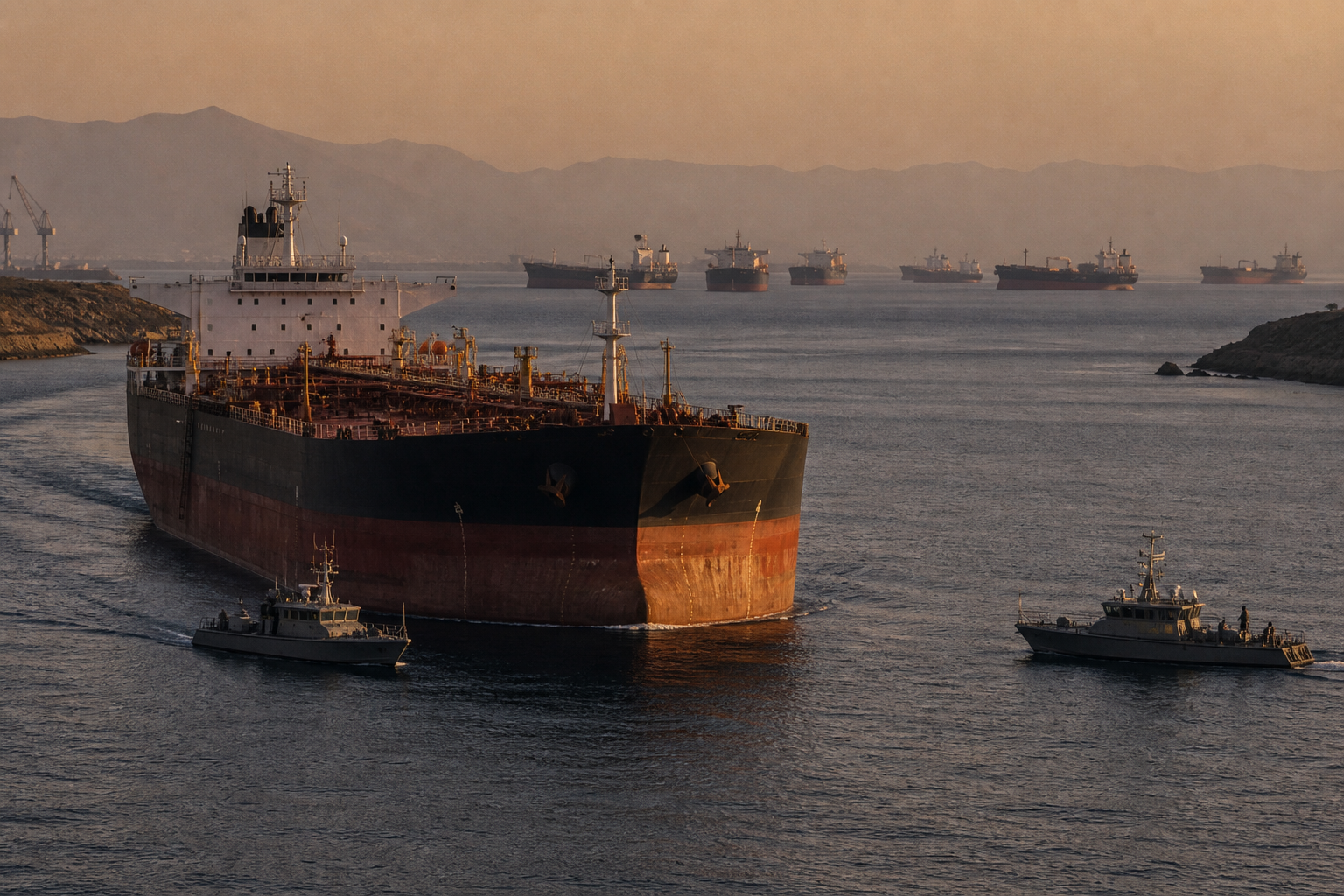
The physical story on the same Saturday is not a full strait. It is an exception. Iran granted special passage to a number of Iraqi oil tankers after repeated requests from Baghdad, Iraqi President Amedi said at the Baghdad Dialogue. Parliament Speaker Qalibaf still insists transit stays conditional on Washington meeting memorandum terms. President Trump told a Myrtle Beach rally Friday that Hormuz is “American territory.” Energy Secretary Wright said Saturday that Navy escorts are keeping a seven-day average above eight million barrels a day. Commercial trackers still put tanker traffic near 20 percent of pre-war levels. Brent settled at $94.39 on Friday.
Both numbers can be true. Escorts can move barrels. Trackers can still see a choke. The market error is treating the Wright print as a reopen and the tracker print as lag. Conditional metering is the regime: one friend’s tankers, one Navy corridor, everyone else in the queue. That is the same enforcement layer that froze the waterway when P&I clubs cancelled Hormuz war-risk cover — insurance as architecture, not atmosphere. Prolonged metering is also the unasked climate lever: conservation and fuel switching that nobody legislated.
Doctrine plus a sanctions date changes the hedge. Event risk is a spike you fade. A stated offensive posture on a two-day clock is duration you cannot fade with a Monday oil option. Force-protection premia, war-risk adders, and freight already know this. Equities that still trade “talks” as a risk-off toggle do not.
The checksum is ugly and short. Tehran converted a Treasury calendar into military language and put a bounty on U.S. personnel while keeping Hormuz as a tap, not a highway. Picture the vacated briefing room and the one tanker waved through. The principle: price Monday as a kinetic trigger with a shipping exception, not as another reopen rumor. If Bessent proceeds, do not wait for the adjective to show up in a tanker AIS track. The army already published the instruction set.
Continue reading


Sources
Saturday Aug. 22, 2026 army briefing: Brig. Gen. Mohammad Akraminia on defensive-to-offensive doctrine, faster retaliation, ~$26,000 bounty for killing or capturing U.S. troops in a ground incursion; armed-forces chief Abdollahi on a crushing response if Washington rolls out new sanctions Aug. 24; Iraqi President Amedi on special Hormuz passage for Iraqi tankers; Trump Myrtle Beach remarks calling the strait American territory; Energy Secretary Wright on Navy-escorted seven-day crude average above 8 million b/d versus commercial trackers near 20% of pre-war traffic; Brent settled $94.39 Friday. Culled prior reporting on the June MOU, Bürgenstock, and Rezaei SNSC elevation.


