

India notified Central Motor Vehicles (Amendment) Rules, 2026 on October 23, allowing E100 alongside E85 only in manufacturer-certified flex-fuel vehicles while updating emission tables for E20 gasoline fleetwide; the change opens a legal path for near-pure ethanol cars but does not mandate pumps or retire India's E20 rollout.
Thursday, October 23 — India’s transport ministry turned a years-long draft into law. Notification G.S.R. 911(E) amends Rule 115 of the Central Motor Vehicles Rules, 1989, adding E100 next to E85 in emission tables for vehicles designed and certified by original equipment manufacturers as flex-fuel. Explanatory notes are blunt: “E85 or E100 shall be used in the vehicles designed by the original equipment manufacturers as Flex-fuel vehicles.” Ordinary E20 petrol cars — the bulk of new sales as India marches toward a 20% ethanol blend nationwide — cannot legally tank E85 or E100.
That line separates permission from transition. Carmakers may now homologate 100% ethanol models with a federal rulebook that matches Annexure SA testing for E100. The notification does not set a national E100 pump rollout date, mandate flex-fuel share of production, or alter the parallel E10/E20 gasoline columns updated in the same tables. A transport ministry official told The Hindu that high blends apply only to certified flex platforms — not the general fleet.
Industrial map: who wins if flex scales
STATE policy still drives the bet. New Delhi wants to cut crude imports, lift farm income (especially sugarcane and maize ethanol), and keep refiners and OEMs invested in domestic molecules.
| Stakeholder | Near-term effect |
|---|---|
| Oil marketing companies | More ethanol offtake contracts; blending infrastructure already built for E20 eases logistics for high-blend islands |
| Sugar and distillers | Demand anchor if flex volumes grow; pricing linked to cane cycles and monsoon |
| Automakers | Certification cost for flex engines, fuel lines, and ECU maps; marketing story for rural and fleet buyers |
| Consumers | No change until flex models and E100 retail appear locally |
Press reports say some manufacturers could launch E100 cars within months; the rules remove a regulatory blocker, not a supply-chain guarantee.
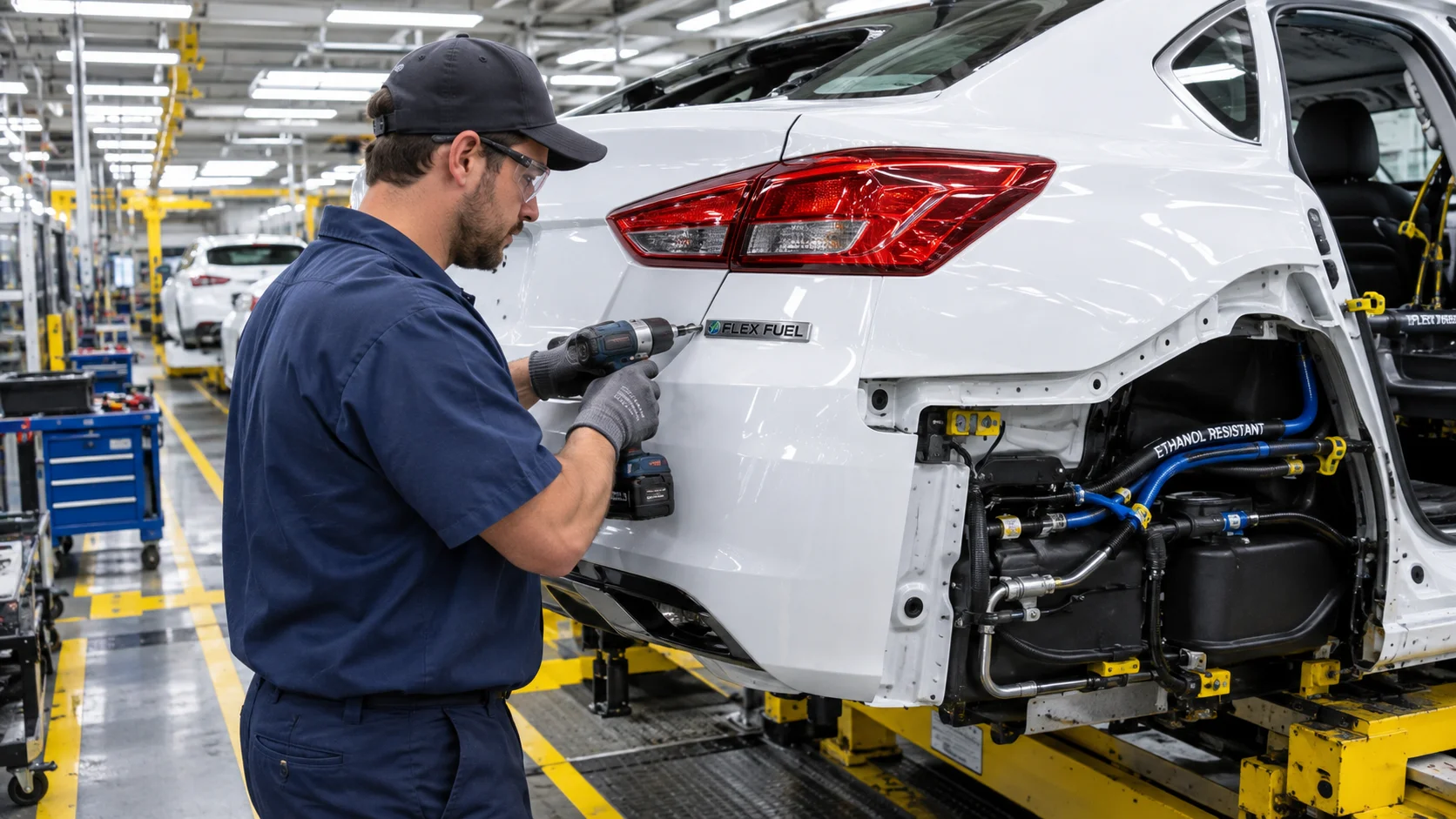
Modeling gasoline displacement
India consumes on the order of 30+ million tonnes of gasoline annually (petroleum ministry trend data). Ethanol blending at E20 already displaces a single-digit share of that pool fleetwide. E100 flex cars shift the curve only through new-vehicle sales and where drivers can buy E100.
Illustrative scenarios — not forecasts — using ~4 million annual passenger-car sales and ~15,000 km/year average driving:
| Flex share of new sales | Years to ~5% of fleet on flex | Approx. extra ethanol demand vs today (blended basis) |
|---|---|---|
| 2% (niche) | >15 years | Marginal — policy signal only |
| 10% | ~5–7 years | Noticeable cane/distillery investment; <2% gasoline pool displaced |
| 25% with 50% of flex km on E100 | ~4 years to 5% fleet | Low-single-digit % of gasoline import barrel; meaningful for sugar belt economics |
Full E100 use maximizes displacement per kilometer but lowers energy density — drivers burn more volume per mile than on petrol. Real-world uptake depends on pump price versus E20 and range anxiety. Without retail E100, flex cars will run on E20 like everyone else, capturing almost none of the import-reduction story.
Binding constraints are not the rulebook:
- Ethanol production — India targets rising blend rates; E100 fleets compete with blending for the same litres.
- Retail certification — Pumps need storage, labeling, and safety compliance per state rules.
- Vehicle economics — Flex hardware adds cost; without tax breaks, buyers may prefer conventional E20 models.
Permission vs industrial transition
October 2026 is the legal start line. An industrial transition needs OEM launches, fueling corridors (likely highway and agricultural belts first), and price administration so E100 undercuts imported gasoline on a rupees-per-kilometer basis.
If those pieces stall, E100 stays a regulatory option — important for GE compliance narratives and sugar lobby politics, invisible at the import terminal. If they align, India adds a second ethanol lane beside fleetwide E20, letting enthusiasts and fleets opt into deeper displacement without waiting for the entire car parc to turn over.
What to watch
- First OEM homologations — which models, which states for launch fueling.
- OMC pump pilots — Indian Oil, BPCL, HPCL announcements on E100 nozzles.
- Ethanol supply balances — whether E100 volumes crowd out E20 blending targets in tight crop years.
India did not ban gasoline. It certified a car that could, in theory, barely use it — and left the harder work to pumps, prices, and production math.
Continue reading


Sources
G.S.R. 911(E) Gazette notification (Oct. 23, 2026); Economic Times, The Hindu, New Indian Express (Oct. 26, 2026); Reuters draft rules (April 2026); Culled India energy coverage.


