

Brazilians vote in the presidential runoff on Sunday, 25 October, while the B3 exchange stays shut until Monday's open. A Citibank survey of 73 asset managers points to violent repricing either way: four in five expect an Ibovespa drop above 5% if Luiz Inácio Lula da Silva wins, while nearly half see a rally above 5% if Flávio Bolsonaro prevails. The same weekend, the Superior Electoral Court ordered Meta and X to explain political distribution, advertising, and AI tools within 24 hours and opened an on-site digital-risk room—so the reopening trade is also a test of whether platform compliance becomes post-election precedent.
Brazil’s presidential runoff lands on Sunday, 25 October, with polls closing while the B3 cash market is dark. The first executable price for the Ibovespa, the real, and DI futures arrives Monday, 26 October—after a full day of vote counting, concession choreography, and whatever leaks through WhatsApp and X while international desks are still awake.
That gap is why the trade stopped being a slow poll drift and became a binary reopening event. Valor International described investors hedging a narrowing race: Flávio Bolsonaro remains the market favorite, but Lula’s path is wide enough that managers are scaling gross exposure and buying optionality instead of riding naked beta. The post-first-round euphoria—7.7% on the Ibovespa and a 4.2% firmer real in the first session—has partly unwound as fiscal promises in the campaign’s final stretch raised estimates of spending above R$300 billion, according to managers quoted by Valor.
What desks are pricing for Monday
Citibank’s survey of 73 equity and multimarket managers, reported by Folha on 23 October, sketches the gap risk in plain numbers.
If Lula wins, 80% expect the Ibovespa to fall more than 5% on Monday; 63% see the real weakening more than 5% against the dollar; 67% look for DI rates on the January 2029 contract to rise more than 100 basis points. If Flávio wins, 49.3% still expect an Ibovespa gain above 5%, 78.1% see the real strengthening 2–5%, and a majority expect rates to fall 50–100 bps.
Those are not consensus forecasts—they are positioning maps. They explain why Monte Bravo’s Felipe Tavares, in Valor’s survey, attached a 55% probability to a B3 circuit breaker on Monday and a median 11% index decline under a Lula scenario, against a fair-value Ibovespa near 174,000 points. B3 rules suspend trading for 30 minutes after a 10% drop from the prior close and for an hour if the slide reaches 15% after reopening—mechanisms Folha reiterated alongside the Citi poll.
Thursday’s Datafolha tie at 50% valid votes each tightened the distribution further. Markets had already been trading fiscal regime under an opposition win, as Culled noted when runoff polls overrode September’s hot IPCA print. Monday tests whether that bet survives the actual ballot box.
The court layer: platforms on the ballot
The runoff is also an enforcement weekend for distribution infrastructure. Electoral corregedor Ricardo Villas Bôas Cueva gave Meta and X 24 hours to detail how they distribute political content, run election ads, remove posts, and deploy AI—including X’s Grok—with R$500,000 daily fines for unjustified non-compliance. The order sits inside an electoral investigation filed by Lula’s coalition alleging uneven reach; Cueva stressed the filings justify inquiry, not proof.
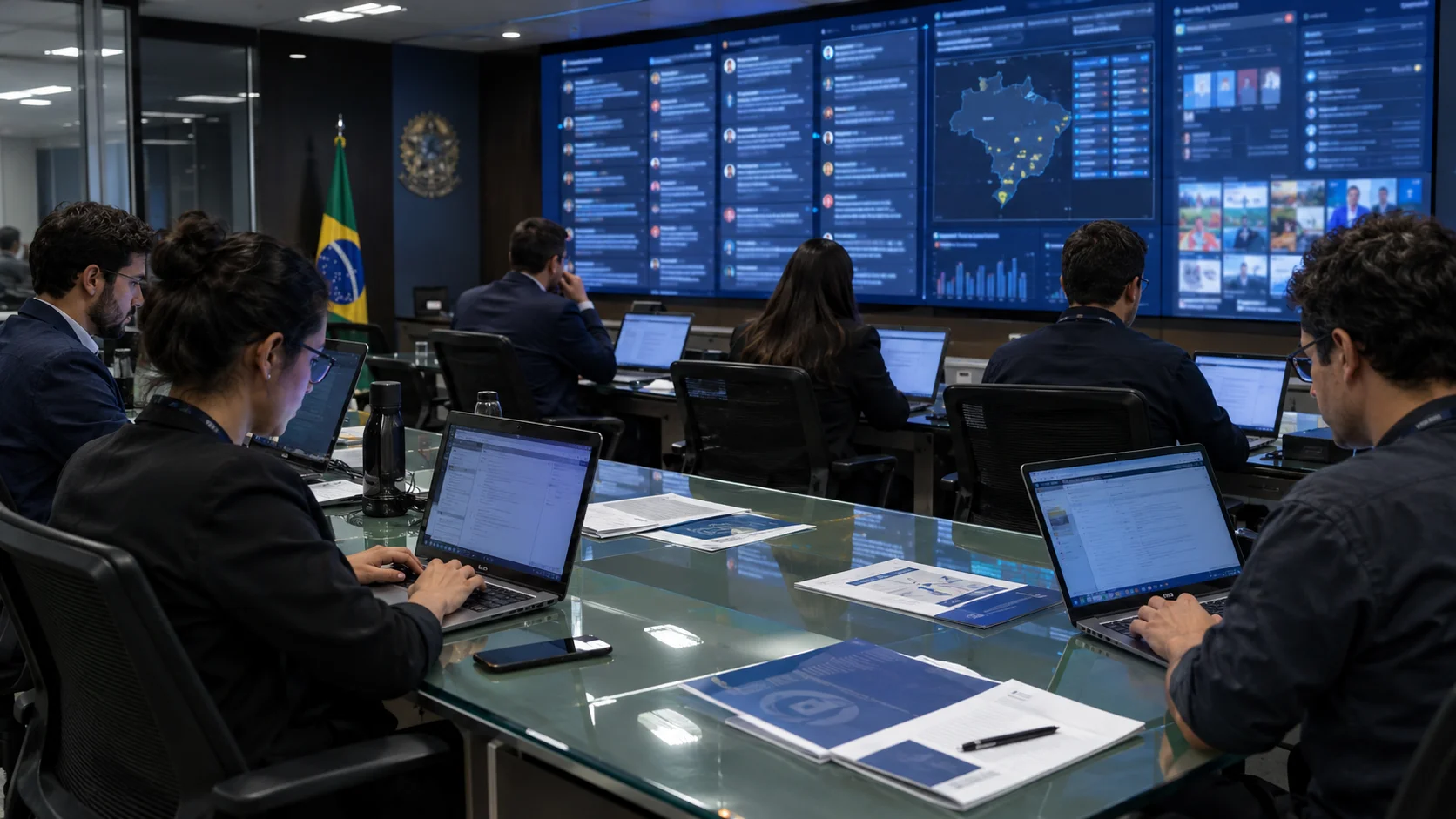
On 23 October, TSE president Kassio Nunes Marques met representatives from Meta, X, Google, TikTok, and Kwai on deepfakes, coordinated attacks, and faster takedown paths. The court opened a Digital Risk Attention Room at its Brasília headquarters from 24 October through 4 November, with platform staff on site so flagged posts move through a priority channel instead of a phone tree—an operational upgrade from prior cycles.
That is the same governance pressure Culled has tracked when platforms outrun election-year statutes in the United States and when Britain widens platform liability. Brazil’s version is faster: live orders on recommendation engines, synthetic media, and ad reach timed to the hours before polls open.
A Monday checklist
Result timing. Watch TSE’s official tally and any early calls from campaigns; B3 will not intermediate Sunday uncertainty.
First prints. Compare Monday’s opening Ibovespa, USD/BRL, and front DI contracts to Friday’s close—not to post-first-round highs. Valor noted the index still sat 2.37% below its record and the real only 1.26% off recent lows before the vote.
Circuit breakers. A Lula scenario in manager surveys clusters around double-digit equity drops; know whether halts buy time or trap liquidity.
Platform compliance. Track whether Meta and X meet the 24-hour technical filings, what the digital-risk room flags on Saturday–Sunday, and whether post-election orders on AI labels and reach caps become template for the next Latin American vote.
Until Monday’s bell, Brazil is two linked binaries: who wins, and whether the court can make distribution rules bite as fast as capital reprices. The first is priced in options; the second is still writing precedent.
Continue reading


Sources
Valor International on pre-runoff hedging and Monte Bravo circuit-breaker estimates; Folha on Citi survey of 73 managers (23 Oct); CNN Brasil on TSE platform meeting and digital-risk room; TSE and G1 on 24-hour Meta/X order from corregedor Ricardo Villas Bôas Cueva; Datafolha tie cited in Folha.


