

AMD booked $11.5 billion in second-quarter sales and still lost roughly 7 percent the next session. Data-center revenue doubled to $6.7 billion while inventory climbed to $8.5 billion. Nvidia reports tonight against a $91 billion guide. The residual is whether those orders are consumption or buffer stock.
AMD cleared the Street in early August and still gave back the prior day’s rally. Revenue hit a record $11.5 billion. Data-center sales more than doubled, to $6.7 billion — 58 percent of the company. Inventory rose to about $8.5 billion. Adjusted gross margin is guided near 56 percent even as the September quarter is aimed at roughly $13 billion. Nvidia reports after the close against a $91.0 billion guide, plus or minus 2 percent, with China data-center compute already set to zero.
The dominant copy still collapses that into one story: AI hardware remains scarce, the buildout is broadening, and capital may be rotating toward software. Nvidia’s last historic beat already taught the tape to shrug. What the copy does not do is put Nvidia and AMD on the same ledger — customer mix, inventory, and what revenue has actually been recognized.
The books already disagree
Nvidia’s first fiscal-2027 quarter was $81.6 billion of revenue and $75.2 billion of data center. Hyperscale customers were about half of that line; the rest was AI clouds, industrial, enterprise, and sovereign buyers. Gross margin was guided near 75 percent. Inventory was $25.8 billion, up from $21.4 billion, with $119 billion of supply-related commitments. Colette Kress said the company had “strategically secured inventory and capacity to meet demand beyond the next several quarters.”
AMD’s data-center print is an order of magnitude smaller, and it does not split Instinct accelerators from EPYC CPUs. Named Helios commitments — including up to two gigawatts of MI450 systems for Anthropic, first gigawatt in the first half of 2027 — are mostly future capacity. Lisa Su put Q3 as the start of the Helios ramp and 2027 as the steep part. That is a different duration of demand than Nvidia’s already-recognized Blackwell 300 shipments.
Purchase orders measure scarcity. Powered racks and recognized revenue measure demand.
If the reported hardware squeeze is end-market consumption, inventories at vendors and server builders should not have to swell as a first-order feature of the cycle. They have.
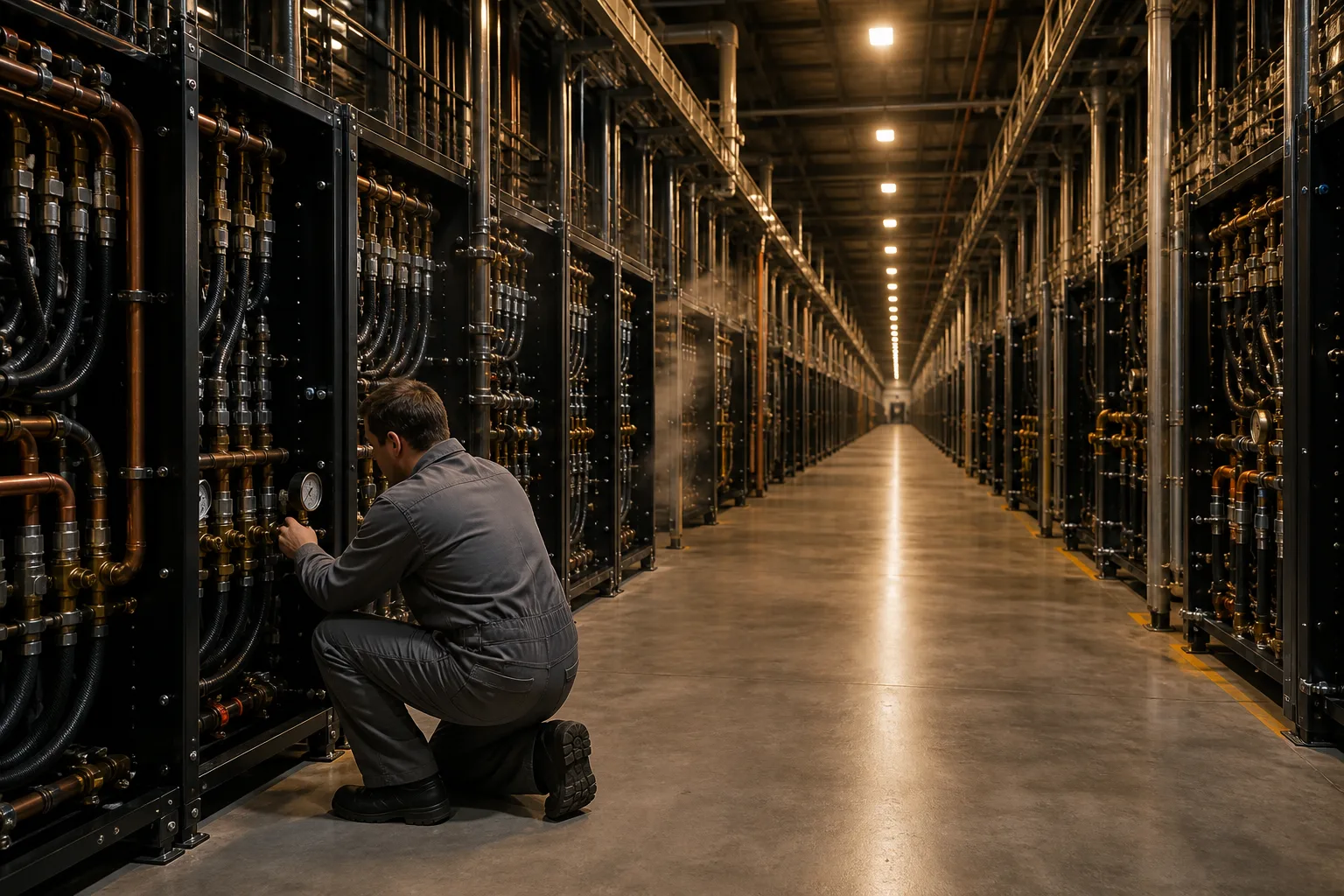
Where the chips actually sit
Super Micro closed its June quarter with $12.9 billion of inventory — up from $4.7 billion a year earlier. Days of inventory rose to 119, built “in anticipation of higher revenues” in fiscal 2027. Inventories absorbed about $8.9 billion of cash in fiscal 2026. The company also cites a backlog above $60 billion. That is the precautionary chain in public view: scarce GPUs get secured before the hall is powered.
None of this proves the purchasing surge is fake. It proves purchasing is not the same object as consumption. Whether apps ever pay for the halls is a later test. The near-term test is earlier: do installed accelerators, utilization, and vendor revenue rise together while inventories stabilize — or do crates accumulate at ODMs while guidance still cites “demand”?
Component bottlenecks confuse the same ledger. High-bandwidth memory and packaging can look like a demand squeeze when they are a supply queue. Nvidia’s $119 billion of commitments is, in part, a bid for that queue. Custom silicon at Broadcom is the other bid: hyperscalers designing around the GPU cartel rather than waiting in it. Cheaper tokens out of China can rewrite the envelope without moving a Western crate.
What the tape still prices as one sleeve
Investors can rotate into software names and still use Nvidia’s guide as the size of the AI spending envelope. That is a portfolio move, not a demand audit. The capex curves already rhyme with an older boom; the cash-flow test does not. AMD’s fade after a doubled data-center print asked for conversion this year, not another 2027 gigawatt slide. A clean $91 billion Nvidia print will be read as proof that aggregate spend is intact. It will not say whether Super Micro’s 119 days of inventory are a bridge to shipments or a warehouse of options.
The claim to test is narrow. If deployments, accelerator utilization, and recognized vendor revenue rise in line with the purchasing surge while inventories at Nvidia, AMD, and the server builders stop climbing, the stockpile thesis dies. If purchase records are tied to non-cancelable end-customer orders rather than supply protection, it dies twice. Until those series move together, Nvidia and AMD are not two tickers on the same squeeze. They are two qualities of demand, and only one of them has already been booked as cash.
Continue reading


Sources
AMD Q2 2026 earnings release and call (revenue $11.5B, data center $6.7B, inventory ~$8.5B, Q3 guide ~$13B, non-GAAP gross margin ~56%); Nvidia Q1 FY2027 results and Q2 guide ($81.6B revenue, $75.2B data center, inventory $25.8B, $119B supply commitments, $91.0B ±2% outlook with no China compute); Super Micro Q4 FY2026 results (inventory $12.9B, 119 days, FY26 inventory cash use ~$8.9B); contemporaneous share-price coverage of AMD's post-print session.


