

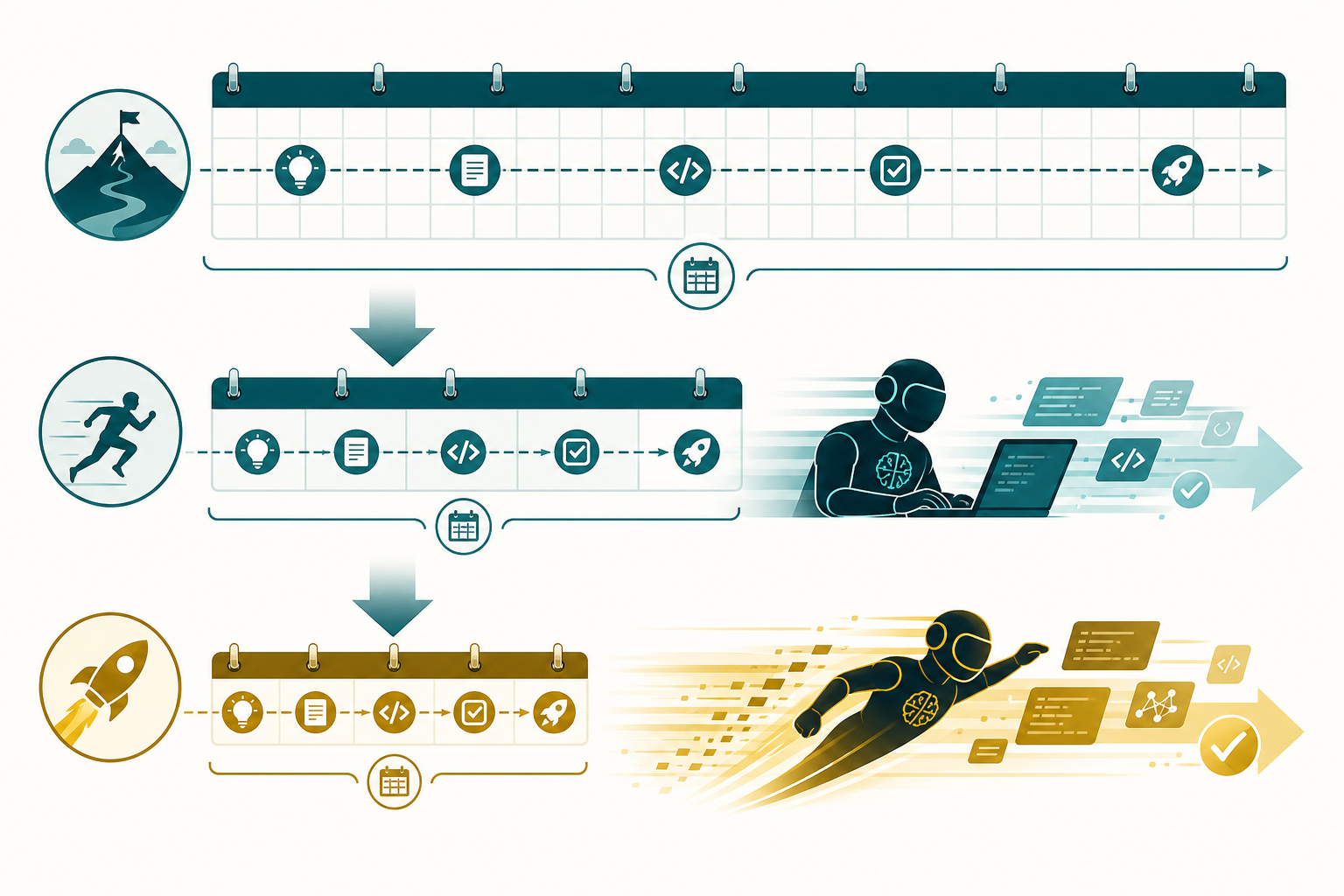
Viral coding agents have turned software delivery from months into weeks and weeks into days. Major firms now sell AI solutions teams that help every other company board the same express — and the logical endpoint is software that no longer arrives as SaaS, but as an in-house capability that no longer needs the SaaS industry's engineers.
The SaaS-pocalypse never really left. It only changed costume. The first wave, early in 2026, was a market narrative: agentic platforms might bypass the per-seat licensing model that underwrote Salesforce, Intuit, and a generation of vertical software. Equity markets priced the fear, partially recovered, and moved on. The second wave is quieter and more lethal. It is not about whether a chatbot can replace a CRM seat. It is about whether the entire industrial organization of software — the SaaS company, its engineering corps, its QA ladder, its solution architects — still has a reason to exist when coding agents compress delivery timelines from months to weeks and weeks to days.
Tools in the Cursor class made the compression legible. A senior engineer with an agentic coding environment does not merely type faster. The agent scaffolds modules, writes tests, refactors across files, and closes the loop on tasks that used to require handoffs between specialists. Precision rises with speed: the same system that drafts the feature also proposes the regression suite. What once justified a twelve-person squad and a quarterly release calendar now fits a two-person pod and a weekend. That is not incremental productivity. It is a change in the unit economics of software production.

The AI Solutions Layer Sells the Recoil
The second half of the story is institutional. Major technology and consulting firms are no longer content to use coding agents internally. They are standing up AI solutions teams whose product is the express itself: help every other company adopt agentic workflows, migrate legacy systems, and build custom software without renting a SaaS stack. The pitch is seductive. Why pay a recurring license for a product designed for a thousand customers when an internal team, armed with agents, can ship a system designed for one?
That pitch is the SaaS recoil. Software production, which spent two decades migrating out of the enterprise into multi-tenant clouds, begins migrating back. Not because cloud infrastructure fails — the opposite — but because the scarce input was never servers. It was engineering labor. When labor becomes abundant through agents, the economic case for buying someone else’s product weakens. The enterprise keeps the data, keeps the workflow, and keeps the margin that used to fund a SaaS vendor’s sales force and support org.
Who Dies First: The SaaS Payroll
If the recoil holds, the first casualties are not abstract “software stocks.” They are the people who staffed the subscription model. Product engineers, platform engineers, solution architects, and QA testers at SaaS companies exist to maintain a shared product across customers. When customers stop needing the shared product, those roles do not migrate gracefully into enterprise IT. Enterprises that build in-house need fewer people, not more — that is the point of the agents. The SaaS industry’s headcount was a tax on the old scarcity of software labor. Remove the scarcity and the tax evaporates.
Markets already priced a version of this in the Russell 2000’s software cohort, which underperformed semiconductor equipment even as AI capex soared. Infrastructure suppliers sell the picks and shovels of the agent era. Niche SaaS vendors sell the seats the agents make optional. Capital is not confused about which side of that trade it prefers.
STEM as the First Knowledge Clearance
Software is the canary, not the exception. Computer scientists, programmers, architects, and testers are the first knowledge workers whose output maps cleanly onto token streams and tool-using agents. The work is digital, measurable, and already mediated by text. That makes it uniquely exposed. Other STEM and knowledge roles — analysts, designers, technical writers, even portions of legal and finance — sit further down the same conveyor. Once the alternative comes online at sufficient reliability, the payroll logic is identical: why maintain a human queue for work an agent completes overnight?
The destruction is brutal precisely because it is not a recession story. Recessions cut demand. This cuts the need for supply. A company that still needs software does not necessarily need software workers. The demand for digital capability rises while the demand for digital labor falls. That is the inversion markets and universities are poorly equipped to price.

Three Endgames for the Stack
Bull for agents, bear for SaaS: Coding agents keep compounding. Enterprises internalize custom software. SaaS vendors consolidate into a handful of platforms that own data gravity or regulatory moats. Engineering headcount across the industry contracts by an order of magnitude over a decade. STEM enrollment becomes a stranded asset.
Base case: Hybrid equilibrium. Commodity workflows go in-house or agent-native. Complex, regulated, or multi-party systems remain SaaS. Headcount falls sharply in the middle of the stack — junior engineers, testers, implementation consultants — while a thin layer of agent supervisors and system designers remains scarce.
Bear for the recoil thesis: Agents plateau on reliability, security, and liability. Enterprises discover that “build it yourself” recreates the same support burden SaaS was invented to absorb. The subscription model survives, thinner and more automated, but not extinct.
Final Compression
The SaaS recoil is the second act of the SaaS-pocalypse: not a valuation scare, but a production regime change. Coding agents collapse delivery time. AI solutions teams sell that collapse to every enterprise that wants software without a SaaS bill. Software comes home. The people who used to build, test, and architect the subscription industry do not.
The actionable principle: treat software labor as the first knowledge market to clear, not the last. If you are pricing SaaS, price the recoil. If you are pricing STEM careers, price the alternative.
Continue reading


Sources
Market coverage of 2026 SaaSpocalypse software selloffs; industry reporting on AI coding agents and enterprise AI solutions practices; Russell 2000 software underperformance vs semiconductor equipment; prior Culled analysis of agentic layoffs and small-cap software casualties


