

On Saturday, Brig. Gen. Mohammad Akraminia told IRNA that Iran's army doctrine had moved from defensive to offensive during the 12-day and 40-day wars, promising immediate replies broader than the attack. Five days after the U.S.-Iran MoU window lapsed and Brent held above $90, that is a speed claim, not a control claim.
The dominant copy writes itself. Iran, after two wars it calls twelve days and forty days, has dropped a defensive posture for an offensive one. Retaliation will be faster and broader than the insult. Preemption is not required, Akraminia said, but Tehran has already practiced it — a strike on a U.S. base in Jordan before Washington entered the fight. Ballistic missiles and the Axis of Resistance are assumed to be the tools. Escalation risk is assumed to rise.
That is what the wire already explained. The residual is the part command-and-control briefings never print. If the doctrine runs through proxy militias and missile forces, how does Iran coordinate those decentralized pieces well enough to run an offensive — rather than merely announce one?
The merger speeds Tehran. It does not wire Sanaa.
The only new hardware in Saturday’s remarks is bureaucratic. Akraminia said the Khatam al-Anbiya Central Headquarters has been merged into the Armed Forces General Staff to make the services more agile and to unify command. That tracks an order issued about ten days earlier, when Mojtaba Khamenei appointed Maj. Gen. Ali Abdollahi chief of staff and told him to finish integrating the two bodies on a plan left by Ali Khamenei. Khatam was the wartime joint operations command; the General Staff set policy and readiness. They were split in 2016. Putting them back together shortens the pause between a strike on Iran and a decision inside Iran.
It does not publish an org chart over the Quds Force’s geographic corps, or over Hezbollah, the Houthis, Iraqi factions, or Hamas. Those relationships have always been equipment, money, training, and strategic guidance — Alma’s work on Quds Corps 8000 describes knowledge transfer and missile/UAV build-out, not a fire-direction net from a Tehran bunker. Unit 190 moves crates. Local commanders choose when the crate becomes a salvo. An “immediate, broader than the attack” rule, pushed to forces that already enjoy local initiative, is an escalation protocol that relaxes the brake, not a calibrated joystick.
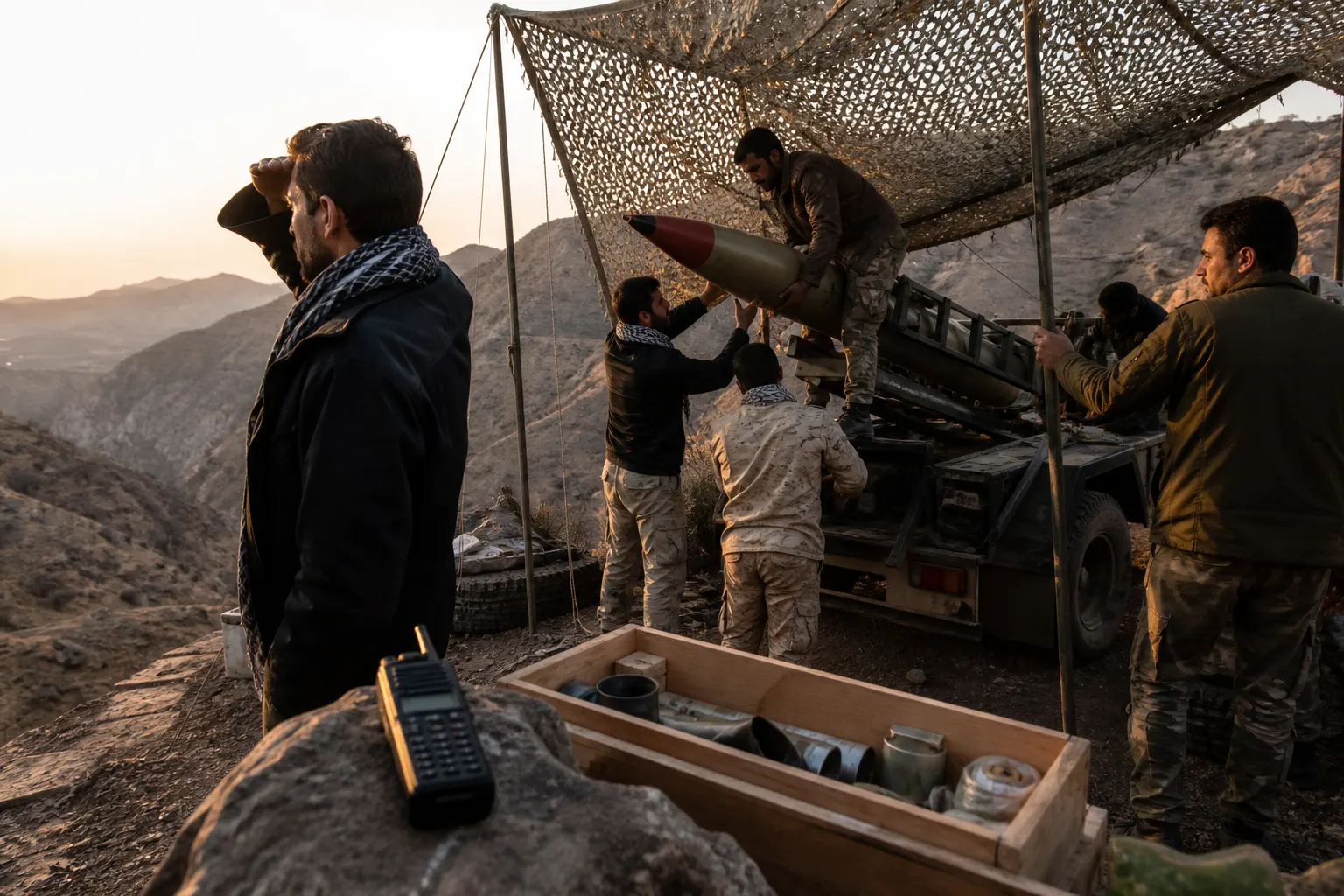
The wars that supposedly taught the new doctrine also chewed the instruments. In early March, the Institute for the Study of War recorded U.S. and Israeli hits on IRGC command nodes, including Quds headquarters, and an Israeli estimate that roughly 300 ballistic launchers had been destroyed; U.S. officers said Iranian ballistic fire had fallen about 86 percent from the opening day. Iran substituted drones. That is not a picture of unused, tightly held mass waiting for a unified offensive. It is a picture of degraded C2 and a force already practiced at firing what it has left, as fast as it can.
Akraminia’s other Saturday flourish — 5 billion tomans, about $26,000, for killing or capturing U.S. troops in a ground incursion, doubled if a woman does it — is recruitment theater for a scenario the army wants to deter. It is not a command system.
What still gets mis-priced
Markets already learned, the hard way, that a memorandum is not a strait. Culled’s MOU-priced-peace warning and the earlier peace-rally tape both treated Hormuz as the test. The 60-day window lapsed on August 17 with no successor; Kpler’s ledger and the subsequent Brent print above $90 said the market had stopped waiting. Swiss talks did not reopen the waterway. Insurance and cloud already showed how a kinetic hour hits contracts that assumed a pause.
The mis-price now is treating Saturday as “Iran goes on offense” in the sense of a general staff that can start and stop every rocket. Underwriters and oil options still need the fatter tail: a shorter domestic decision cycle plus proxies that remain delegated. The first fire after the next insult may be a Houthi anti-ship shot or a militia drone Tehran then narrates. That is offensive doctrine as permission structure, not as orchestra.
The testable claim is narrow. If the next Iranian or Axis salvo after a U.S. or Israeli strike arrives inside hours and matches Tehran’s stated grievance in target and scale — not a wider freelance — the merger-plus-doctrine is a real C2 upgrade. If the first round is a local theater that Tehran interprets after the fact, the joystick was never installed. Price the pause, not the press conference.
Continue reading


Sources
IRNA via Anadolu/Middle East Monitor and Iran International (Aug 22); Mojtaba Khamenei Aug 10–11 General Staff/Khatam merger and Ali Abdollahi appointment; ISW/Critical Threats March 2026 on IRGC C2 and launcher attrition; Alma Research on Quds Force geographic corps and Corps 8000; Kpler and Reuters on MoU expiry and Brent above $90


