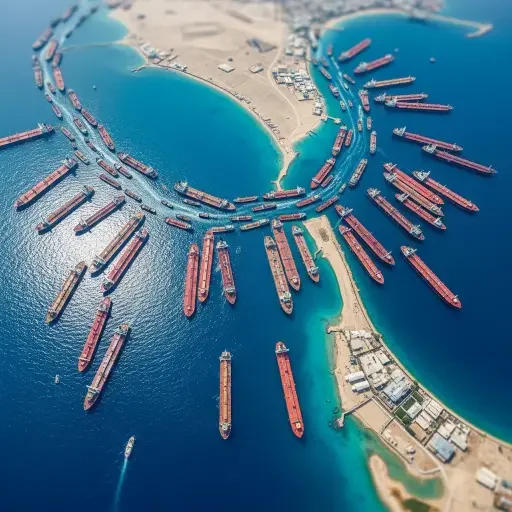
There is a dark irony embedded in the 2026 Hormuz crisis that climate modelers are only beginning to formalize. The disruption of roughly 20 million barrels of oil per day—the largest supply shock in the International Energy Agency’s fifty-year history—has accomplished, in weeks, what fifteen consecutive Conference of the Parties agreements could not: it has made decarbonization feel economically rational to governments that previously treated it as a sacrifice.

That is not an argument for war. The human costs in the Gulf region are staggering, and the cascading damage to food systems, fertilizer supply chains, and emerging-market balance sheets is likely to compound for years. But the climate signal embedded inside the catastrophe is real, and dismissing it because it arrived in an ugly container would be its own kind of analytical failure. The world is being forced to participate in an energy transition it was deferring. The question is whether that participation sticks.
The Chokepoint That Priced in Decades of Procrastination
The Strait of Hormuz is a 21-mile passage between Iran and Oman. Through those miles moved, until February 28, 2026, approximately 20% of all global seaborne oil trade—roughly 20 million barrels per day—alongside about one-fifth of global liquefied natural gas exports and a third of the world’s fertilizer trade. When Iran effectively closed the strait following US and Israeli military strikes, it did not merely disrupt a shipping lane. It repriced, overnight, the hidden cost of fossil fuel dependency that carbon taxes and emissions-trading schemes had spent years attempting to surface.
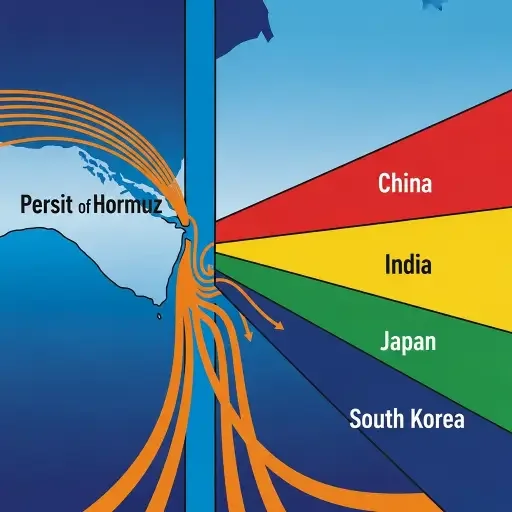
Brent crude crossed $100 per barrel by March 8. It peaked at $126. Analysts at Macquarie Group warned the figure could reach $200 if the closure persisted into summer. In Asia—which receives 84% of the oil and 83% of the LNG that transits Hormuz—the shock was existential in its immediacy. Japan sources roughly 90% of its crude imports from the Middle East; South Korea routes more than 95% of its Middle Eastern crude through the strait. LNG prices in Asia surged. South Korea activated a 100 trillion won market-stabilization program. These are not numbers from a climate scenario model. They are fiscal and macroeconomic facts now fully embedded in national accounts.
Forced Participation as Climate Mechanism
Climate policy literature has long recognized that sustained high fossil fuel prices are among the most effective drivers of clean energy adoption. The mechanism is straightforward: when oil is expensive and geopolitically unreliable, the comparative economics of solar, wind, and electrified transport improve without subsidy. What the Hormuz crisis has done is administer that price signal at an intensity that no carbon levy in democratic politics has ever approached.
The behavioral evidence is already accumulating. In Vietnam, Vingroup moved to cancel the country’s largest planned gas-fired power plant and redirect investment toward renewables, citing prohibitive LNG costs. The Philippines fast-tracked renewable permitting. South Korea’s president stated publicly that his country “needs to transition to renewable energy quickly” to avoid future crises. BYD showrooms across Southeast Asia reported their highest-ever traffic volumes as consumers repriced vehicle ownership in real time. In Pakistan, electric rickshaws sold out. In India, interest in electric stoves surged. In the United Kingdom, homeowners began switching to heat pumps at rates that previously required years of subsidy incentivization.
These are demand-side responses to a price signal—exactly the mechanism that climate economists model. DNV’s energy transition research group published a note confirming their forecasting models show that heightened energy security concerns accelerate the global transition, because the net policy effect favors renewables, batteries, nuclear, and efficiency over fossil infrastructure.
IEA Executive Director Fatih Birol framed the dynamic precisely at the National Press Club in Australia: “I expect one of the responses to this crisis will be an acceleration of renewables. Not only because they are helping to reduce the emissions but also they are a homegrown domestic energy source.” Birol noted that renewables accounted for 85% of all new global power capacity installed in the prior year, with solar as the primary driver. “Ten years ago, solar was a romantic story,” he said. “Now solar is a business.”
The 2022 Template, Applied at Larger Scale
The 2026 shock has a direct predecessor: Russia’s 2022 invasion of Ukraine, which severed European natural gas supply lines and compelled the EU to do in two years what its own climate roadmaps projected would take a decade. Between 2022 and 2025, Europe added approximately 250 gigawatts of renewable capacity, raising the share of renewables in electricity generation from 37% to 44%. EU gas demand fell 18% by 2024. Russian imports dropped from 150 billion cubic meters in 2021 to roughly 40 billion by 2025. The Bruegel Institute documented this acceleration with unusual directness: the 2022 crisis had done more to accelerate Europe’s green transition than a decade of climate negotiations.
The Hormuz shock is the same template applied at global scale and with higher intensity. Europe’s primary exposure was gas—a fuel with some substitution flexibility. Asia’s primary exposure is oil and LNG, with far fewer short-run alternatives and far larger import dependencies. The economic pain is therefore sharper and the incentive to eliminate it structurally is proportionally greater. As Sam Butler-Sloss of Ember put it: “This is Asia’s Ukraine moment. In the same way Ukraine compelled Europe to cut gas dependency, Hormuz will push Asia to cut oil dependency—but with even cheaper technology available.”
That technology point is not rhetorical. In 2022, solar and battery storage were competitive in many but not most markets. By 2026, they are the lowest-cost new power source in virtually every major economy. The 2022 crisis accelerated deployment into a favorable but not yet dominant cost environment. The 2026 crisis accelerates deployment into an environment where clean energy is the cheapest available option, full stop.
Stress-Testing the Thesis: Where It Holds and Where It Doesn’t
The argument that Hormuz disruption produces net climate benefit is a medium-to-long-run claim. It requires holding it against three legitimate counterweights.
The first is coal rebound. When gas prices spike, coal often returns as a substitute, particularly in Asia. This happened in Europe in 2022 before renewables buildout overtook it. In the near term, coal’s carbon intensity means that any demand substitution from oil and LNG to coal temporarily increases emissions even as it does nothing to address energy security. The honest accounting must include this lag.
The second is the clean energy supply chain disruption. Higher fuel, feedstock, insurance, and freight costs are raising production costs for solar panels, batteries, and wind components—the very infrastructure of the transition. Airspace closures and rerouted shipping increase logistics costs between Europe, the Gulf, and Asia. Short-term, the crisis mildly taxes its own solution.
The third is the political economy of government response. Greenpeace’s analysis of 37 government responses introduced since February 28 found that many risk deepening fossil fuel dependency rather than reducing it—fuel subsidies, emergency supply deals, accelerated drilling. A price signal only redirects investment if governments resist the political temptation to absorb it rather than transmit it to consumers and industries.
Against these counterweights, however, the structural case for accelerated transition holds for one reason that didn’t exist in prior oil shocks: the alternative is now cheaper than the status quo. IRENA Director-General Francesco La Camera stated it clearly: “Countries that invested in the energy transition are weathering this crisis with less economic damage, as they boost energy security, resilience, and competitiveness.” Spain, with its heavy investment in wind and solar, is registering the lowest gas prices in the EU despite the crisis. The countries with the most exposure are precisely the ones that deferred the transition.
The Forced Participation Frame
Climate policymakers have spent years searching for a mechanism that could make decarbonization feel compulsory rather than optional. Carbon pricing does it slowly, at politically tolerable intensities. Renewable portfolio standards do it sectorally. International agreements do it aspirationally, with enforcement gaps wide enough to accommodate decades of delay. None of these has produced the behavioral response visible in BYD’s Southeast Asian showrooms in March 2026.
The Hormuz shock has no policy author and no diplomatic mandate. It arrived through military strikes, geopolitical miscalculation, and the structural fragility of a global energy system built on the assumption that narrow straits would remain open. But its functional effect—pricing fossil fuel dependency at its real cost—is precisely what the Paris Agreement’s architects were trying to engineer through negotiation. The UN UNFCCC’s Simon Stiell captured the geometry of it at the 2026 Green Growth Summit: “Sunlight doesn’t depend on narrow and vulnerable shipping straits. Wind blows without massive taxpayer-funded naval escorts. Renewable energy allows countries to insulate themselves from global turmoil.”
That framing matters because it changes the political valence of clean energy investment. Across the Asia-Pacific, in Indonesia, in South Korea, in Vietnam, energy ministers are now framing renewables not as a climate obligation but as a geopolitical asset—an escape from the structural vulnerability exposed by Hormuz. “Renewables and their associated technologies are now commonly perceived as an energy security tool,” Gonzalo Escribano of the Elcano Royal Institute wrote, “no longer only a way to combat pollution and climate change, but a geopolitical asset supported by pragmatism rather than idealism.”
Pragmatism, it turns out, may be the fastest route to the energy transition that idealism never was.
The Long Shadow of This Moment
Whether the 2026 shock produces durable acceleration depends on the decisions governments make in its immediate aftermath. The same pattern has repeated across prior oil shocks: prices spike, adoption accelerates, prices fall, the urgency dissipates. Japan made this error after 1973. The world made it again after 2008. The difference this time is structural: renewables are cheaper, deployment infrastructure is more mature, and the geopolitical argument for energy sovereignty has never been more viscerally demonstrated.
The Rockefeller Foundation’s framing of the 2026 moment is the most precise available: this is the first energy shock where clean energy is not a moral or long-term bet, but the cheapest and fastest way for low- and middle-income countries to protect macroeconomic stability, food security, and fiscal space. The countries that treat the Hormuz disruption as a temporary crisis to be absorbed will pay the same price again when the next chokepoint is tested. The countries that treat it as a structural diagnosis—and build accordingly—will have purchased the only form of energy security that doesn’t require naval escorts.
It is the observable output of the climate systems and energy economics literature, made suddenly legible by 21 miles of contested water. The transition was coming. The strait just made it mandatory.
Tags
Related Articles
Sources
Research draws from IEA emergency reports, EIA Short-Term Energy Outlook (March 2026), IRENA statements, Zero Carbon Analytics, Bruegel Institute, the UN UNFCCC, CNBC energy analysis, Rockefeller Foundation perspectives, and Wikipedia documentation of the 2026 Hormuz crisis and its economic impact.