

Alphabet raised 2026 capital spending toward $205 billion to feed AI data centers. That money buys servers, power, and networking — yet every advanced accelerator still depends on ASML's extreme ultraviolet tools at the foundries printing Google's TPUs and Nvidia's GPUs. Capex scales ambition; EUV rationing scales throughput.
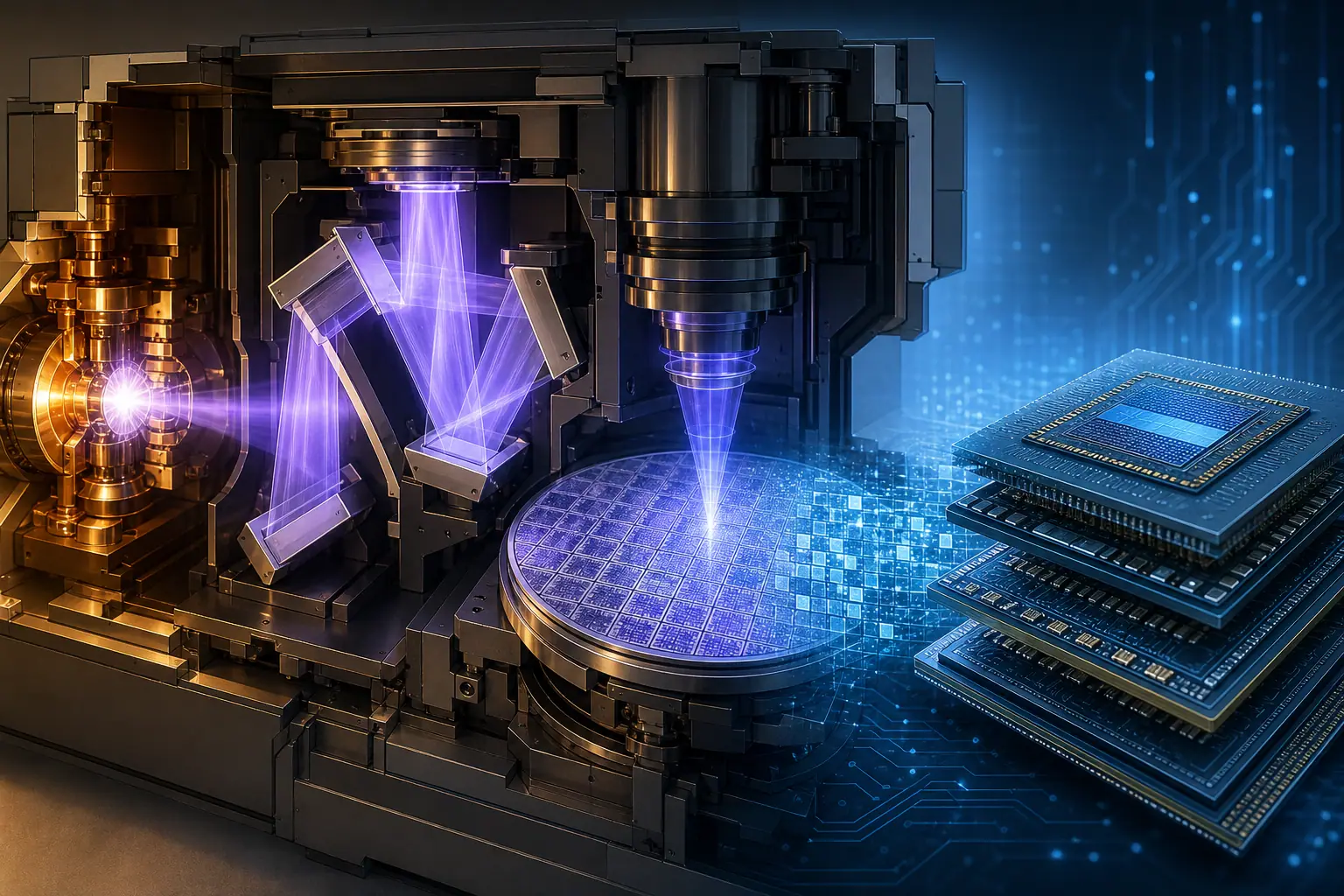
Markets read Alphabet’s summer guidance as a spending story. The company lifted 2026 capital expenditure to $195–205 billion, logged $44.9 billion of capex in a single quarter, and watched free cash flow flip negative while Google Cloud revenue jumped 82%. The surface narrative is familiar: hyperscalers buy the future in concrete and silicon. The substrate narrative is colder. Those servers — Google’s own TPUs and the Nvidia GPUs still filling racks beside them — only exist because ASML’s extreme ultraviolet lithography tools can print the features that make advanced logic economical.
Capex is a purchase order. Lithography is a physics franchise.
Budgets Scale Ambition; EUV Scales Throughput
Google can raise debt, lease third-party campuses, and accelerate server spend — roughly 60% of its technical-infrastructure dollars in the latest quarter went to servers, the rest to data centers and networking. None of that multiplies the installed base of EUV scanners at TSMC, Samsung, or Intel. ASML remains the sole commercial supplier of the machines that pattern the densest transistor layers; a High-NA tool now ships in the neighborhood of $400 million. When CEO Christophe Fouquet described demand as “extremely strong” and lifted 2026 revenue guidance toward €43–45 billion while pledging roughly 30% annual capacity growth, he was describing the same AI cycle Alphabet is funding — from the other end of the supply chain.
That is why Nvidia’s best quarter still drew a shrug: record GPU revenue does not prove the foundry stack can clear at the same rate. Packaging remains a parallel tollbooth, as Culled tracked when the cloud race hit CoWoS limits. Lithography is the prior gate. Without EUV wafers, there is nothing to package into an accelerator that can fill a Google rack.
The arithmetic is unforgiving. Combined 2026 hyperscaler capex across Amazon, Microsoft, Alphabet, and Meta is tracking toward roughly $725 billion. ASML’s entire annual revenue target sits an order of magnitude below a single hyperscaler’s infrastructure budget. Money is abundant; patterning tools are not.
Google’s Custom Silicon Still Ends in Veldhoven
Google’s answer to GPU scarcity has been architectural: design TPUs, lean on Broadcom and other partners to translate those designs into silicon, and own more of the stack from model to metal. That strategy is real — it is the same force behind the custom silicon wars — and it does not dissolve ASML’s position. Custom dies still need EUV layers. Diversifying designers multiplies tape-outs; it does not multiply scanners.
The geopolitical mirror sharpens the point. China’s push toward AI efficiency and indigenous tooling is an attempt to route around the same monopoly, as Culled mapped in both the efficiency challenge and Beijing’s AI-first industrial planning. Google sits on the opposite side of that wall: abundant capital, privileged access to leading-edge foundry capacity, and still no alternative to ASML for the most advanced nodes. Export controls can deny tools to rivals; they cannot mint a second EUV champion for allies.
The Monopoly Capex Cannot Duplicate
Investors keep asking whether AI applications can justify the buildout. That is the right demand-side question. The supply-side question is narrower: even if Cloud backlog — Alphabet’s now north of $500 billion — converts cleanly, the industry still serializes through a handful of EUV lines whose expansion is booked years ahead. The dot-com echo warned against confusing fiber overbuild with durable scarcity. EUV capacity is the scarce strand this cycle cannot darken and restart cheaply; each tool is a multi-year industrial project, not a commodity server you can overnight from a contract manufacturer.
Platform force binds the outcome. Alphabet can outspend peers on data centers and still wait on Veldhoven’s delivery calendar. Capital adapts to guidance calls. Lithography adapts to mirrors, lasers, and yield. Until High-NA throughput and standard EUV capacity expand faster than hyperscaler ambition, Google’s capex wave funds the queue — it does not erase it.
Watch three dials. ASML’s booked EUV capacity versus Alphabet’s implied second-half capex ramp. TPU and GPU lead times as the tell for whether lithography-plus-packaging is clearing. And High-NA adoption curves: the next node of density is also the next node of concentration. Google is buying compute at industrial scale. ASML still decides how fine that compute can be printed.
Continue reading


Sources
Alphabet Q2 2026 earnings and capex guidance coverage; ASML Q2 2026 results and capacity-expansion comments via Reuters; MIT Technology Review on High-NA EUV economics; Culled prior coverage of Broadcom custom silicon, Nvidia earnings paradox, CoWoS packaging, and AI utility gap


