

U.S. Pharmacopeia found that 33 of 75 drugs in shortage depend on a key starting material made only in one country. Antheia’s federally backed fermentation expansion points to a different resilience model: build domestic capacity that can make selected complex ingredients, rather than merely relocating conventional chemical plants.
The U.S. pharmaceutical supply chain does not fail only at the pill press. It can fail far upstream, where a key starting material—a KSM—comes from one country, one cluster or one small set of plants. U.S. Pharmacopeia’s 2026 shortage report puts a number on that hidden exposure: 33 of the 75 drugs then in shortage relied on at least one KSM manufactured exclusively in a single country. Six depended entirely on KSMs from one country.
That is the opening for synthetic biomanufacturing. The idea is not to turn every drug factory into a brewery. It is to use engineered microorganisms and fermentation to make selected complex precursors or active pharmaceutical ingredients (APIs) domestically, creating a qualified fallback when the conventional route is concentrated abroad.
The shortage statistic identifies a starting-material problem
USP’s count is more precise than the usual slogan about dependence on China and India. Of the six fully single-country KSM cases, four were injectables tied solely to China and two were oral solids tied to India. The report also found that active shortages were lasting more than five years on average. A shortage can have several causes—quality failure, low margins, capacity loss or demand shocks—but geographic concentration makes every other problem harder to absorb.
The operative unit is not “pharma manufacturing” in the abstract. It is the molecular node for which no qualified substitute is ready. Supply-chain power has the same logic in semiconductors: resilience is determined at the bottleneck, not by a country’s total industrial footprint.
A domestic backstop is valuable only if it can make the specific ingredient that is missing, at the quality and scale a regulated buyer can use.
Fermentation changes the route, not the regulatory burden
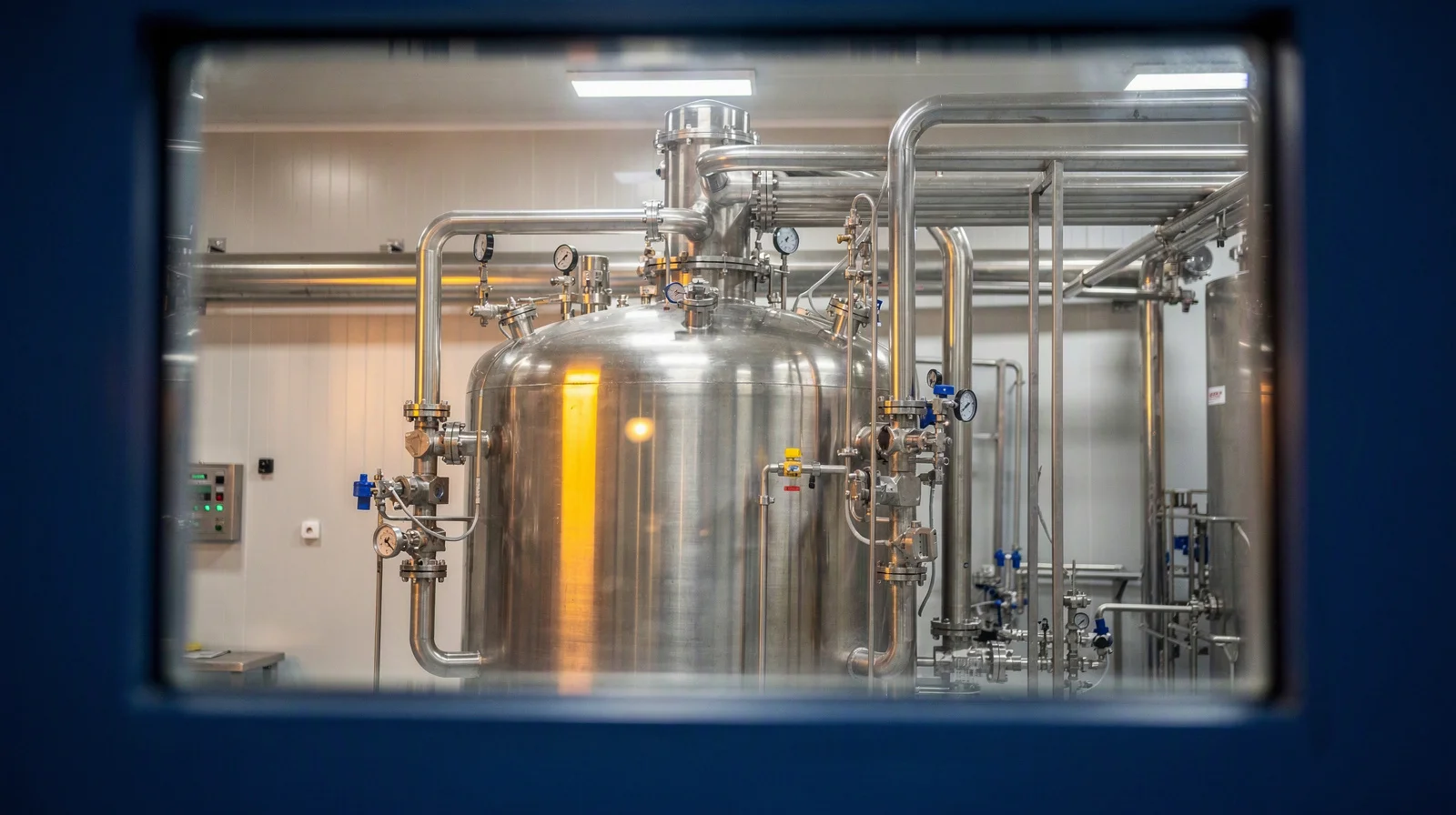
In a fermentation process, engineered yeast or another microbial host converts feedstocks such as sugars into a target molecule. That can be especially attractive for structurally complex natural-product-like ingredients whose conventional production depends on agriculture, many chemical steps or a specialized foreign supplier. The Senate testimony’s “brew beer” comparison is useful only to describe the production logic: program an organism, grow it, recover and purify the output.
It should not be mistaken for a shortcut. A pharmaceutical ingredient still needs a reproducible process, analytical validation, quality controls, a suitable manufacturing facility and regulatory acceptance in the finished drug’s supply chain. A commercial fermentation tank is not interchangeable with a regulated API supply contract. Yield, downstream purification, batch consistency, raw-material access and a buyer’s qualification timetable all decide whether a technically elegant route becomes resilient capacity.
Antheia makes the policy shift concrete
The federal government is now paying for more than diagnosis. In March, HHS’s Administration for Strategic Preparedness and Response awarded Antheia an additional $9 million through the BioMaP-Consortium, building on a 2024 award. The stated aim is domestic production of thebaine, a KSM used in medicines for pain management, alcohol-use disorder and opioid-overdose reversal. The expanded project totals $21 million and supports two critical ingredients at increased commercial scale.
That is evidence of a targeted strategic program, not of a generalized API reshoring boom. Thebaine is a revealing first case because it sits upstream of medicines with public-health and national-security value, and because its molecular complexity is the sort of challenge biosynthesis is designed to address. Biotech’s commercial prize often sits in the production tools rather than the headline therapy. Here the tool is a manufacturing platform whose output can become a strategic input.
The first redeployments will be selective
The early candidates are likely to have four features: acute supply consequence, a concentrated upstream source, a molecule suited to a microbial pathway, and enough purchasing certainty to justify qualification and scale-up. Complex alkaloids are a natural target. Certain antibiotic intermediates, specialty KSMs and ingredients for sterile injectables may follow where fermentation already has a technical advantage.
Commodity APIs with mature, efficient chemical routes are a tougher proposition. A domestic biosynthetic process cannot claim resilience if it costs too much to survive outside a grant cycle, or if it depends on another concentrated input. Nor should it be sold as an argument for autarky. A qualified U.S. producer plus allied suppliers and strategic stocks may be stronger than a single domestic source.
The commercial proof is an offtake contract
The next signal is not another laboratory result. It is a named supply agreement between a biosynthesis company and a generic-drug manufacturer, distributor or large pharmaceutical buyer. Such a contract would show that a molecule has cleared the gap between a promising process and a qualified supply chain. It would also give capacity finance a revenue base rather than a resilience narrative.
Government support can make that transition more credible through purchase commitments, targeted incentives for critical KSMs and faster clarity on the data needed to qualify an alternate source. But federal awards do not settle unit economics or regulatory adoption. The $9 million Antheia expansion is a meaningful test of a pathway, not confirmation that the U.S. has rebuilt pharmaceutical independence.
A strategic reserve that can replenish itself
Stockpiles are useful for a disruption with a known shelf life. They do less for shortages that persist for five years. The more durable model is a reserve of capabilities: qualified microbial strains, available fermenters, validated purification routes, trained operators and contracts that keep selected lines economically alive between emergencies.
That is why synthetic biology is a strategic backstop rather than a replacement thesis. It gives policymakers a third route alongside conventional domestic chemistry and supplier diversification. The test is visible: watch for commercial output of a critical KSM or API, public procurement that rewards qualified redundancy, and offtakes that prove buyers will pay for it. Until then, the brewing analogy describes potential. The contracts and batches will determine whether it becomes supply security.
Continue reading


Sources
USP 2026 Annual Drug Shortages Report; HHS/ASPR announcement of Antheia’s BioMaP award; Antheia announcement; Senate Aging Committee hearing materials.


