
Mortgage rates dipping back below 6 percent feels, at first blush, like arithmetic: Treasury yields fall, mortgage-backed securities (MBS) rally, and conventional 30‑year fixed quotes follow. That is the proximate mechanism. Less obvious—and more consequential—is how a short, politically freighted phrase from an ally of former President Trump reframed the market’s expectations about future balance-sheet support and credit plumbing. The result: a modest reprieve for borrowers and a renewed, if tentative, market bid for duration.
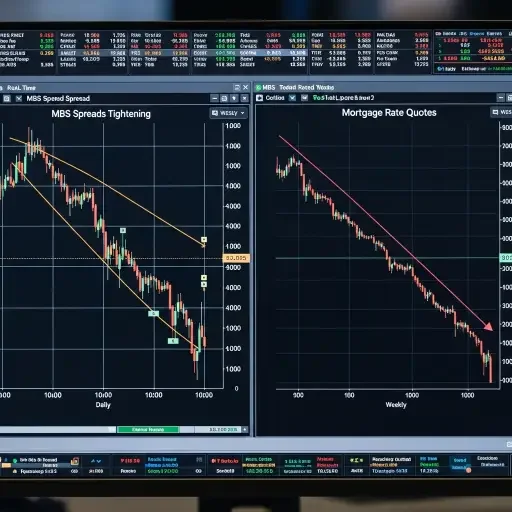
Two forces moved in tandem. First, U.S. Treasury yields—particularly the 10‑year note—slid on softer economic prints and a rotation away from hawkish Fed pricing. That pushed MBS prices higher; when MBS compress, lenders can offer lower rates because the economics of bundling, servicing, and hedging the mortgages improve. Second, and less mechanical, was the market’s reaction to public comments by a political figure closely associated with Trump who described recent agency purchases of mortgage bonds as “a start.” Traders translated that line into a narrative that balance-sheet acceptance of MBS might expand—reducing the tail risk for liquidity and improving the perceived buyer-of-last-resort story for agency paper.
The intersection matters because mortgage rates are not set by the Federal Reserve directly. They are the product of a market ecosystem: Treasury yields set the discount rate; MBS spreads add a liquidity and credit premium; banks and nonbank lenders manage hedging costs and pullthrough capacity. Any credible signal that one of those components will see persistent demand—public or private—reduces the risk premium embedded in spreads. In plain terms: if buyers exist for the bonds that fund mortgages, lenders need less cushion and pass savings to borrowers.

Markets prize narratives. The phrase “a start” functions like a low-bandwidth commitment: not a policy pledge, but also not denial. It reduces uncertainty asymmetrically—markets suspect downside is smaller than before. That asymmetric update can be enough to tighten spreads. But two caveats matter. One: political signaling without operational follow-through has a short half-life in fixed-income markets. Two: even if MBS buying expands, the scale and permanence determine whether rate relief is structural or ephemeral.
For homeowners and prospective buyers, the immediate difference is practical: lower advertised rates boost purchase affordability and can resuscitate refinancing activity that had been dormant while 30‑year rates hovered above 6.5 percent. For mortgage lenders—especially nonbank originators that rely on short-term warehouse lines—the liquidity psychology shifts. Tighter MBS spreads ease hedging costs and reduce the frequency of margin calls. That improves day-to-day origination economics, modestly expanding credit supply.
Yet this is not a return to the decade-long troughs of the 2010s. Structural constraints remain: higher long-run neutral rates estimated by many economists, persistent inflationary scarring in some sectors, and a still‑painful gap between incomes and house prices in many metro areas. The housing market’s distributional reality—K‑shaped affordability where some buyers regain access while many remain priced out—remains intact.

Policy design will decide whether this episode is an interlude or an inflection. If public entities expand agency MBS purchases in scale—whether through careful, rule‑driven programs that address liquidity dysfunction or blunt, calendar-driven buying—the effect could be durable. That requires operational capacity, legal authority, and political will. If the comments amount to signaling aimed at calming markets without the institutional follow-through, the stabilization will be transient and markets will reprice when economic data or Fed rhetoric changes.
Investors should treat two threads as watchpoints. First, supply-side dynamics: issuance schedules from Fannie Mae and Freddie Mac and the behavior of nonbanks that package and sell loans affect immediate MBS availability. Second, the fiscal and regulatory context: any legislative or administrative moves that alter the agencies’ remit or the Fed’s emergency toolkit would materially change the buyer-of-last-resort calculus.
The practical takeaway is modest but useful. For prospective borrowers whose pricing sensitivity sits near conventional breakpoints (say, a quoted 5.75% versus 6.25%), the present window can change calculus on purchase timing or refinancing sweat equity. For lenders and investors, tighter spreads temporarily improve margins, but operational resilience—hedge lines, servicing capacity, and capital buffers—remains decisive.
Mortgage rates falling under 6% is a market fact; the political framing that accompanied it is the story that determines persistence. Numbers do the heavy lifting—yields, spreads, originations—but narratives steer capital. If the “start” becomes a program, the housing market’s recent volatility could contract into a steadier lower-rate regime. If it doesn’t, today’s relief will behave like a spring rain: refreshing but rapidly evaporating.
Tags
Related Articles
Sources
Market yield data, Treasury and MBS movement, public comments from political allies, Federal Reserve and GSE balance-sheet context, mortgage origination flows.