

The Nasdaq fell about 4.5% in the week ended 16 October while the Dow edged higher, Brent approached $110, and CoreWeave’s bonds and CDS priced financing stress in AI infrastructure. With the Fed in blackout until 27–28 October, six common desk themes—energy, crude volatility, leveraged neocloud credit, Wednesday’s mega-cap earnings, and defensive rotation—frame what to watch, not what to buy at Monday’s open.
The most revealing number on Wall Street last week was not the Nasdaq Composite’s 4.48% weekly decline. It was the Dow Jones Industrial Average’s 0.67% gain.
Investors were not simply selling everything. They were separating companies that might benefit from inflation and supply shocks, firms that can finance their own growth, and businesses whose valuations still assume abundant cheap capital. Oil added a second axis: Brent approached $110 a barrel as Middle East shipping risk stayed elevated, helping producers while raising costs for airlines, manufacturers, and the power-hungry data centers behind the AI build-out.
The result is an unusual market entering Monday, 19 October: energy finds support from some of the same conditions that could make financing the AI boom more expensive. On Wednesday, corporate earnings will stress-test that tension—with the Federal Reserve in pre-FOMC blackout and no official rate narrative to absorb a surprise guide.
The market entering Monday
The week ended 16 October with a sharp split between technology and the broader industrial economy.
| Market indicator | Friday / weekly reading | What it suggests |
|---|---|---|
| Nasdaq Composite | 26,140.03 / −4.48% weekly | Growth and technology under pressure |
| S&P 500 | 7,659.44 / −1.95% weekly | Losses extend beyond mega-cap tech |
| Dow Jones | 52,002.41 / +0.67% weekly | Rotation, not indiscriminate selling |
| Russell 2000 | −3.05% weekly | Smaller caps also struggling |
| Brent crude | Near $110/bbl | Supply and geopolitical risk still elevated |
| CoreWeave shares | Roughly −25% weekly | AI infrastructure financing concerns |
| CoreWeave credit | CDS near 1,195 bps; some bonds ~15–16% yield | Credit demanding high compensation |
Snapshot: 16 October cash close or observations during the week ended that date. Weekly equity returns are historical, not forecasts; bond yields and crude are dated observations, not live quotes.
The message is less about an imminent collapse than about a repricing of risk. Firms with pricing power and manageable debt look different from businesses that need repeated capital markets access to fund growth. That distinction runs through the six themes below.
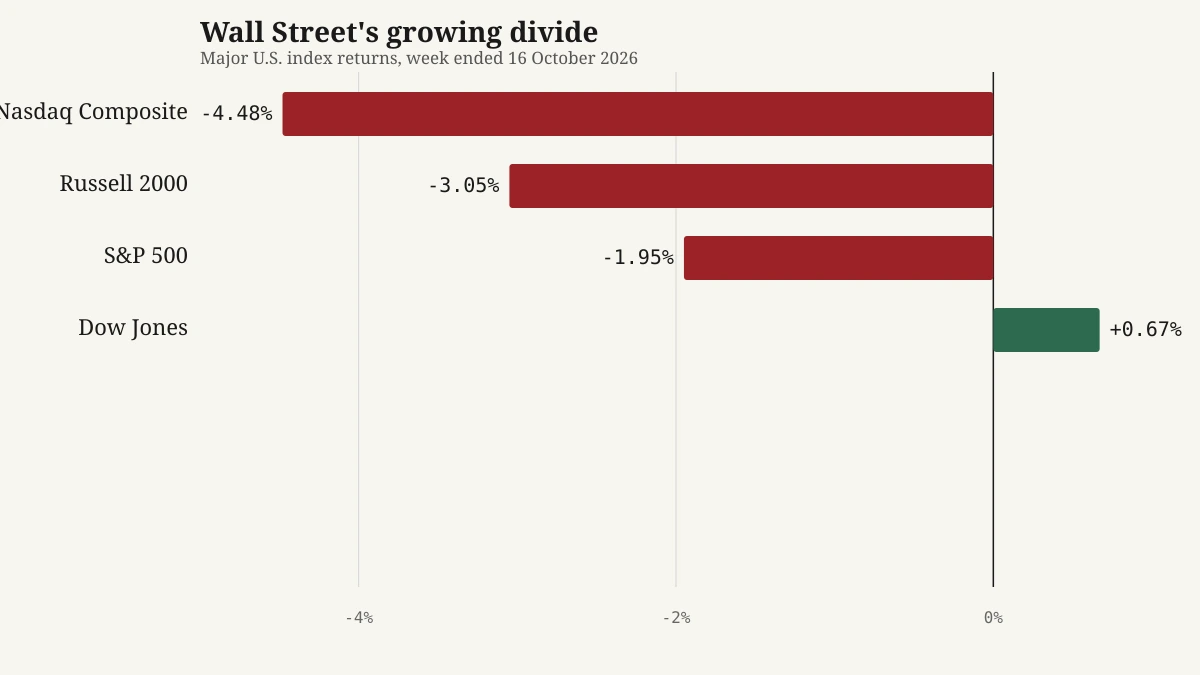
Chart: Major U.S. index weekly percentage changes, week ended 16 October 2026, per financial press weekly recaps (including −4.48% on the Nasdaq). Technology-led selling ran considerably deeper than the broad market.
Six setups worth watching
These are conditional opportunities—not six instructions to trade at Monday’s open. A sound thesis can still be a poor entry at the wrong price or implied volatility.
| Theme | Instruments to watch | What would support the trade | What could undermine it |
|---|---|---|---|
| 1. Energy strength | XLE, XOM, CVX | Sustained supply disruption, firm crude, sector outperformance | Credible de-escalation, restored flows, SPR/IEA releases |
| 2. Oil volatility | USO, crude futures/options | Large two-way moves as headlines compete with inventory data | Falling realized vol or expensive option premiums |
| 3. AI financing stress | CRWV, NBIS, APLD, IREN | Further bond weakness, refinancing pressure, weak unit economics | New capital, demand surprise, tighter credit spreads |
| 4. Meta and semiconductors | META, LRCX, TXN | Earnings or guidance that shifts growth and capex math | Weak guide-up, IV crush, rotation back into growth |
| 5. Tesla earnings | TSLA | Margin, cash flow, or autonomy narrative surprise vs pricing | In-line results with elevated implied move |
| 6. Defensive rotation | XLV, XLP, QQQ, XLE | Continued leadership outside technology | Broad growth rebound after strong AI prints |
The common thread is the gap between what is already priced and what new information would force investors to reconsider.
1. Energy: the obvious trade is easy to chase
Brent near $110 makes energy the natural starting point. Exxon Mobil, Chevron, and XLE offer equity exposure to stronger sector economics without trading futures directly.
Supply-driven rallies are headline-sensitive. Diplomatic progress, a reopened shipping lane, or coordinated reserve releases can reprice crude before inventories catch up. That favors watching pullbacks and relative strength rather than chasing gaps—consistent with the discipline in the original desk notes.
Producers are not crude: they carry refining exposure, decline curves, and buyback policy. Futures and capped-risk options track the commodity more directly.
What to watch: Whether Brent holds recent gains, tanker and inventory data (API Tuesday, EIA Wednesday), and whether XLE keeps outperforming the S&P 500.
2. Oil volatility: direction is only half the story
With supply risk competing against possible diplomatic relief, oil can move sharply in either direction. That is a separate expression from owning energy shares.
Defined-risk structures can target the size or direction of the next move, but premium matters. When the market already expects turbulence, a correct directional call can still lose if the move does not exceed what options implied.
What to watch: Implied volatility, Brent–WTI spreads, inventory surprises, and confirmed changes to shipping conditions.
3. AI infrastructure: when bonds challenge the equity story
CoreWeave became the week’s credit signal. Shares fell roughly 25% for the week; Culled’s digest flagged five-year CDS touching a record near 1,195 basis points and unsecured yields in the mid-teens on some lines—against a debt stack on the order of $50 billion.
That does not prove AI demand is collapsing. It asks whether infrastructure operators can earn adequate returns on GPUs and power when refinancing costs spike—a question of leverage and duration, not model capability.
CoreWeave, Nebius, Applied Digital, and IREN belong on the same watchlist but are not interchangeable: customer concentration, lease structures, and power contracts differ. Bearish structures often work better on failed rallies than on chasing a stock already down hard; squeeze risk remains real, especially if prime-broker books are still de-risking.
What to watch: Bond yields, CDS, new funding announcements, and whether weakness spreads beyond the most leveraged names.
4. Wednesday’s AI earnings: spending meets accountability
Meta, Lam Research, and Texas Instruments report after Wednesday’s close.
Together they span the AI investment chain: a cash-rich platform spending on models and data centers (Meta), wafer-fab equipment demand (Lam), and broader industrial analog semis (TI). Strength in one name does not guarantee strength in the others.
The market cares about guidance: revenue growth, margins, and whether capex still outruns monetization. For options structures, beating estimates is not enough if implied move was already large—a correct direction can lose to volatility collapse.
What to watch: Capex guidance, free cash flow, customer commentary, and actual post-earnings moves versus the options-implied range.
5. Tesla: business performance and narrative can diverge
Tesla shares the Wednesday spotlight with a different question set: vehicle margins, manufacturing cost, energy storage, and the gap between robotaxi or robotics ambition and near-term automotive cash flow.
Deliveries are largely known; margin and investment commentary move the stock. At a rich multiple, the distance between results and expectations can matter as much as the EPS line.
What to watch: Automotive gross margin, operating cash flow, capex commitments, and implied earnings move versus realized gap.
6. Defensive rotation: is leadership changing?
The Dow’s positive week while the Nasdaq fell sharply makes sector rotation worth tracking. XLV and XLP offer steadier cash-flow profiles than long-duration tech; pairing defensives against QQQ (or long XLE) tests rotation without a naked index short.
Defensive is not risk-free. A liquidity shock can hit both legs; a strong Meta or semi guide could unwind the trade quickly.
What to watch: Sector relative performance, breadth, Treasury yields and term premium, and credit spreads.

Three scenarios that could define the week
The six setups are not independent. Several respond to the same forces.
| Scenario | Likely beneficiaries | Likely pressure points |
|---|---|---|
| Oil risk persists, AI credit weakens | Energy; selective defensives | Leveraged AI infrastructure; fuel-sensitive margins |
| Oil fears ease, AI guidance strengthens | Technology rebound; credit-sensitive growth | Energy momentum; bearish AI financing trades |
| Credit stress broadens beyond AI | Hedges, cash-like exposures | Growth and cyclicals alike; possibly crude if growth fears dominate |
Illustrative directional scenarios—not predicted returns. Correlations shift sharply in stress.
The third scenario deserves emphasis. Energy and defensives may outperform during a tech selloff, but they are not full hedges against a broad financing contraction. If tighter credit damages growth expectations, oil can fall even while geopolitical risk remains on the map. Watch credit spreads, not just the direction of yields.
The week’s calendar
| Date | Main events | Why they matter |
|---|---|---|
| Mon, Oct 19 | Cleveland-Cliffs, Steel Dynamics; China macro in focus | Industrial demand and Asia opening tone |
| Tue, Oct 20 | GE Aerospace, GM, Netflix, airlines; U.S. housing | Capex, consumer demand, fuel costs |
| Wed, Oct 21 | Meta, Tesla, Lam, Texas Instruments; EIA oil inventories | AI expectations collide with energy data |
| Thu, Oct 22 | P&G, Honeywell, Western Digital; jobless claims | Pricing power, labor read |
| Fri, Oct 23 | Flash PMIs; Michigan sentiment | Momentum and household confidence |
Schedules subject to change.
Fed officials remain silent until after 27–28 October. Corporate results and macro prints therefore carry more weight than usual in shaping rate expectations. Wednesday is the focal point, but Friday’s PMIs and sentiment can decide whether earnings look idiosyncratic or macro.
What would change the outlook?
Oil must confirm whether the supply shock has staying power—firm prices with constrained shipping and supportive inventories reinforce energy themes; rapid de-escalation undermines them.
Credit must show whether CoreWeave is isolated or symptomatic. Recovery in AI infrastructure bonds weakens the bearish financing case; widening stress across issuers strengthens it.
Earnings must show whether AI spending still produces believable returns. High capex is sustainable when cash generation and demand keep pace; it is fragile when the cost of funding rises faster than the economic return on new capacity.
It may be the week investors grow more selective about who can afford to build the AI transformation—and who can profit from it.
The useful question is not which ticker will “win” Monday. It is which assumptions the market is about to test, what evidence would confirm them, and what would force a rethink. The six themes are six ways to watch that process; none requires a position before the evidence arrives.
Continue reading


Sources
U.S. index levels and weekly returns week ended 16 October 2026 (Culled world briefs and financial press); Nasdaq −4.48% weekly cited in market recaps; CoreWeave equity, CDS near 1,195 bps, and bond yields per Culled FMP digest and credit-market reporting; Brent near $110; earnings and macro calendars; related Culled coverage on Treasury yields, prime-broker de-risking, and Fed blackout.


