

Michael Dell's Millennium Tower penthouse is on a sealed-bid auction with a $6.5 million reserve through October 29—not a foreclosure, but a 40% haircut to his 2016 purchase. Sotheby's Magnum Opus exhibition opens October 17 in New York with more than 900 objects and 600-plus lots estimated above $60 million from an unnamed collector. Oheka Castle follows October 27 in Chapter 11, with roughly $60 million secured debt and condo entitlements still subject to planning review. Net worth is a valuation; clearing price is what a stranger pays.
Three October disposals sound unrelated—a Texas billionaire’s Boston sky perch, an anonymous museum-grade hoard on Madison Avenue, a Jazz Age castle on Long Island headed for creditor sale. They are different asset classes, different sellers, and different legal wrappers. What aligns them is price discovery under lights: the moment a balance-sheet mark must meet a counterparty who can wire funds by a deadline.
For readers who track wealth only through Forbes lists, the lesson is blunt. Net worth is an estimate; clearance is a transaction. Auctions, sealed bids, and bankruptcy sales strip the fiction that a penthouse “worth” $10.9 million in 2016 still commands that number in 2026, that provenance always clears estimates, or that a Gatsby silhouette survives when $60 million of secured debt needs paying.
The Boston penthouse: discount without distress
Michael and Susan Dell’s 59th-floor unit at Millennium Tower—4,110 square feet with harbor and Charles River views and a rare high-altitude terrace—is not a foreclosure story. The Boston Globe reported that an LLC tied to Dell paid $10.9 million in 2016 and that the couple “never truly lived in” the penthouse, which the Paramount Realty USA auction listing markets as pristine, turn-key inventory.
The marketing path already telegraphed liquidity friction: an April 2025 ask near $9.5 million, later reductions, and a canceled contract before the sealed-bid process with Serhant Massachusetts. Bids are due October 29 at 4 p.m. Eastern; the published reserve is $6.5 million—about 40% below the 2016 deed price and roughly 18% below a more recent list near $7.9 million, per syndicated property reporting. A 6% buyer’s premium applies on top of the hammer.
That pattern matches other trophy markets where guide prices fail to clear even when the seller is solvent. Dell does not need the cash; he needs a clearing price in a Boston luxury condo market still digesting high carrying costs, insurance, and the memory of Millennium Tower’s 2016 foundation settlement saga. Sealed bids are a tool to learn whether any buyer will cross $6.5 million without another public price cut—a liquidity experiment, not a distress flag.
Magnum Opus: liquidating a private world in public
While Dell’s bidders tabulate harbor views, Sotheby’s opens Magnum Opus at the Breuer on 945 Madison Avenue (exhibition 17–22 October). The house describes more than 900 works on four floors—Roman marble, Old Masters, Marie Antoinette–era furniture, Degas pastels, Islamic carpets, twentieth-century design—then more than 600 lots across four single-owner sales 21–23 October, estimated in excess of $60 million.
Sotheby’s press materials stress curatorial coherence: a collector’s eye for the human figure and provenance, not a warehouse clearance. The consignor’s name is not established in public catalog copy—standard for high-profile single-owner sales where privacy is part of the product. What is established is the mechanism: decades of accumulation converted into catalogue numbers, reserves, and buyer’s premiums in a week when Madison Avenue’s gallery circuit already concentrates discretionary attention.
The financial question is not whether the evening sale hammers above estimate headlines—it is whether breadth (900 objects) still commands depth (top-lot competition) when collectors can cherry-pick one era and ignore another. Weak spots in thematic day sales would signal that even museum-quality provenance cannot lift every shelf of a life’s collecting. Strong evening results would confirm that a single intelligent narrative still reduces liquidity risk for the seller—buyers trust the editing.
Oheka Castle: romance priced as development option
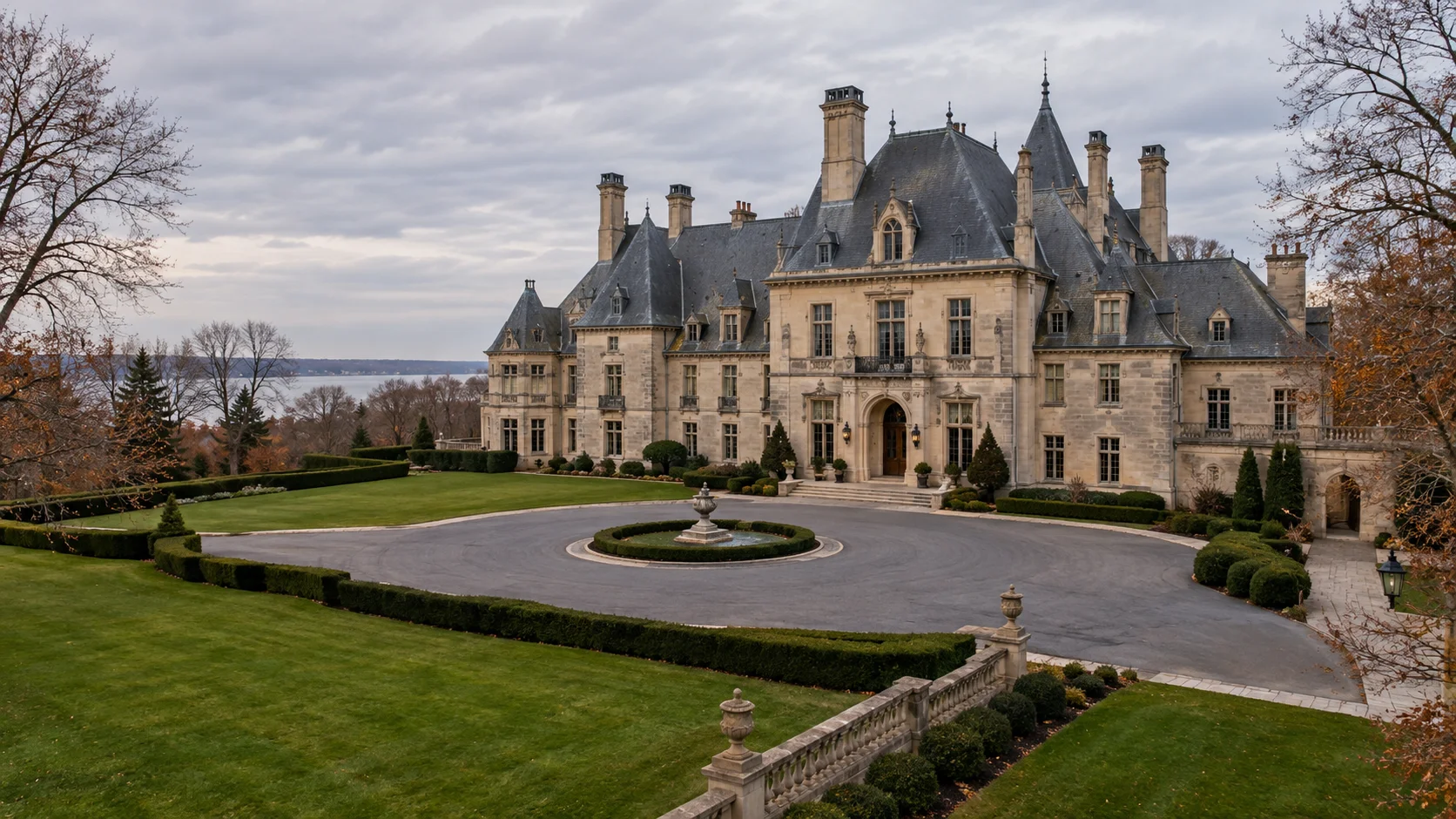
The third disposal is the most legally entangled. Oheka Castle—Otto Kahn’s 127-room Gold Coast estate, later a wedding venue and film set—heads to Concierge Auctions on October 27 inside Kahn Property Owner LLC’s Chapter 11 case filed in 2025. Newsday quoted attorney Joseph S. Maniscalco that the entity owes about $60 million to Taconic Capital plus $8 million to $10 million to unsecured creditors and fees; local reporting aggregates higher total claims. The estate operator Gary Melius told the paper he cannot carry the debt and will not retain ownership after sale.
The auction package is not a single fairy-tale château. It bundles hospitality operations, event bookings (weddings through March 2028 are to be honored, per attorneys cited in local press), and development rights for 95 luxury condominiums on 5.13 acres—a Huntington Town Board–approved plan from 2023 that has not completed Planning Board site-plan review, according to subsequent local reporting. Bidders face a $750,000 deposit and a 6% buyer’s premium.
Here the liquidity trap is architectural: the romantic asset (castle, lawns, cinematic façade) may be worth less than the entitled dirt brokers describe—luxury condos at implied seven-figure unit economics—minus the cost of finishing approvals and absorbing event-business volatility. That is the opposite of Dell’s empty penthouse, where the product is purely residential views. Oheka asks buyers to underwrite history plus zoning option value minus bankruptcy friction—a harder DCF in a week when London trophy blocks already show how tax and planning reshape bids.
One fortnight, three clearing mechanisms
| Disposal | Seller motive (on the record) | Mechanism | What “success” looks like |
|---|---|---|---|
| Millennium Tower penthouse | Unused trophy; prior listings stalled | Sealed bid, $6.5M reserve (Oct. 29) | Hammer at or above reserve without further public cuts |
| Magnum Opus | Single-owner collection rotation (unnamed) | Four Sotheby’s sales, >$60M estimate | Evening sale depth; low bought-in rate on day sales |
| Oheka Castle | Chapter 11; secured lender pressure | Public auction (Oct. 27) | Sale proceeds cover ~$60M secured claim; buyer accepts planning risk |
None of these events proves that billionaires are broke. Together they show that illiquid greatness—a view, a collection, a castle—carries carrying costs and narrative risk that compound quietly until a calendar date forces a number.
What to watch after the gavels
For Dell, the outcome is a single data point on whether Boston’s ultra-luxury condo stock clears at mid-single-digit millions per thousand square feet when the seller is indifferent. For Magnum Opus, watch sell-through rates by sale segment and whether Asian and Middle Eastern buyers step into Old Master inventory—a test of global liquidity, not just New York taste. For Oheka, the hammer matters less than the identity of the winner (hotel operator vs condo developer) and whether Huntington’s planning process resets entitlements.
The weekend’s visual glamour—Breuer vitrines, harbor glass, castle turrets—should not obscure the bond-market truth underneath. When possessions must find buyers, the price is whatever someone signs before the deadline, premium and planning risk included. Everything else is still marketing, however magnificent the object.
Continue reading


Sources
Boston Globe and Paramount Realty USA listing on Dell's sealed-bid auction; Sotheby's Magnum Opus series pages and press materials; Newsday and Long Island reporting on Oheka Castle Chapter 11, Taconic debt, and October 27 Concierge Auctions sale; Suffolk County and Huntington planning context on the 95-unit condo entitlement; prior Culled coverage on luxury auction clearance.


