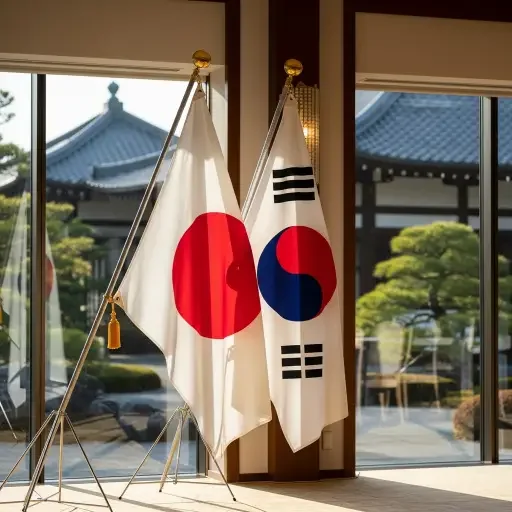
The 90-minute meeting in Takaichi’s home constituency produced commitments spanning artificial intelligence development, intellectual property frameworks, and joint responses to transnational crime. But the substantive shift centers on economic security and defense coordination—domains where Japan and South Korea have historically maintained distance despite both being treaty allies of the United States.
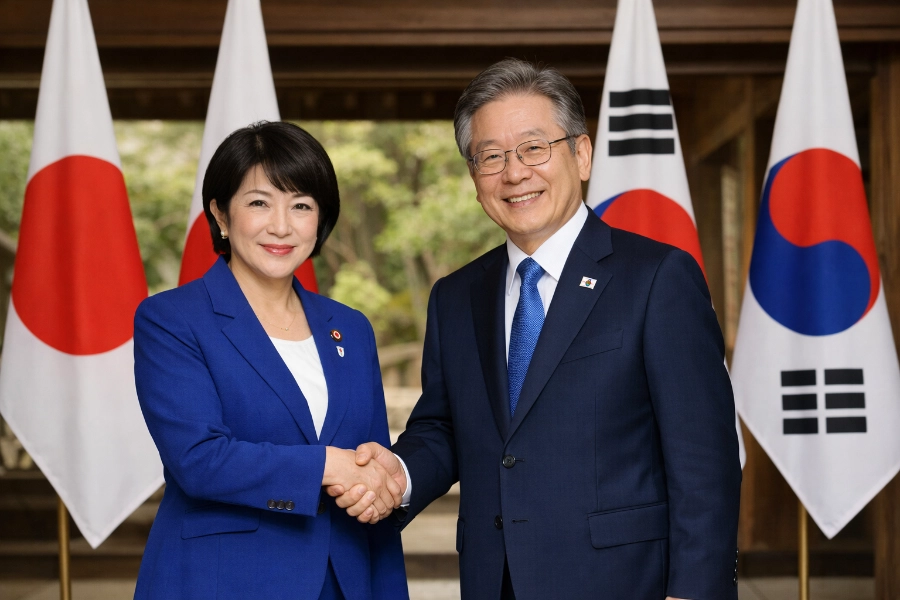
Takaichi emphasized that cooperation has become structural rather than optional. As the international environment becomes more severe, she stated, both countries must work together to contribute to regional stability. Lee framed the summit within what he described as a rapidly changing international order where cooperation matters more than ever.
The timing reflects converging pressures. China halted rare earth export license approvals to Japan days ago after Tokyo restricted dual-use technology sales. Beijing’s move suspended shipments of heavy rare earths and magnet materials across Japanese industries, recreating the economic coercion Japan last experienced during the 2010 rare earth embargo. Japan imports 91.2 percent of rare earth elements from China—a dependency that now carries direct strategic costs.
Japanese Finance Minister Satsuki Katayama convened G7 counterparts in Washington on Sunday specifically to coordinate critical minerals strategy. The extraordinary meeting included finance chiefs from South Korea, Australia, India, and Mexico alongside G7 members. Katayama told reporters Friday that China’s monopolization of critical minerals through non-market means poses a crisis for the global economy and presents serious problems for economic security.
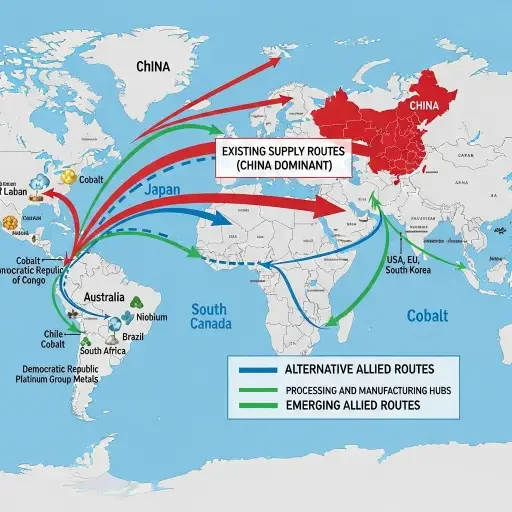
South Korea’s participation in the G7-plus gathering signals its position as a preferred partner for diversifying mineral supply chains. Both Tokyo and Seoul share extreme vulnerability to Chinese export restrictions—South Korea depends heavily on China for graphite, tungsten, and rare earth processing despite being a semiconductor manufacturing powerhouse.
The summit joint statement committed both countries to cooperation going beyond trade-centered engagement toward comprehensive collaboration including economic security, science, technology, and jointly shaping international norms. This language represents a departure from previous bilateral frameworks that carefully circumscribed cooperation to avoid antagonizing China or reopening historical disputes.
Semiconductor cooperation forms the industrial foundation of the realignment. Japan holds approximately 9 percent of global semiconductor production and dominates equipment and materials segments. South Korea controls 56.9 percent of global memory semiconductor markets and accounts for 18.4 percent of overall semiconductor production. Neither country is a dominant player in chip design—an area where cooperation could address mutual gaps.
Japan lifted semiconductor material export restrictions against South Korea in 2023 after a four-year trade dispute that began when Tokyo limited exports of hydrogen fluoride, photoresists, and fluorinated polyimide following South Korean court rulings on forced labor compensation. South Korea dropped its World Trade Organization case against Japan as part of the normalization. The materials in question—critical inputs for semiconductor manufacturing—underscore how technological interdependence now outweighs historical grievances in bilateral calculations.
Taiwan Semiconductor Manufacturing Company’s $8.6 billion fab in Kumamoto, which began operations in 2024, produces 12-nanometer to 28-nanometer logic chips with substantial Japanese government subsidies and Sony’s operational support. Samsung announced plans for a similar facility investment in Japan. These partnerships demonstrate that competition in global chip markets is giving way to coordinated capacity building among allied producers.
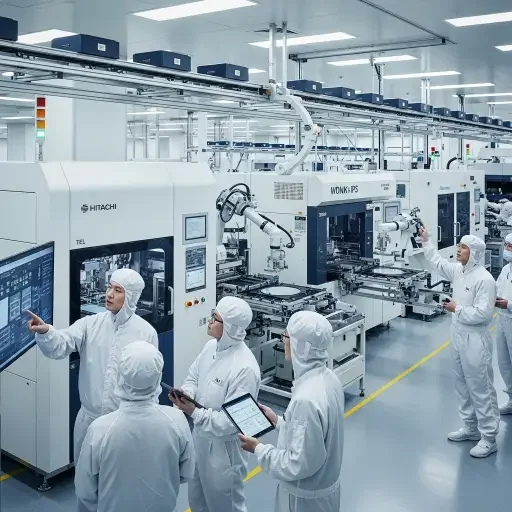
The semiconductor dimension extends beyond manufacturing to encompass the entire value chain. Japan dominates silicon wafer production through firms like Shin-Etsu, which holds 29.4 percent of global market share. Japanese companies also control critical segments of fabrication equipment and specialized chemicals. South Korea’s strength in memory chips and advanced packaging complements Japan’s position, creating potential for vertical integration across the supply chain.
Both countries face the same workforce constraint—aging demographics that reduce the available pool of skilled semiconductor engineers and technicians. Joint training programs and labor mobility frameworks could address shortages more effectively than either country acting alone. India possesses approximately 20 percent of global semiconductor design talent, making an India-Japan-South Korea trilateral arrangement attractive for addressing design weaknesses while leveraging Japanese and Korean fabrication expertise.
Defense cooperation advanced more quietly but no less significantly. The summit reaffirmed trilateral security coordination with the United States and acknowledged the strategic importance of Japan-South Korea bilateral defense ties. This language approaches what defense analysts describe as a joint security declaration—a formalization of common values and shared strategic purpose.
Japan and South Korea agreed in 2024 to resume defense exchanges including regular vice minister-level dialogue and high-level engagements between the Self-Defense Forces and ROK military. These institutional channels had been frozen for years despite both countries facing North Korea’s expanding nuclear arsenal and ballistic missile capabilities.
North Korea’s weapons development creates a shared threat perception that overrides bilateral disputes. Pyongyang conducted multiple missile tests in 2025 and continues enriching fissile material for nuclear warheads. Japan activated a real-time missile warning data-sharing mechanism with South Korea and the United States, enabling coordinated tracking and response protocols.
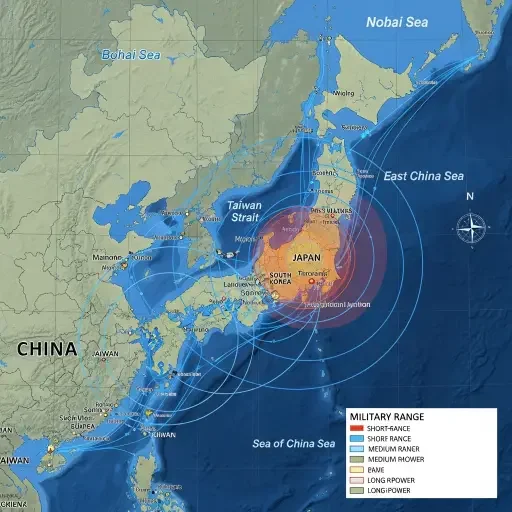
The defense dimension increasingly incorporates Taiwan contingency planning. While neither Japan nor South Korea has formally committed to roles in a Taiwan Strait conflict, strategic planners in both countries recognize that Chinese military action against Taiwan would directly threaten their security and economic interests. Japan’s southwestern islands sit less than 200 kilometers from Taiwan. South Korea’s economic exposure to cross-strait trade and its security dependence on U.S. forces that would almost certainly be involved in defending Taiwan create unavoidable strategic connections.
American officials have encouraged closer Japan-South Korea defense integration as insurance against potential shifts in U.S. commitment. The August 2023 Camp David summit institutionalized trilateral cooperation through frameworks that survived leadership changes in all three countries. The Trilateral Security Cooperation Framework established regular consultations at ministerial and working levels, crisis communication protocols, and joint military exercises.
Leif-Eric Easley, professor of international studies at Ewha Womans University in Seoul, notes that both leaders are politicians focused on national interest. They share many economic and security concerns, seek to reduce North Korean threats through negotiations, want to dissuade economic coercion from China, and need to manage foreign policy amid U.S. political uncertainty.
That uncertainty stems from questions about American reliability under President Donald Trump’s second term. Trump has pressured both Japan and South Korea to increase defense spending and threatened to reduce U.S. troop presence in the region unless allies pay more for American security guarantees. These demands create incentives for Tokyo and Seoul to develop autonomous capabilities and deepen bilateral coordination as hedges against potential American retrenchment.
The economic security agenda extends beyond semiconductors to artificial intelligence, quantum computing, biotechnology, and advanced materials. Both countries committed to cooperation in these emerging technology sectors where first-mover advantages and standard-setting authority will determine competitive positioning for decades.
Critical minerals diversification requires coordinated action across multiple fronts. Japan signed a bilateral framework with the United States in October 2025 establishing joint mechanisms for securing critical minerals and rare earth supply chains. The framework commits both countries to geological mapping, rapid response protocols for supply disruptions, complementary stockpiling arrangements, and fair competition mechanisms to counter non-market pricing from China.
South Korea is pursuing similar bilateral arrangements while also participating in the Chip 4 alliance with the United States, Japan, and Taiwan. This configuration focuses on semiconductor supply chain security and technology cooperation, creating overlapping frameworks that reinforce rather than duplicate one another.
G7 ministers announced 26 new critical minerals projects and partnerships in October 2025, mobilizing $6.4 billion to bolster supply chains. These span Canadian graphite mines with Japanese and EU offtakes, rare earth processing in Ontario backed by Germany and the United States, and new lithium extraction projects. The flurry of activity demonstrates that supply chain resilience has moved from abstract discussion to concrete investment.
France’s aerospace industry warned this week that 90 percent of French aerospace rare earth needs come from China, with Chinese authorities now asking intrusive questions about end-uses of such exports. The vulnerability extends across European defense industries, creating common cause between G7 allies and Asian partners in diversifying sources.
Japan and South Korea face a strategic choice about how confrontational to be with China. Both maintain substantial economic ties with Beijing—China is South Korea’s largest trading partner and a major destination for Japanese exports. Managing simultaneous cooperation with the United States and commercial engagement with China requires diplomatic precision that becomes harder to sustain as great power competition intensifies.
Lee told reporters last week during meetings in Beijing that relations with Japan are as important as those with China, but acknowledged South Korea’s limited ability to broker reconciliation between its neighbors. The pragmatic approach accepts that Seoul cannot mediate between Washington and Beijing or between Tokyo and Beijing, but can work to maintain productive relationships with all parties while speaking up when any actor attempts to unilaterally change regional status quo by force.
Chinese tourism to Japan has declined while South Korean tourist destinations have received a boom in Chinese visitors since November. Investors see the China-Japan strain potentially benefiting Korean retail and consumer stocks. These economic adjustments demonstrate how geopolitical tensions create both costs and opportunities that countries seek to exploit.
The Nara summit’s choice of venue carried symbolic weight. Nara served as the center of cultural exchanges between the Korean Peninsula and Japan in ancient times. Takaichi’s political home base provided historical resonance for a relationship that both leaders described as entering a new 60-year period following the 60th anniversary of diplomatic normalization in 2025.
Historical issues remain unresolved. Korean forced laborers during Japan’s 1910-1945 colonial rule and their descendants continue seeking compensation through court proceedings. The summit included commitments to search for remains of Korean forced laborers, acknowledging rather than resolving the underlying disputes.
The strategy appears to be compartmentalization—addressing historical grievances through specific mechanisms while not allowing them to block cooperation in domains where strategic interests align. This approach differs from previous attempts to comprehensively settle all outstanding issues before advancing bilateral ties.
Whether the current alignment proves durable depends on factors beyond bilateral control. Leadership changes in either country could shift priorities. A less confrontational China might reduce the security pressures driving cooperation. American disengagement from the region would force both countries to recalculate their strategic positioning.
The institutional frameworks now being established—regular summit meetings, defense ministry dialogues, semiconductor industry partnerships, critical minerals coordination—create path dependencies that make reversal costlier. Each new agreement and each joint project raises the stakes for future leaders who might consider returning to the antagonistic postures that characterized much of the post-war period.
For now, the strategic foundation for cooperation has arguably never been broader or deeper. Northeast Asia faces converging pressures from China’s military modernization, North Korea’s nuclear expansion, and Russia’s deepening strategic ties with both Beijing and Pyongyang. In such an environment, bilateral mistrust between Japan and South Korea represents a strategic indulgence neither can afford.
The semiconductor and critical minerals dimensions add economic urgency to security imperatives. Global AI development depends on advanced memory chips from South Korea and specialized materials from Japan. Electric vehicle production requires rare earth permanent magnets. Defense systems need semiconductor components that meet stringent reliability standards. The technological foundations of 21st-century power run through supply chains that both countries help control.
China’s willingness to weaponize economic dependencies—demonstrated again with rare earth restrictions against Japan—validates the risk assessments driving allied coordination. Beijing’s export controls on antimony, tungsten, gallium, and germanium affect not just Japan but the entire network of countries seeking to reduce dependence on Chinese critical mineral processing.
The question is whether coordination can move fast enough to reduce vulnerabilities before they are exploited. Building new mines takes 7-15 years. Establishing processing facilities requires specialized knowledge that currently concentrates in China. Recycling technologies that could recover critical minerals from electronic waste remain commercially unproven at scale.
Japan and South Korea are making the bet that middle power cooperation, amplified through partnerships with the United States and other allies, can accelerate the timeline and share the costs. The Nara summit advanced that agenda across multiple domains simultaneously—a recognition that economic security, technological competitiveness, and military deterrence now form an integrated whole that cannot be addressed through separate, siloed approaches.
The strategic realignment between Tokyo and Seoul represents one of the most significant geopolitical developments in Asia since the normalization of relations six decades ago. Whether it endures will depend on sustained political will, continued external pressure, and the ability of both countries to deliver concrete benefits that justify the risks of antagonizing China.
Related Articles
Sources
Research drawn from joint summit statements, Ministry of Economy Trade and Industry announcements, G7 critical minerals coordination meetings, U.S. Treasury Department briefings on allied supply chain cooperation, Center for Strategic and International Studies analysis of trilateral defense frameworks, defense ministry official statements, semiconductor industry partnership announcements, and reporting from The Diplomat, Washington Post, Japan Times, and Korea Times on bilateral diplomatic developments.