The Immediate Trigger
On January 17, President Trump announced via Truth Social that Denmark, Norway, Sweden, France, Germany, the United Kingdom, the Netherlands, and Finland would face 10% tariffs on all goods exported to the United States beginning February 1. The levies would increase to 25% on June 1 unless an agreement is reached for “the Complete and Total purchase of Greenland” by the US.
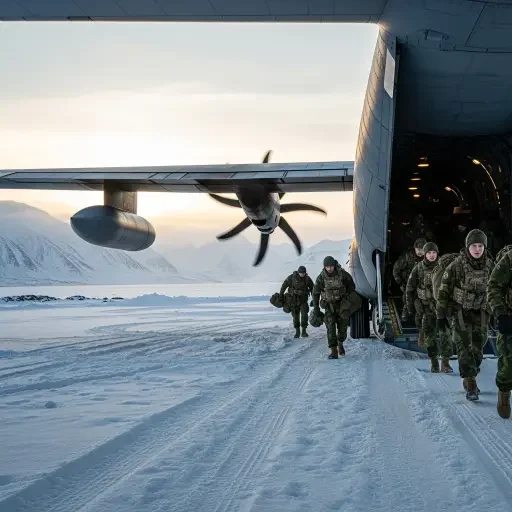
The tariff threat directly followed European military deployments to Greenland that began January 14. Germany sent 13 reconnaissance personnel. Sweden, Norway, France, the Netherlands, Finland, and the UK each deployed small contingents ranging from one to several dozen troops. The deployments were framed as participation in Operation Arctic Endurance, a Danish-led exercise announced Wednesday.
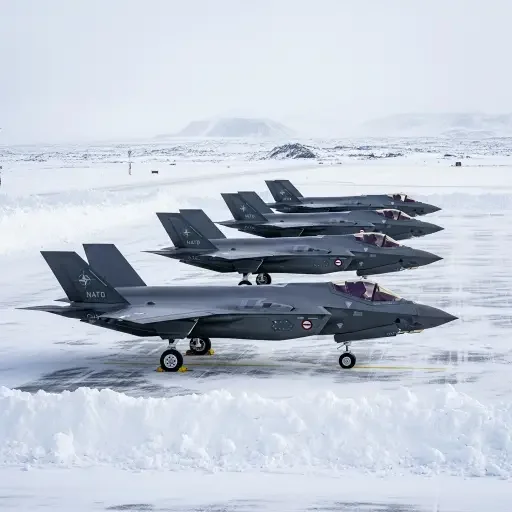
Trump characterized the European presence as creating “a very dangerous situation for the Safety, Security, and Survival of our Planet.” The post claimed China and Russia pose threats to Greenland that Denmark cannot counter, asserting “Only the United States of America, under PRESIDENT DONALD J. TRUMP, can play in this game.”
Danish Foreign Minister Lars Løkke Rasmussen described the tariff announcement as a surprise following what he termed a “constructive meeting” with Vice President JD Vance and Secretary of State Marco Rubio two days earlier. That January 14 Washington meeting produced an agreement to establish a working group on Arctic security, though Denmark and the White House offered diverging interpretations of its mandate.
Operation Arctic Endurance: Improvisation or Strategy?
Operation Arctic Endurance appears to have been conceived rapidly in response to escalating US rhetoric. Defense News reported finding no public record of the operation name before January 14. A search of NATO’s official website similarly returned no results, suggesting the exercise was either recently conceived or hastily rebranded from existing planning.
The operation’s stated purpose is to strengthen allied capabilities in Arctic conditions and reinforce security across the Atlantic. Activities include guarding critical infrastructure, deploying fighter aircraft, and conducting naval operations. Denmark announced it would host allied troops, coordinate with Greenlandic authorities, and work with Inuit-led partners.
Denmark’s Defense Minister Troels Lund Poulsen emphasized that activities would be conducted “in close cooperation with NATO allies,” positioning the deployments as routine alliance cooperation rather than a provocation. He referenced ongoing dialogue with allies about “new and increased activities in 2026” focused on Arctic security.
The timing and scale of deployments suggest they serve dual purposes: demonstrating solidarity with Denmark while offering Trump a potential off-ramp through expanded NATO Arctic presence. Radio Free Europe reported that NATO diplomats are discussing an “Arctic Sentry” mission that would formalize increased surveillance and defense activities, with Europeans handling air and sea patrols while the US increases its troop presence under the existing 1951 Defense of Greenland Agreement.
That agreement grants the US extensive military basing rights on Greenland and places no limits on American military presence as long as NATO exists. The US currently maintains approximately 150 personnel at Pituffik Space Base in northwestern Greenland, focused on ballistic missile early warning and space surveillance. During the Cold War, up to 10,000 US troops were stationed across 17 bases on the island.
The Economic Stakes
The tariff threat carries immediate financial consequences. In 2024, the United States conducted $236 billion in goods trade with Germany, $147.7 billion with the UK, $122.27 billion with the Netherlands, and $103 billion with France, according to US Census Bureau data. Sweden, Norway, and Finland each account for tens of billions in annual bilateral trade.
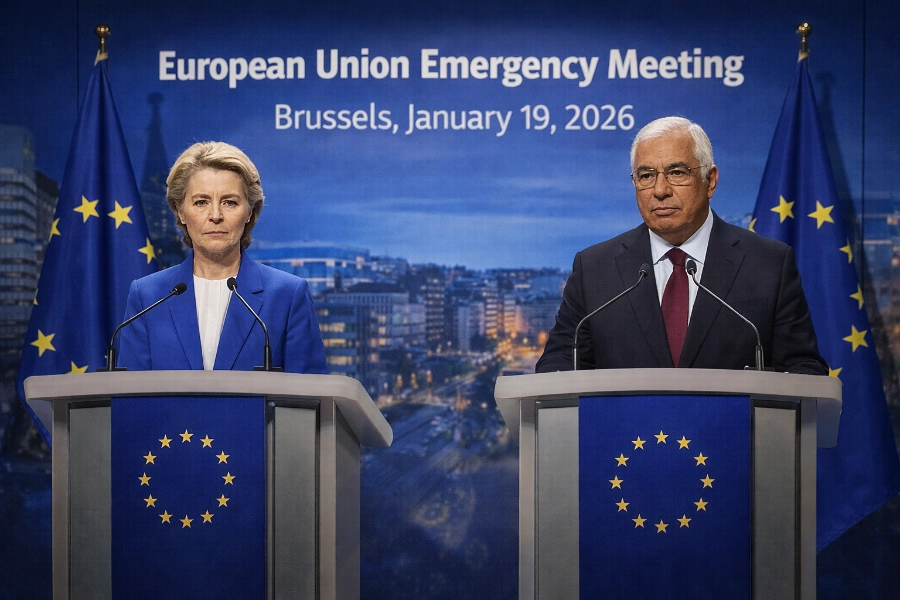
European Union capitals entered emergency consultations Sunday to coordinate retaliatory measures. Reuters reported discussions of tariffs worth up to $108 billion on American products. French President Emmanuel Macron asked the EU to activate its anti-coercion instrument—colloquially termed a “trade bazooka”—designed for exactly this type of unilateral economic pressure from partners.
The threatened tariffs would apply on top of existing levies negotiated under a trade framework agreement reached between the EU and US in 2025. That deal capped tariffs at 15% for the EU and 10% for the UK. European Parliament members indicated the agreement’s ratification—scheduled for debate this week—is now in jeopardy. Manfred Weber, president of the European Parliament, stated on X that “given Donald Trump’s threats regarding Greenland, approval is not possible at this stage.”
Markets began pricing in escalation risk. Analysts noted the potential for factory construction delays and investment postponement as companies face tariff uncertainty. University of Chicago economist Steven Durlauf characterized the situation as representing “an end of the credibility of American commitments” with “adverse effects on the world economy.”
The dispute complicates trade realignment already underway. Canada announced a “strategic partnership” with China last week that includes tariff easing and Chinese EV sales. The EU finalized a trade agreement with South America’s Mercosur bloc after 25 years of negotiation. The simultaneous pursuit of Greenland through economic coercion risks accelerating US trading partners’ pivot toward alternative relationships.
Legal and Constitutional Constraints
Trump’s authority to impose the threatened tariffs faces imminent Supreme Court scrutiny. The tariffs would likely be imposed under the International Emergency Economic Powers Act (IEEPA), the law cited in previous executive orders outlining levies. The Supreme Court is expected to rule in coming weeks on whether Trump can use emergency powers under IEEPA to impose tariffs.
During oral arguments, justices appeared skeptical of the administration’s interpretation. IEEPA makes no explicit mention of tariffs, and its legislative history suggests Congress intended it for freezing assets and blocking transactions during genuine national emergencies—not for trade policy enforcement.
If the Court rules against IEEPA usage for tariffs, Trump would need to rely on alternative legal authorities that tend to be more limited in scope and duration. Section 232 of the Trade Expansion Act allows tariffs on national security grounds but requires Commerce Department investigations. Section 301 addresses unfair trade practices but applies primarily to intellectual property and market access disputes. Neither maps cleanly onto territorial acquisition demands.
The legal uncertainty creates compliance challenges for European exporters and US importers. Companies must decide whether to adjust supply chains, renegotiate contracts, or wait for judicial clarity—a calculus complicated by the February 1 implementation date.
European Unity and Fracture Points
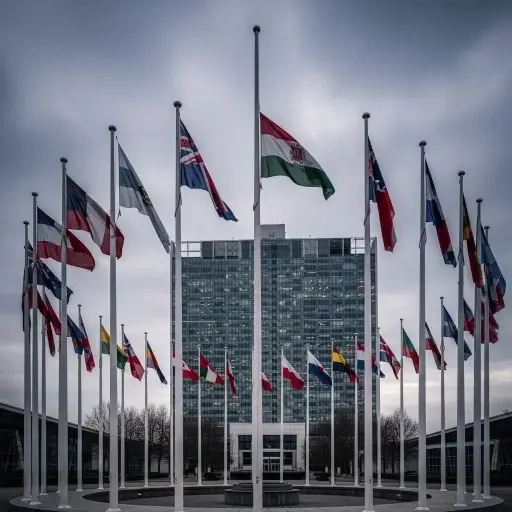
Eight European countries issued a joint statement Sunday condemning the tariff threats as undermining “transatlantic relations” and risking “a dangerous downward spiral.” The statement emphasized their commitment to “upholding sovereignty” and standing “united and coordinated in our response.”
Individual leaders amplified the collective message. UK Prime Minister Keir Starmer told Trump in a phone call that “applying tariffs on allies for pursuing the collective security of NATO allies is completely wrong.” He spoke with Danish Prime Minister Mette Frederiksen, European Commission President Ursula von der Leyen, and NATO Secretary-General Mark Rutte to coordinate positions.
French President Macron declared that “no intimidation or threat will influence us—neither in Ukraine, nor in Greenland, nor anywhere else in the world.” Spanish Prime Minister Pedro Sánchez warned that US military action against Greenland would make Russian President Vladimir Putin “the happiest man in the world” by legitimizing forcible territorial revision.
The unified messaging masks underlying tensions about appropriate response levels. Italy’s Defense Minister Guido Crosetto reportedly likened the troop deployments to “the start of a joke” and hinted the operation was “irrational,” though Italy ultimately declined participation after being asked by Denmark. Italian Prime Minister Giorgia Meloni insisted the operation must be conducted within NATO framework, with NATO coordination, and with US involvement.
Germany’s position evolved over 48 hours. Initially announcing troops would fly directly to Greenland, Berlin reversed course to route personnel through Denmark aboard civilian aircraft—a tactical shift that reduced visibility while maintaining commitment. Chancellor Friedrich Merz, who supported the 2025 trade deal to avoid tariff escalation, now faces pressure to demonstrate resolve without triggering further retaliation.
Greenlandic Self-Determination
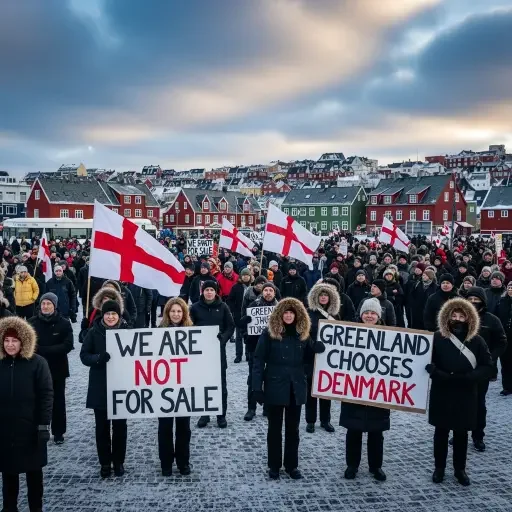
Greenlanders themselves have consistently rejected US acquisition proposals. Opinion polls show overwhelming opposition to American control while strong majorities support eventual independence from Denmark. On January 17, hundreds gathered in Nuuk—Greenland’s capital—to protest Trump’s rhetoric. Signs read “We are not for sale,” “Greenland is not for sale,” and “We shape our future.”
Greenland’s Prime Minister Jens-Frederik Nielsen stated that if forced to choose, “we choose Denmark. We choose NATO. We choose the Kingdom of Denmark. We choose the EU.” Trump responded by saying he didn’t know Nielsen and that his position would be “a big problem for him.”
The demonstrations represented approximately one-third of Nuuk’s population, a remarkable turnout that reflects broad concern about external pressure on Greenlandic autonomy. Greenland holds extensive self-governance rights within the Kingdom of Denmark, including control over most domestic affairs. Denmark retains responsibility for foreign policy and defense.
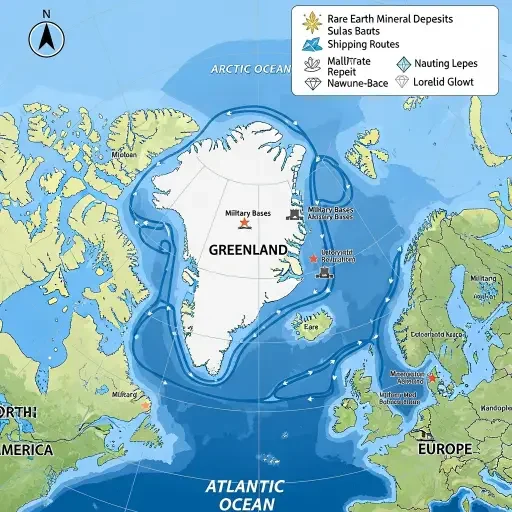
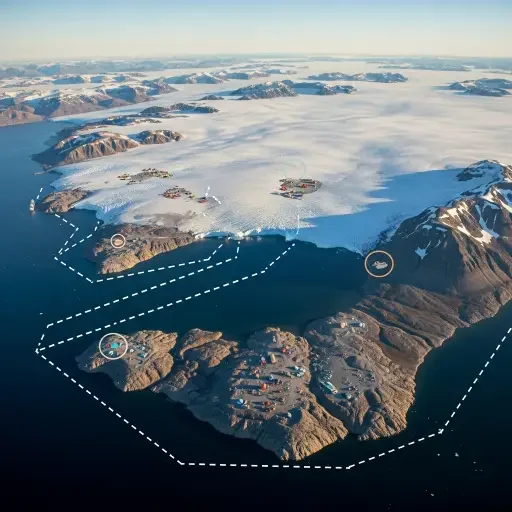
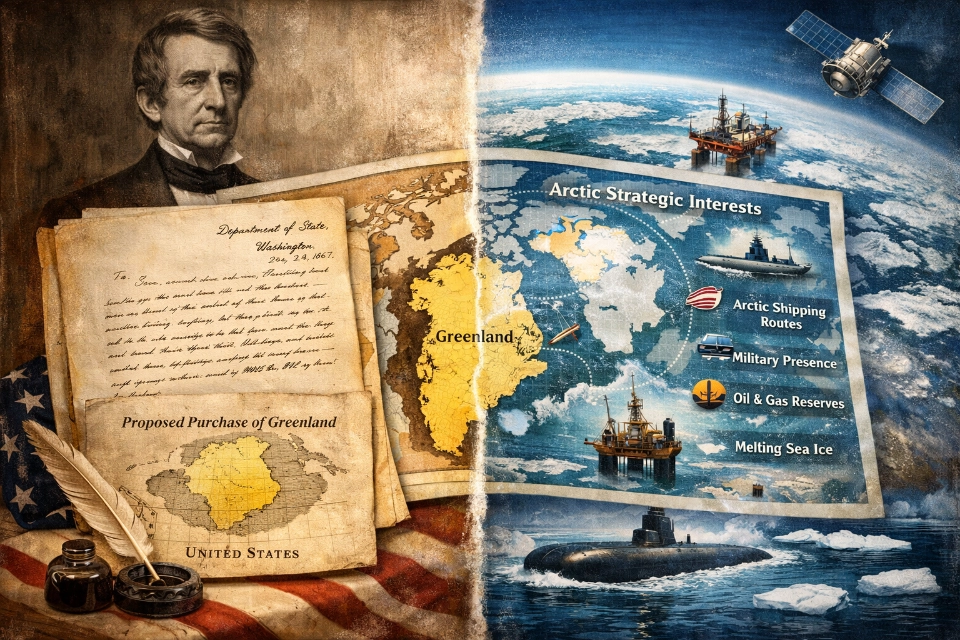
Greenland’s strategic importance has grown as climate change melts Arctic ice, opening shorter shipping routes to Asia and raising interest in untapped mineral reserves. The territory holds significant deposits of rare earth elements used in advanced electronics, renewable energy systems, and defense applications. Trump has also described Greenland as vital to his proposed “Golden Dome” missile defense system.
The competing claims on Greenland’s future—Greenlandic self-determination, Danish sovereignty, US security interests, and NATO collective defense—create a complex negotiating environment where traditional alliance frameworks provide limited guidance.
The NATO Precedent
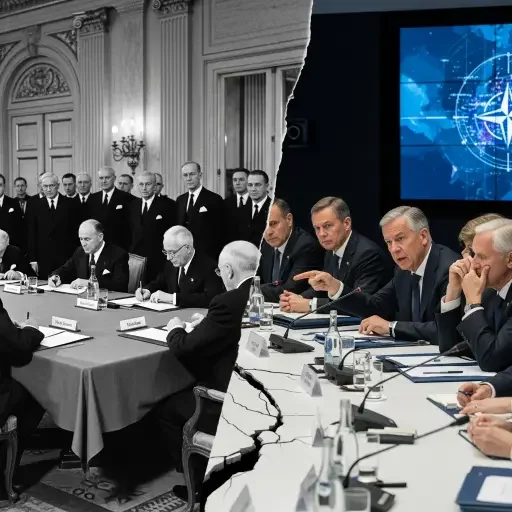
The crisis represents NATO’s first instance of a member state threatening punitive measures against other members for participating in collective defense activities. Article 5 of the North Atlantic Treaty commits members to consider an attack on one as an attack on all. While the provision addresses military attacks rather than territorial acquisition threats, the principle of collective defense underpins the alliance’s 75-year existence.
Danish Prime Minister Frederiksen warned earlier this month that a US attack on Greenland would mark “the end of NATO.” Spanish Prime Minister Sánchez echoed the assessment, calling it “the death knell for NATO” that would make Putin “doubly happy” by creating precedent for forcible territorial revision.
NATO Secretary-General Mark Rutte confirmed he spoke with Trump about the issue Sunday, stating “We will continue working on this, and I look forward to seeing him in Davos later this week.” Rutte’s measured response reflects the alliance’s institutional effort to prevent escalation while maintaining the principle that members’ territorial integrity is inviolable.
The precedent extends beyond Greenland. If a NATO member can successfully use economic coercion to extract territorial concessions from an ally, the framework that has deterred major power conflict in Europe for nearly eight decades loses its binding force. Poland, the Baltic states, and other members with historical experience of territorial revision by larger neighbors are watching the Greenland dispute as a test of whether NATO’s mutual defense guarantees retain meaning.
Market Implications and Sector Impacts
Defense stocks face conflicting pressures. Increased European Arctic military activity and potential NATO Arctic Sentry missions would boost demand for cold-weather equipment, surveillance systems, and naval platforms. However, alliance fracture would complicate transatlantic defense cooperation and integrated procurement.
Shipping and logistics companies with Arctic routes confront regulatory uncertainty. If Greenland’s status remains contested, insurance costs for vessels transiting newly opened northern passages could rise. Maritime law regarding territorial waters and exclusive economic zones becomes more complex when sovereignty itself is disputed.
Rare earth minerals represent the most direct commodity exposure. Greenland holds an estimated 38.5 million metric tons of rare earth oxides—the world’s second-largest known deposit. Current production is minimal, but planned developments could supply 10-15% of global demand within a decade. Chinese firms currently dominate processing and refining, creating strategic competition layers that extend beyond US-European tensions.
Energy markets watch for escalation spillovers. European nations facing US tariffs might accelerate energy independence initiatives or deepen relationships with alternative suppliers. LNG import contracts, renewable energy component sourcing, and grid infrastructure investments could all shift if transatlantic trade reliability declines.
Financial markets have begun pricing sovereign risk premiums for smaller European economies heavily dependent on US trade. Irish, Dutch, and Belgian government bonds—all from countries with significant American economic ties—saw modest spread widening Friday. Currency markets showed euro weakness against the Swiss franc, a traditional safe haven during European political uncertainty.
Congressional and Domestic Opposition
Bipartisan voices in Congress have criticized the Greenland strategy as damaging to NATO cohesion and American credibility. Senator Chris Coons (D-DE) led a congressional delegation to Copenhagen that sought to reassure Denmark and Greenland of American commitment to the alliance regardless of executive branch rhetoric.
“I hope that the people of the Kingdom of Denmark do not abandon their faith in the American people,” Coons stated in Copenhagen. He emphasized respect for Denmark and NATO based on “all we’ve done together.”
Republican opposition has been more muted but present. Some GOP lawmakers expressed concern that tariff threats against allies undermine America’s negotiating position with China and Russia. The Supreme Court case on IEEPA authority originated partly from congressional dissatisfaction with expansive executive trade powers, suggesting institutional resistance to unchecked presidential tariff authority spans partisan divides.
Domestic political calculations complicate the dispute. Trump faces reelection messaging that emphasizes strength, deal-making, and America-first positioning. Backing down on Greenland without securing concessions could be framed as weakness by political opponents. Yet sustained confrontation with European allies risks alienating national security establishment Republicans and moderate voters concerned about alliance stability.
The Working Group Wild Card
The January 14 Washington meeting between US, Danish, and Greenlandic officials produced an agreement to establish a working group on Arctic security. The group is set to convene within weeks, though its mandate remains disputed.
Denmark characterized the working group as focused on strengthening Arctic security within existing frameworks—meaning NATO structures, Danish sovereignty, and Greenlandic self-determination. The White House offered no detailed description but has not publicly committed to respecting Danish sovereignty as a precondition for negotiations.
The working group could provide diplomatic cover for de-escalation. If discussions produce a formula that increases US military presence in Greenland under the 1951 agreement while preserving Danish sovereignty and Greenlandic consent, Trump could claim enhanced American Arctic capabilities while European allies avoid challenging precedent.
Alternatively, the working group could formalize the impasse. If US demands explicitly include sovereignty transfer or governance arrangements that Greenlanders reject, the diplomatic process clarifies that no compromise exists—potentially accelerating both economic and military escalation.
NATO diplomats privately suggest the Arctic Sentry concept could be introduced through the working group as a face-saving mechanism. Formalizing a multilateral NATO Arctic mission allows Trump to claim credit for forcing increased allied defense spending and Arctic focus, while Denmark and Greenland avoid direct sovereignty concessions. European capitals could tout burden-sharing success and Arctic security enhancement.
Whether the working group produces breakthrough or breakdown depends partly on whether Trump views Greenland primarily as a strategic security objective or as leverage for broader negotiating goals with Europe and China.
Historical Context and Presidential Ambitions
The United States has pursued Greenland acquisition since the mid-19th century. Secretary of State William Seward proposed purchase in 1867, the same year the US acquired Alaska from Russia. President Harry Truman offered $100 million for Greenland in 1946, shortly after World War II demonstrated the territory’s strategic value for Arctic air routes and early warning systems.
Trump first raised Greenland acquisition publicly during his first term, generating brief controversy before other issues dominated attention. His renewed focus during the second term coincides with several strategic shifts: accelerated Arctic ice melt opening shipping routes, intensified great power competition with China and Russia, and domestic political emphasis on territorial expansion and resource nationalism.
The “Golden Dome” missile defense system Trump has promoted represents updated thinking about ballistic missile threats from multiple vectors. Greenland’s geographic position offers coverage of northern approach routes that southern US bases cannot address. Whether a missile defense architecture truly requires sovereignty rather than basing rights under the existing 1951 agreement remains technically disputed.
Chinese and Russian Arctic activity has increased measurably over the past decade. China has invested in icebreaker construction, polar research stations, and northern shipping route development despite being a non-Arctic nation. Russia has expanded military installations along its Arctic coast and conducted exercises demonstrating capabilities to project power in polar regions.
Whether those developments constitute threats that only US sovereignty over Greenland can address—or whether NATO collective defense and enhanced allied Arctic presence provide adequate security—represents the core strategic question the current crisis forces into focus.
What Happens Next
February 1 represents the first decision point. If Trump implements the 10% tariffs as announced, European retaliation would likely follow within days. EU emergency procedures allow trade countermeasures without the lengthy investigations typically required for WTO-compliant tariffs. The resulting escalation spiral could reach $200-300 billion in affected trade within weeks.
The Supreme Court ruling on IEEPA authority could arrive before February 1 or after. A decision limiting presidential tariff power would force Trump to pursue alternative legal authorities or acknowledge constraints. That outcome might de-escalate the crisis by making the tariff threats unenforceable, though it could also prompt Trump to seek more dramatic actions to demonstrate resolve.
The working group’s initial meeting—scheduled for sometime in late January or early February—could produce early signals about negotiating space. If participants emerge emphasizing shared interests and incremental progress, markets would likely interpret that as reducing escalation risk. If the meeting collapses amid public recriminations, both tariff implementation and military posturing would accelerate.
European unity faces its own sustainability questions. Maintaining coordinated trade retaliation and military deployments requires consensus among eight nations with varying threat perceptions, economic exposures, and domestic political pressures. The longer the crisis extends, the greater the opportunity for Trump to exploit divisions through selective exemptions or bilateral deals.
Greenlandic public opinion will continue shaping constraints. If protests expand and political leaders face domestic pressure to reject any framework that compromises self-determination, Denmark’s negotiating flexibility narrows regardless of what security arrangements the working group might propose.
The crisis unfolds against multiple simultaneous pressures: Trump’s meeting with NATO Secretary-General Rutte at Davos this week, the European Parliament’s debate on the US-EU trade agreement, Supreme Court deliberations on IEEPA authority, and European capitals’ coordination of potential retaliatory measures. Each proceeding operates on different timelines with different decision-makers, creating a complex strategic environment where miscalculation risks are elevated.
What began as a territorial acquisition proposal has evolved into a test of whether the post-World War II transatlantic security architecture can survive internal economic coercion. The answer will determine more than Greenland’s future—it will establish precedent for how NATO members relate to each other when strategic interests and sovereignty claims collide.
Related Articles
Sources
Research drawn from Wikipedia Operation Arctic Endurance details and timeline, CNBC/CNN/Bloomberg on European troop deployments and Danish defense minister statements, NBC/ABC/NPR on Trump tariff announcement and European leadership responses, Radio Free Europe and Defense News on NATO Arctic Sentry, TIME and Atlantic Council on Greenland strategic importance, Al Jazeera and Reuters on EU emergency meetings and retaliation planning.