

On June 30 in Gwangju, Samsung and SK Hynix pledged 800 trillion won to build four memory fabs in South Korea's Honam region — the country's first southwest chip hub — as President Lee Jae Myung's government targets doubling national DRAM capacity within five years. The bet tests whether AI-driven HBM demand overrides memory's brutal boom-bust cycle.
On Tuesday at the Kim Dae-jung Convention Center, Samsung Vice Chairman Jun Young-hyun and SK Hynix CEO Kwak Noh-jung stood beside President Lee Jae Myung and signed memoranda that redraw South Korea’s industrial map. Samsung pledged 425 trillion won for the Honam region — 400 trillion for two memory fabs in Gwangju plus a national AI computing center in Haenam. SK Group committed 470 trillion won for two memory fabs and a one-gigawatt AI data center. Amkor Technology added one trillion won for advanced packaging nearby. Together, the southwest package totals 896 trillion won ($578 billion).
The headline number is 800 trillion won for four front-end fabrication plants — the first memory fabs ever sited in Honam, a region better known for agriculture and shipbuilding than cleanrooms. Each chipmaker builds two fabs. Seoul’s goal is explicit: double national DRAM production capacity within five years while accelerating timelines at existing clusters in Yongin and Pyeongtaek that can no longer absorb the demand alone.
Yongin Was Not Enough
South Korea’s memory industry has always concentrated north of Seoul. Samsung’s Yongin cluster — a 360 trillion won, six-fab program targeting 2040 — and SK Hynix’s 600 trillion won Yongin investment, announced in 2019 with its first fab not arriving until February 2027, illustrate the physics of semiconductor geography. Power, water, talent, housing, permitting: each fab is an eight-year civil engineering project wearing a bunny suit.
Jun Young-hyun said as much on stage. Yongin will not meet future global demand. With AI-era investment schedules already accelerated at the capital-region complex, the timing to prepare a second hub has moved forward. SK Hynix’s Yongin timeline was compressed by twelve years under the government’s new “3S+1F” framework — speed, hubs, leadership, plus full state support for permitting, infrastructure, and workforce pipelines.
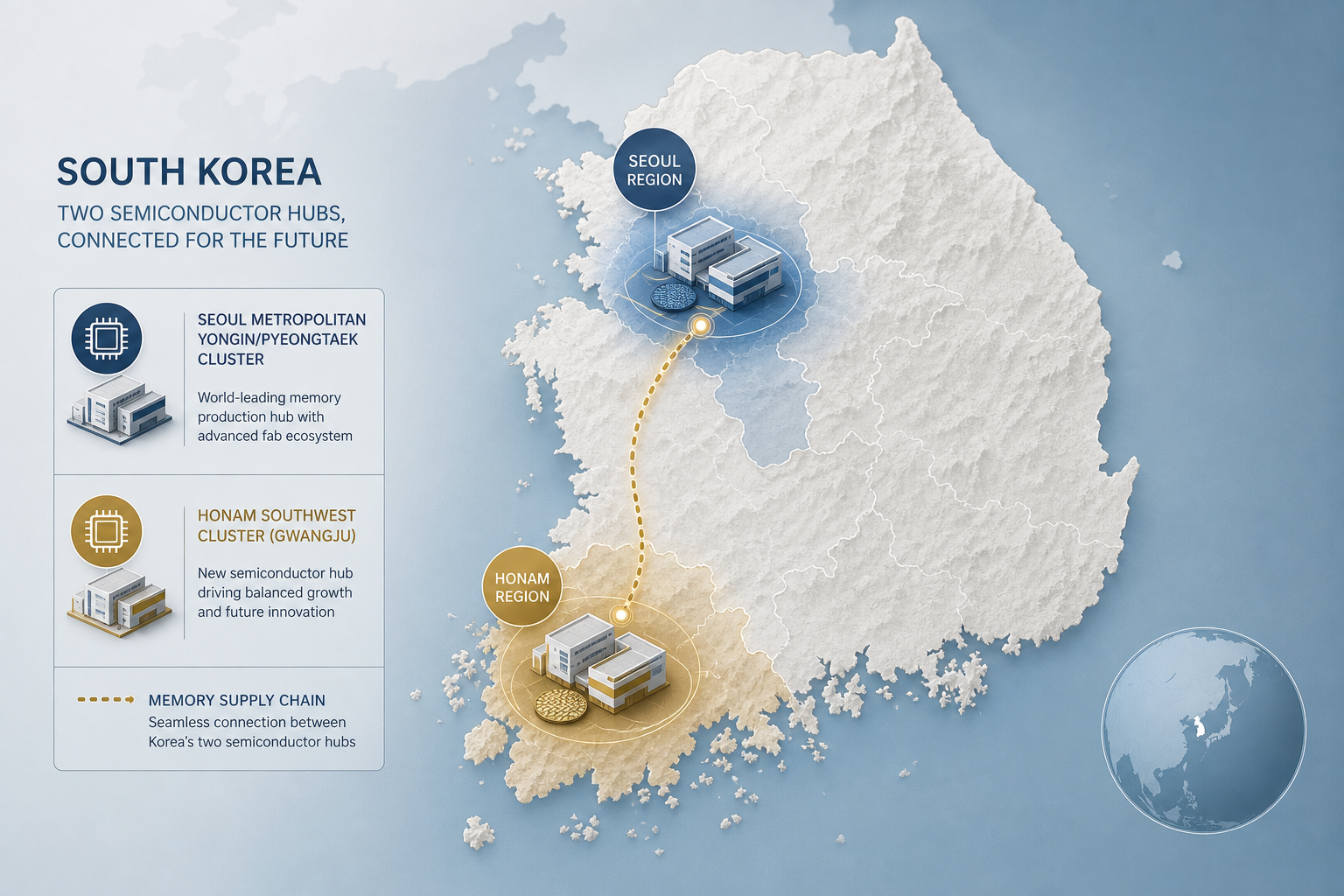
The Honam sites remain under final selection among three candidates: the Gwangju military airport parcel, the Advanced District 3 site in Oryong-dong, and Solaseado near Haenam and Yeongam. Samsung targets construction start in the second half of 2026 and initial operations in 2028 — aggressive by historical standards, enabled by fast-track permitting and coordinated ministries spanning trade, finance, science, land, and energy. President Lee told the chairmen he urged them to proceed with both Yongin and Honam simultaneously. The government, he said, would provide financial aid, infrastructure, and education improvements without reservation.
HBM Rewrites the Wager
The investment logic is not abstract industrial policy. It is Nvidia’s supply chain wearing a hanbok.
SK Hynix dominates high-bandwidth memory — the stacked DRAM packages that feed AI accelerators — and its shares have risen roughly 307 percent year to date. Samsung Electronics, investing heavily to narrow the technology gap with its domestic rival, is up about 179 percent. Both stocks slipped on Monday when the mega-project headlines landed, a reminder that even believers price in execution risk, capital intensity, and memory’s ancestral curse: the oversupply hangover.
HBM is supposed to break that cycle. AI servers do not swap out memory modules on commodity spot markets; they bind to validated stacks with long qualification windows. The government’s parallel 81 trillion won Chungcheong packaging hub — an HBM-specific belt — signals where Seoul thinks margin will pool. Front-end fabs in Honam feed back-end packaging in Chungcheong, which feeds hyperscaler racks globally.
Yet the scale still staggers. Industry reports place Samsung’s decade-long roadmap near 2.65 quadrillion won and SK Group’s near 2.1 quadrillion when data centers and nationwide AI infrastructure are included — figures that begin to rhyme with hyperscaler capex and China’s own five-year semiconductor ambitions. The Korea Economic Daily floated two quadrillion won in fresh investment over ten years. Companies stressed flexibility: schedules adjust with market conditions, a hedge against the very bust their expansion might invite.
A Nation Betting on Silicon Geography
Lee Jae Myung called Samsung Chairman Lee Jae-yong and SK Chairman Chey Tae-won “national heroes” at Sunday’s Blue House briefing — language usually reserved for Olympic medalists, not men who announce fab timelines. The rhetoric is strategic. South Korea’s export economy lives and dies on memory pricing. A second production hub in the politically neglected southwest doubles as regional development policy: integrated Jeolla-Gwangju governance launches alongside the semiconductor pledge, tying industrial prestige to votes.
For the rest of the world, the Honam gamble is simpler. If Samsung and SK Hynix execute, AI’s memory bottleneck eases. If they overbuild into a demand shortfall, the industry’s familiar script returns — writ larger, because this time the fabs sprawl across two national corridors instead of one.
The chairmen bowed. The president bowed back. Eight hundred trillion won is a bet that the AI cycle is not another flicker on memory’s long chart — that HBM demand is a lamppost sturdy enough to justify pouring concrete in a region that has never seen a wafer. Gwangju will find out first.
Continue reading


Sources
Yonhap News Agency, Korea Herald, Korea JoongAng Daily, Herald Business, The Elec, CNBC, Business Times Singapore, DongA Science, TechCrunch on Samsung and SK Group investment briefings in Gwangju, June 29–30, 2026


