

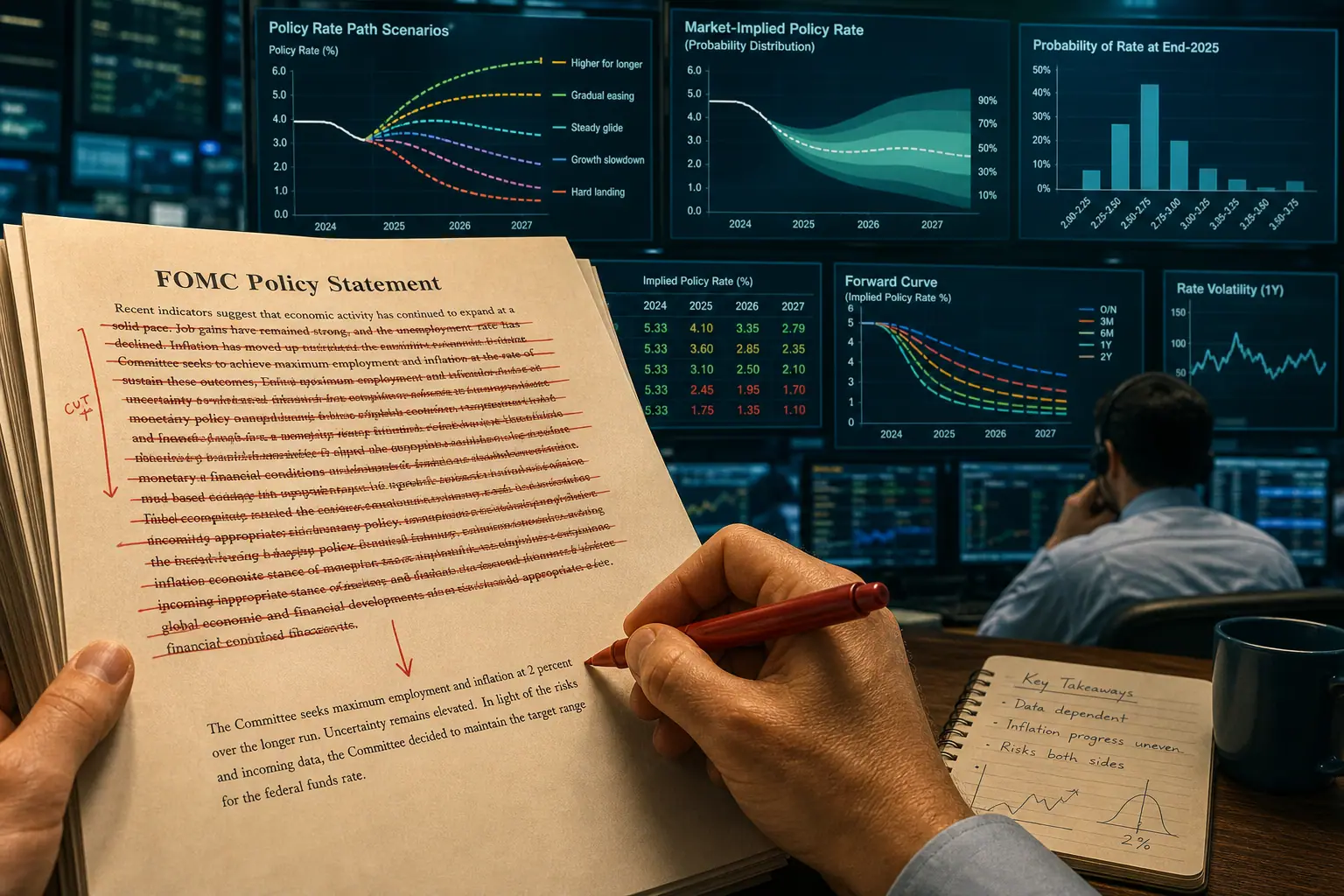
The Federal Reserve's July statement was the second under Kevin Warsh and still ran near 130 words — less than half the Powell-era norm. Forward guidance remains gone; vote detail returned only as a partial patch. Markets that once traded adjective edits now face a thinner official channel and a thicker interpretive bottleneck.
The Federal Reserve used to publish a short essay. Under Kevin Warsh it publishes a telegram.
June’s inaugural Warsh statement ran about 130 words — down from figures above 300 in recent Powell-era meetings, per CNBC’s count — and stripped out forward guidance and the vote tally. July 29’s follow-up kept the short template, held the funds rate, and restored only one missing instrument: names. Beth Hammack, Neel Kashkari, and Lorie Logan dissented in favor of a quarter-point hike in a 9–3 decision. The prose still refused to sketch a path. Warsh’s June gloss remains the doctrine: the statement is “a bit shorter, a bit simpler,” and forward guidance is “not well suited for the current policy conjuncture.”
Less Text, More Improvisation
Markets did not lose information in some abstract sense. They lost a protocol — the ritual of scanning for adjective substitutions that once moved Treasury futures by basis points. When the official channel thins, improvisation thickens. Desks lean harder on the press conference, the dot plot when it appears, regional Fed speeches, and — as several firms now admit — AI parsers trained on Warsh’s thinner corpus. That is not clarity. It is bandwidth migration.
Warsh’s stated rationale is almost the inverse of the Powell years. He wants market prices “direct and unfiltered,” not fogged by rolling Fed forecasts that the committee then has to chase. In the July press conference he refused the word “pause,” preferring “rigorous review,” and reminded markets that five-plus years of above-target inflation will not be cured in nine weeks. The Fed is trying to stop talking so that prices can talk. Traders hear a vacuum and fill it — which is how risk premia reprice when political and policy signals arrive half-formed, a pattern Culled tracked when Trump-era freezes and tariff talk widened spreads.
Governance Quiet, Capital Loud
The bottleneck is institutional, not stylistic. A communication task force — including Peter Fisher and former Bank of England Governor Mervyn King — is still reviewing Fed practice. Until that review hardens into a stable template, every meeting is a format experiment as well as a rate decision. That sits inside a broader 2026 shift: GOP-aligned regulators remaking oversight while the central bank remakes its voice. State power still sets the rules; capital invents the footnotes.
Cross-asset readers should treat the statement the way they already treat fragile narratives elsewhere. When markets priced peace on thin geopolitical text, the correction arrived through earnings and energy, not through a clearer communiqué. Crypto faces its own audit of existential risk vectors without a central narrator. Sparse official language does not eliminate uncertainty. It relocates it onto whoever is willing to underwrite a story.
Trade the Bottleneck, Not the Adjective
The actionable frame is narrow. Watch whether vote tallies remain a permanent fixture or a July exception — that is the only high-entropy field left inside the statement itself. Watch the spread between press-conference verbs (“review,” “not waver”) and futures-implied paths; when the gap widens, the interpretive premium is rising. Watch the task force’s output as a regime marker: a settled short template is tradeable; a moving template is noise tax.
State force binds the channel. Capital adapts by inventing substitutes. Until Warsh’s Fed decides how much of the old crossword it will restore, the scarce input is not another adjective. It is a shared reaction function — and markets are writing drafts in public.
Continue reading


Sources
CNBC redline comparison of June and July 2026 FOMC statements; Federal Reserve July 29 press conference transcript; coverage of Warsh's communication task force and 9–3 rate hold; Culled prior Warsh and political risk premia reporting


