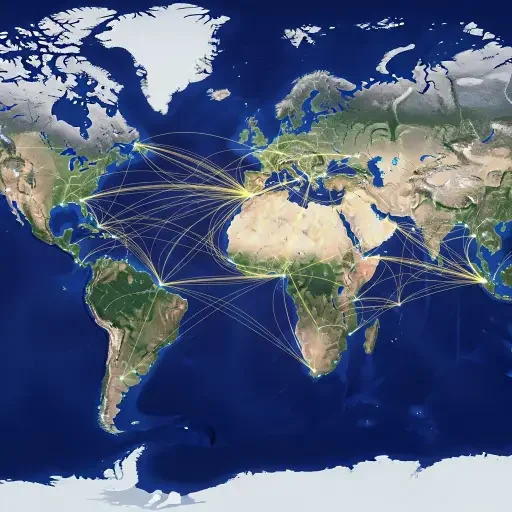

The European Union and the Comprehensive and Progressive Agreement for Trans-Pacific Partnership are in early-stage talks to link their economies in what would constitute the most expansive trade alignment since Bretton Woods. According to multiple diplomatic sources reported by Politico in mid-February, Canada is spearheading the effort — a logical move from Prime Minister Mark Carney, who has spent weeks urging middle powers to resist unilateral U.S. tariff pressure rather than accommodate it.
The numbers are difficult to overstate. An integrated EU-CPTPP framework would connect economies representing roughly 45 percent of global GDP and more than a third of all international trade. The CPTPP alone — which now includes the United Kingdom following its December 2024 accession — already binds twelve nations across the Indo-Pacific. Add the EU’s twenty-seven member states, and the combined bloc encompasses over three billion people. Projections suggest it could account for 40 percent of global GDP growth in 2026 alone.
The Membership Pipeline Compounds the Shift
The CPTPP isn’t just talking to Europe — it’s simultaneously expanding its own perimeter. At the bloc’s ninth commission meeting in Melbourne last November, members advanced Costa Rica’s accession and declared four additional countries — Uruguay, the United Arab Emirates, the Philippines, and Indonesia — eligible to begin negotiations in 2026. Cambodia applied in late December, citing the pressure of U.S. tariffs as an explicit motivator.

Each new entrant compounds the gravitational pull. A German automaker sourcing parts from Japan, Vietnam, and Mexico — all CPTPP members — can move components tariff-free. The same automaker sourcing from a U.S. supplier faces elevated duties. The calculus doesn’t require ideology. It requires arithmetic.
Self-Reinforcing Exclusion
This is the dynamic that American trade coverage consistently underplays. The standard framing treats tariffs as bilateral negotiations — Washington versus Beijing, Washington versus Ottawa. But the structural consequence is multilateral. As allied nations build alternative supply chains under lower tariff regimes, those systems develop their own inertia: contracts get signed, logistics routes get optimized, regulatory standards converge. The World Trade Organization projects that North America faces the steepest drop in exports for 2026, and the reason is architectural, not cyclical.
The pattern is self-reinforcing. Every month that countries invest in CPTPP-aligned supply chains is a month in which the cost of re-integrating the United States increases. Rejoining a trade architecture you helped design but then abandoned is a qualitatively different challenge than joining a new one. The institutional memory of American withdrawal — first under Trump in 2017, then the continued absence under Biden, and now the active hostility of the second Trump term — has altered how partner nations calculate reliability.
What the U.S. Loses Isn’t Just Markets
Vietnam now chairs the CPTPP for 2026. The bloc is negotiating upgrades in e-commerce, digital trade, services, and customs administration — the very sectors where American firms hold competitive advantages. Standards being written without U.S. input become standards that don’t favor U.S. business models. If the EU-CPTPP negotiations produce a linked digital trade chapter, the regulatory framework governing data flows, platform competition, and intellectual property across nearly half the world’s economy will have been designed in rooms Washington chose not to enter.
The United States still has the world’s largest single-country economy, the reserve currency, and unmatched military reach. But trade architecture is not built on power alone — it’s built on participation. And participation, once forfeited at scale, is not easily recovered by decree.
Tags
Related Articles
Sources
Politico diplomatic sources via Anadolu Agency, CPTPP 9th Commission proceedings (Melbourne, November 2025), Australian Department of Foreign Affairs and Trade, Wageningen University economic projections, US-ASEAN Business Council analysis, IISD trade reporting