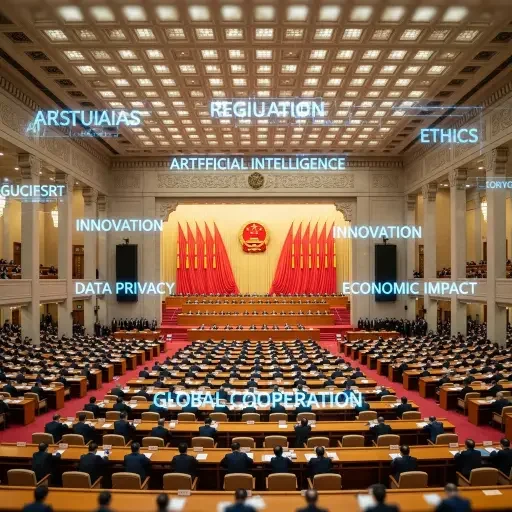
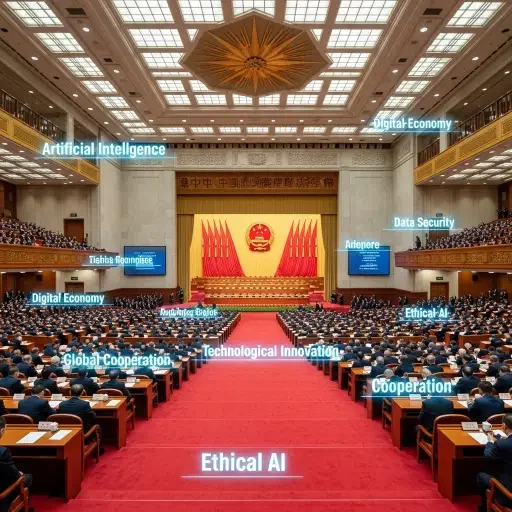
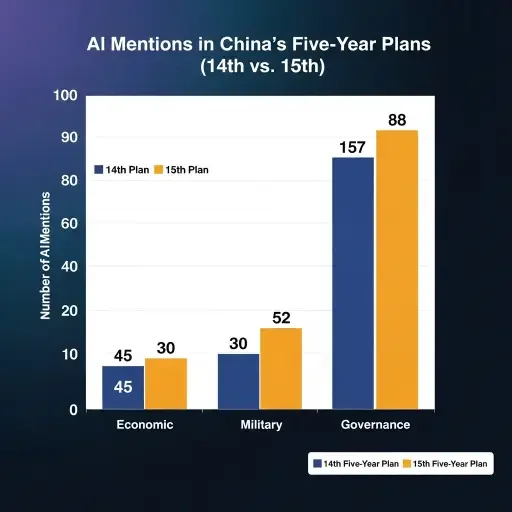
The draft of China’s 15th Five-Year Plan, submitted to the National People’s Congress on March 5, mentions artificial intelligence 52 times. The 14th plan, released in 2021, mentioned it 11 times. This is not incremental emphasis. It is a doctrinal reclassification — what the Government Work Report calls, for the first time, the construction of a “new form of intelligent economy.” AI has been elevated from a capability to be deployed into a structural principle around which economic activity is organized.
The plan’s AI Plus initiative, first announced in 2024, now carries a formal target: integrate AI across 90 percent of China’s economy by 2030. That target spans manufacturing, healthcare, logistics, finance, and agriculture. The government intends to deploy AI agents capable of performing tasks with minimal human oversight and experiment with robots in industries facing labor shortages — a category that, given China’s demographics, encompasses nearly all of them.
The Demographic Logic Behind the Bet
China’s working-age population peaked around 2015 and has been declining since. The fertility rate has fallen below Japan’s. The country’s old-age dependency ratio is projected to double by 2050. Beijing’s response is not to stimulate consumption or liberalize immigration. It is to substitute labor with intelligence — literally. The Five-Year Plan calls for accelerated deployment of humanoid robots, expansion of autonomous systems in manufacturing, and investment in brain-machine interfaces as a “future industry” alongside 6G, quantum computing, and nuclear fusion.
The logic is internally consistent, even if the scale is staggering. If you cannot grow the workforce, you grow its per-capita output through automation. If that automation requires compute, you build compute infrastructure. If that compute infrastructure requires chips you cannot currently manufacture at the frontier, you invest in domestic semiconductor production while racing to close the gap. Each link in the chain connects to the next. The plan’s target of raising the value-added of “core digital economy industries” to 12.5 percent of GDP is not an aspiration — it is a structural dependency.
What the Plan Does Not Say
HSBC’s chief Asia economist Fred Neumann observed that China’s government “remains laser-focused on spurring technological breakthroughs and high-tech investment.” What it remains conspicuously unfocused on is household consumption. The plan pledged a “notable” increase in consumer spending without specifying figures — a vagueness that disappointed analysts expecting demand-side reforms. China currently invests 20 percentage points of GDP more than the global average while its households spend roughly 20 points less. The Five-Year Plan does not close that gap. It deepens the bet that production-side intelligence can substitute for demand-side growth.
The growth target itself — 4.5 to 5 percent for 2026, down from last year’s 5 percent — signals that Beijing is absorbing the slowdown rather than fighting it with stimulus. Dan Wang of Eurasia Group noted that the government appears to be using a period of relative trade truce with the United States to manage the labor market pressure that comes from cutting overcapacity in low-value industries. The plan also pledges to maintain competitive dominance in rare earths, a supply chain lever that remains among Beijing’s most effective instruments of technological statecraft.
The Containment Paradox
The plan was written in the shadow of U.S. export controls, entity list designations, and the ongoing attempt to deny China access to frontier chips and chipmaking equipment. Beijing’s response is not retreat but acceleration. The blueprint calls for breakthroughs in new model algorithms and high-end AI chips, expanded basic research funding, and a stronger pipeline of scientific talent — framed under the banner of “high-level sci-tech self-reliance.”
The paradox for Washington is structural. Every round of export controls increases Beijing’s incentive to build domestic alternatives. Every domestic alternative that succeeds — DeepSeek’s cost-efficient models, SMIC’s progress at mature nodes, BYD’s autonomous driving stack — reduces the leverage of future controls. The Five-Year Plan is not a reactive document. It is a five-year roadmap for making containment obsolete.
China is not adding AI to its economy the way a company adds a software tool. It is redesigning the economy’s operating system around a technology it believes can offset demographic decline, absorb geopolitical shocks, and sustain growth without the consumption rebalancing that every Western economist has been recommending for a decade. Whether the bet pays off is an open question. That the bet has been placed is not.
Tags
Related Articles
Sources
South China Morning Post 15th FYP draft reporting, Daily Sabah NPC analysis, The Quantum Insider quantum/AI coverage, Al Jazeera NPC preview, China Galaxy Securities government work report interpretation, Rödl & Partner FYP overview, Asian Tech Roundup synthesis, Reuters AI mentions data, HSBC chief Asia economist commentary