
California’s proposal to levy a supplemental tax on the ultra-wealthy lands like a moral corrective: take more from those who have benefited most from the tech boom and spend it on housing, climate resilience and education. The political argument is straightforward; the economic one is knotty. At stake is not only a revenue line but the behavioural architecture that underpins venture-backed risk-taking: where founders live, how investors price risk, and how much upside is needed to justify long-shot firms. This piece unpacks the mechanisms by which a billionaire surcharge could change capital flows and firm behavior, and which effects matter most for California’s future as an innovation engine.

The tax’s direct arithmetic is simple: a modest additional effective tax rate on household wealth or realized gains of the very richest can raise meaningful sums when concentrated at the top. Those dollars buy public goods—affordable housing near transit, pre‑K slots, wildfire defenses—that arguably bolster long-run productivity and broaden the talent pipeline. But money is not the only input to innovation. Incentives—particularly the asymmetric payoff structure that compels founders to endure multiple failures before a disruptive success—are equally important.
A surcharge alters that payoff structure in three ways. First, it reduces after-tax upside. Founders and early employees accept outsized risk because the marginal value of a successful exit is large relative to alternatives. Increase the tax wedge on that upside, and the incentive to tolerate extreme risk shrinks. Second, it raises the effective cost of failure. If successful outcomes are taxed more heavily, risk-seeking capital might demand higher expected returns ex ante, raising hurdle rates and narrowing the set of fundable ideas. Third, it reshapes domiciliary decisions: high-net-worth individuals can move, re-domicile companies, or restructure holdings to minimize state exposure.
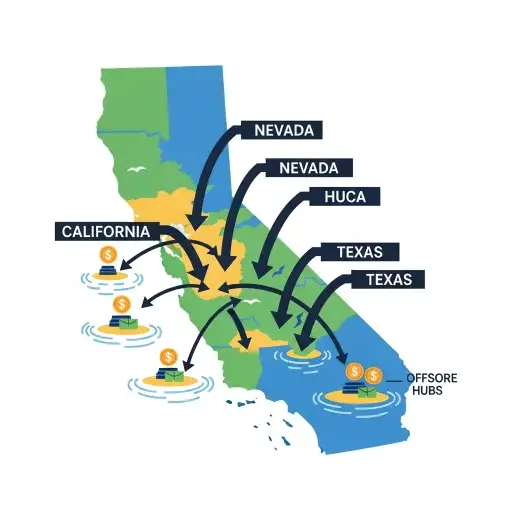
How large are these behavioural margins? Empirical work offers mixed signals. Studies of state-level tax changes suggest that moderate increases in top rates produce modest migration of wealthy households but sizable reaction in timing of realized gains—founders accelerate exits or defer liquidity events to avoid taxes. Evidence also shows that entrepreneurs respond to after-tax returns: higher taxes on gains correlate with fewer firms reaching the scale needed for public listings, all else equal. Still, causality is messy. Many founders value local ecosystems—talent pools, specialized services, venture networks—so migration has friction. The decision calculus is not solely fiscal; it’s architectural.
Policy design can blunt the downside. A narrowly drawn surcharge on net wealth above a very high threshold, with exemptions for unrealized stock options held in private companies or generous loss offsets for failed startups, preserves the skewed upside entrepreneurs need. Temporary credits for local reinvestment, or carve-outs tied to job creation and R&D spending in California, can tilt the calculus back toward staying put. Conversely, a broad, poorly targeted tax on realized gains could incentivize founders to exit earlier, transfer headquarters, or optimize residency out of state.
The investor side is instructive. Venture capital doesn’t exist in a vacuum: returns are after-tax returns discounted for illiquidity and failure rates. If taxes bite into the distributable carry or partners face higher effective rates, fund structures could shift—longer hold periods, larger deals, or migration of fund managers to friendlier jurisdictions. That would not eliminate capital; it would reallocate it. California’s comparative advantage is not only capital abundance but an embedded service layer—law, banking, talent, specialized SaaS—that responds poorly to fragmentation.

There is also a normative calculation. Inequality has externalities: exploding housing costs and overwhelmed public schools undermine labor supply and civic cohesion. A targeted billionaire tax that funds concrete public-good investments could strengthen the ecosystem by expanding access and removing bottlenecks that currently throttle productivity. Put differently: some public investments have positive returns to the private sector that exceed the administrative cost of the tax.
Where the political rhetoric often outruns the economic precision is in framing the tax as binary—either salvation or death for Silicon Valley. The empirical middle ground is more plausible: modest distortion to incentives, concentrated mostly among the very richest, systemic benefits if revenue is well-directed, and real—but mitigable—risks of tax‑driven restructuring. The magnitude of behavioral change depends on rate design, enforcement, and reciprocity across jurisdictions.
Three pragmatic prescriptions follow. First, design the surcharge to protect venture-specific upside: allow favorable treatment for carried interest tied to long-term fund performance, or permit extended loss carryforwards for failed startups. Second, earmark proceeds transparently for services that directly raise productive capacity—affordable housing near employment centers, scaled childcare, and transit—so the public return is visible to capital allocators. Third, monitor and iterate: collect data on residency changes, timing of exits, and investment patterns, and be prepared to tweak the rules to prevent avoidance or excessive relocation.
The policy question is not whether to tax the rich—that ship has sailed politically—but how to tax them without dismantling the upside asymmetry that powers risk-taking. California’s experiment can succeed if designers acknowledge that capital responds to after-tax geometry, while also recognizing that public goods can amplify private returns. Get both levers right and the state could turn concentrated wealth into sustained, inclusive productivity. Botch them, and you only accelerate a fiscal—and entrepreneurial—exodus.
Tags
Related Articles
Sources
Analysis synthesizes public policy proposals, academic literature on taxation and entrepreneurship, California fiscal data, and interviews with venture investors and founders reported in public filings.