

New Zealand's average 91 petrol price moved back above NZ$3 a litre around Sept. 11, with Gaspy printing about $3.06 to $3.08. The print is not a crude headline. It is finished-fuel import cost — priced off Asian product markets — landing inland after Marsden Point closed.
New Zealand’s average price for unleaded 91 moved back above NZ$3 a litre around Sept. 11. Fuel-tracking app Gaspy put the national print near $3.06, with weekend reads around $3.08. Auckland is where that import bill becomes a household receipt — not because the city owns a unique crude benchmark, but because it sits at the end of a finished-fuel chain that no longer runs through a domestic refinery.
The dominant explanation is already on the wire: Middle East maritime stress, a tighter Red Sea, Brent above $100, and “pain at the pump.” That story is true as atmosphere. It does not say why the number is specifically north of three dollars now, or which lag turns a Hormuz week into an Auckland fill-up.
The residual is the measured transmission. If Hormuz-and-Bab-el-Mandeb is the shock, what connects that waterway to a Gaspy average that cleared NZ$3?
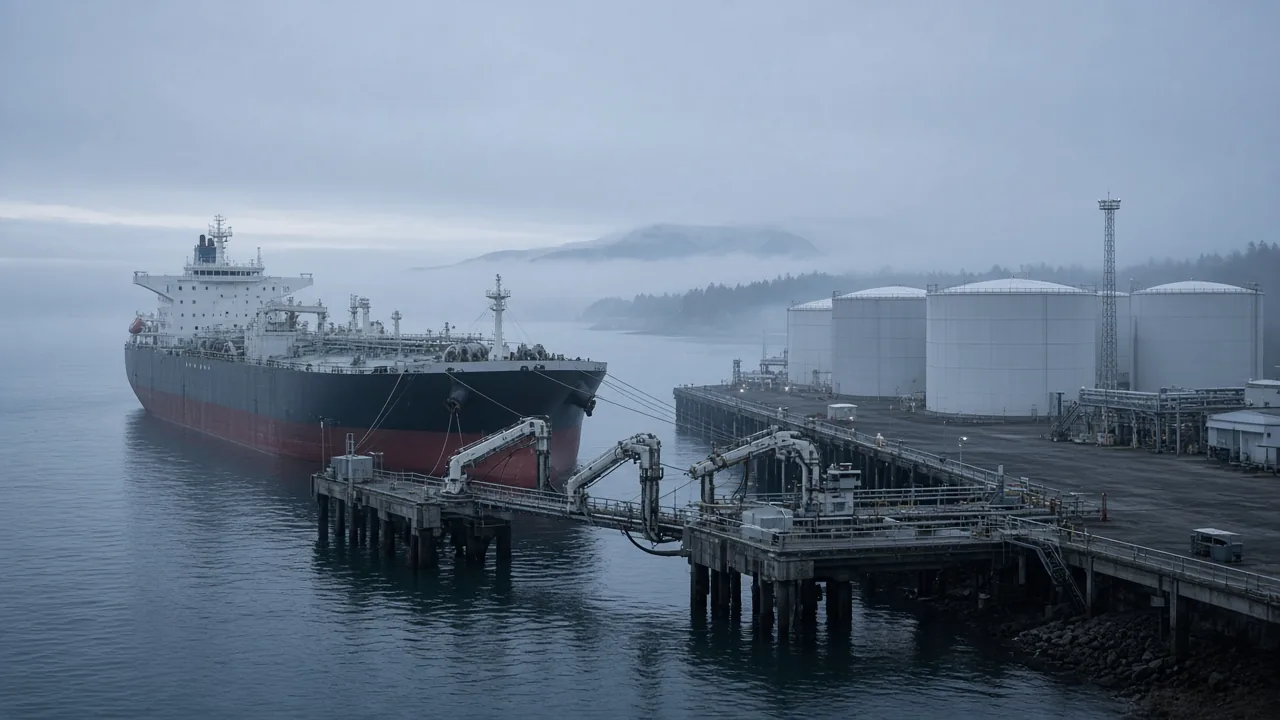
New Zealand does not import the war as crude into a home cracker. Marsden Point closed in 2022. The country now imports finished petrol and diesel. ANZ Research’s Sept. 11 Weekly Fuel Market Watch notes that more than 98 percent of imported petrol in 2025 came from South Korea, Singapore, and Malaysia — and that the Asian refineries feeding those cargoes still take the bulk of their crude from the Persian Gulf. Hormuz does not have to send a tanker to Marsden Point to move Auckland. It has to tighten the feedstock and freight book behind Singapore and Korea.
That is why Brent alone stopped being a sufficient CPI steer. ANZ’s Miles Workman is explicit: since the Middle East conflict broke out, converting a global crude print into New Zealand dollars is no longer enough. Refining margins, clean-product freight, and the NZD all sit between the strait and the nozzle. ANZ advances Singapore gasoline prices by a week to align with MBIE’s weekly pump series — a chart convention that is also an empirical claim about timing.
MBIE has measured the retail lag. In its restart analysis of importer costs and margins during the 2026 conflict, the ministry describes a usual one-to-two-week delay before domestic pump prices respond to an international surge. Early in the war, international costs jumped while retail moved slower, crushing importer margins — diesel margins even flipped negative in the first week. Later, when international prices eased, retail came down more gradually and margins rebuilt. The NZ$3 print is therefore not “instant Hormuz.” It is inventory roll-off plus delayed pass-through of Singapore-linked importer cost, freight, and insurance into board prices.
Westpac’s Kelly Eckhold has already said the quiet part: if firms restore historical margins on today’s import costs, 91 may need to travel toward about NZ$3.20. Gaspy clearing three dollars is the first threshold, not the clearing price of the shock. Australia and New Zealand already reopened the fuel-security ledger when Hormuz made stock days and product fixtures the binding objects. This week is the household version of that ledger.
What still gets mis-priced is the unit of account. Markets can trade Brent and celebrate a Muscat meeting that has not signed. Auckland pays Singapore product, Baltic clean freight, and a one-to-two-week MBIE lag. The same distillate stress that pushed U.S. diesel through a $6.06 AAA record and turned cracks into food-chain stress arrives in New Zealand as an import invoice, not a Midcontinent harvest. Forced conservation under pump pain is again a climate lever nobody scheduled. Warsh’s September projections are the U.S. version of the same constraint. New Zealand’s version is simpler and colder: there is no LNG export offset to soften the terms of trade.
The testable claim is narrow. If Gaspy’s national 91 average falls back below NZ$3 while Singapore gasoline in NZD and clean freight stay elevated, the print was inventory noise. If the average holds above three — or climbs toward Westpac’s $3.20 margin-restore level — while MBIE’s importer-cost series remains high, the Hormuz week will have completed its inland pass-through on the documented lag. Watch next Wednesday’s MBIE weeklies and the Singapore gasoline line ANZ already shifts forward by seven days. The strait sets the feedstock. The pump prints the lag.
Continue reading


Sources
NZ Herald Sept. 11, 2026: Gaspy national average unleaded 91 back over $3, touching $3.06; importers cite Middle East volatility, higher import costs especially diesel, freight, tighter regional refined supply. NZ Fuel Watch / Gaspy: national 91 about $3.080/L on 11 Sept 2026. ANZ Weekly Fuel Market Watch (Miles Workman) 11 Sept 2026: Asian refineries supplying NZ source bulk crude from Persian Gulf; Singapore gasoline 92 RON FOB advanced one week to align with MBIE weekly pump series; >98% of imported petrol in 2025 from South Korea, Singapore, Malaysia; Marsden Point closed 2022 → refined fuels only; Clean Tanker Index direct to NZ pump; freight/war-risk stress. MBIE weekly fuels importer cost/margin restart analysis: usual 1–2 week lag before domestic pumps respond to international surge; early-conflict negative margins when retail lagged costs. The Post / Westpac (Kelly Eckhold, ~10 Sept): 91 may need ~$3.20 to restore historical margins if import costs stick. Culled prior: anz-fuel-importers-hormuz-risk-reprice; diesel-record AAA $6.06.


