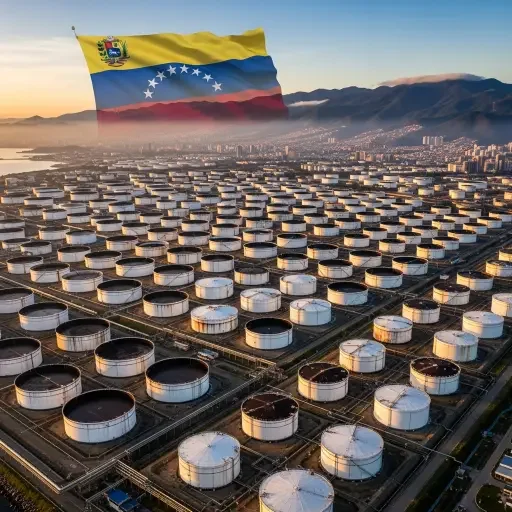
Venezuelan sovereign bonds currently price a long winter of misrule — capital controls, contested institutions, and erratic oil management. If a transitional government can credibly stabilize policy, normalize oil receipts to state coffers, and open channels to creditors, discounted claims could rerate rapidly. Yet that upside is conditional: oil-price trajectories and the sequencing of debt talks remain the determinative variables.

Why the market is skeptical. Bond prices embed political discounting. Investors in Venezuela today face three overlapping uncertainties: the identity and durability of executive power; the flow of oil revenues to official balance sheets; and external willingness to recognize or restructure liabilities. Each axis multiplies the others: political remission without oil-revenue clarity yields limited recovery; oil revenue flows without institutional credibility invite re-siphoning.
Distressed paper is cheap because recovery depends on a sequence — transition, revenue normalization, creditor negotiation — not any single event. That sequence explains why certain bonds trade at pennies on the dollar while others, tied to more senior claims or oil-linked revenue streams, command higher haircuts. The market is pricing a scenario where capital-adverse outcomes remain the path of least resistance.
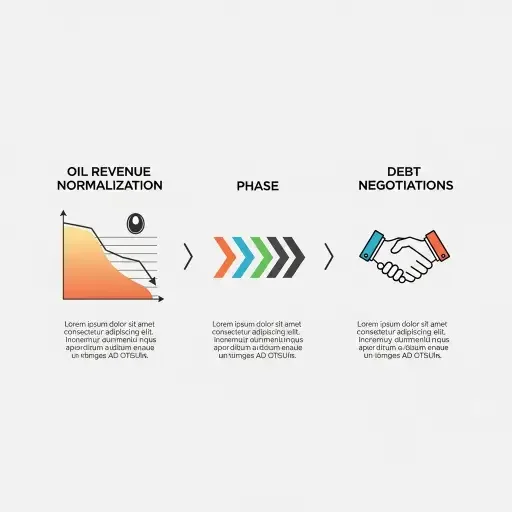
How a transition materializes. A credible transition government must deliver three operational moves within months, not years. First, transparent accounting of oil exports and escrow mechanisms that route a predictable share of receipts to debt service. Second, concessions that reassure key domestic actors — military pensions, public-sector payrolls — without immediate fiscal collapse. Third, a roadmap for debt talks that sets clear priorities for bondholders versus domestic claimants.
Investors should think of these as checkpoints: escrow and cashflow certainty reduce commercial risk quickly; domestic political stabilization lowers expropriation and re-denomination risk more slowly; and debt architecture — whether partial haircuts, bridging finance, or staged restorations of credit access — determines ultimate recovery rates.
Consider a hypothetical: escrowing 60% of oil export cashflows into an internationally supervised account while the transition negotiates with bondholders. That single operational change converts opaque, fungible cash into near-cash collateral. Market models that assume zero enforceability jump to mid‑single-digit recovery probabilities; models that accept escrowed revenues push recoveries meaningfully higher. Liquidity engineering trumps headline politics when it comes to price action.
Where frontier hedges fit. For allocators in frontier sovereigns, Venezuela is not merely a binary bet; it’s a portfolio-wide risk factor. Hedges favored in frontier strategies — CDS, commodity-linked derivatives, and options on oil producers — remain highly sensitive to oil-price volatility. That sensitivity creates two practical rules for allocation architects.
First rule: treat Venezuelan trades as event-driven, not permanent allocations. Enter positions when political signaling crosses objective thresholds (escrow set up; transition recognized by major external creditors; public roadmap released). Exit or hedge actively around oil-market shocks.
Second rule: size exposure relative to oil convexity. If your fund lacks the capacity to absorb a multi‑month oil drawdown, downweight. Instruments that seem like cheap insurance (deep out‑of‑the‑money puts on sovereign CDS) can become costly if oil flips the sign.
Capital markets are the binding constraint: investors set prices that force governments to adapt. In Venezuela’s case, a credible sequence of stabilization actions would force repricing — not automatically to perfection, but enough to produce outsized returns for those who front‑run the checkpoints. Conversely, oil shocks can wipe out those gains faster than politics can correct them.
Watch for escrow arrangements and audited export ledgers — they’re the fastest price catalysts. Use staged exposure: small initial positions conditional on first milestones; ladder exposure as each subsequent checkpoint clears. Employ oil hedges priced for volatility — calendar spreads, collars, and CDS ladders — rather than blunt directional bets. Prefer instruments with convex payoff to political progress (convertible structures, staged payment claims).
Venezuelan debt is a time‑conditional arbitrage: if public finance is stabilized via credible escrowed oil revenues and a transition government demonstrates staying power, deeply discounted bonds could rerate sharply. But this is an oil‑dependent rally; hedges matter. Treat positions as event trades, size them for oil convexity, and demand operational proof before moving from rumor to capital.
Think of Venezuelan bonds as a dam behind a sluice gate: the political transition is the gate control; oil flows are the water. Open the gate with engineered certainty, and the reservoir’s pressure converts into recoveries. Until that engineering is visible, keep exposures measured, hedges active, and expectations disciplined.
Tags
Related Articles
Sources
Venezuelan sovereign debt market data and bond pricing; political transition announcements and policy statements; oil market analysis from Bloomberg and Reuters; frontier market research from investment banks and sovereign debt analysts.