
Nvidia’s kingdom was built on training — the brute-force phase where every frontier lab needed the same general-purpose GPU and paid whatever HBM scarcity demanded. That era is not over, but it is no longer where the strategic leverage concentrates. Inference is different: it runs continuously, scales with users rather than researchers, and punishes latency in fractions of a second. It is also where unit economics decide whether a model business prints cash or bleeds it on every query. OpenAI’s unveiling of Jalapeño — a custom “intelligence processor” co-developed with Broadcom and brought to tape-out in nine months — is best read not as another hyperscaler cost-cutting exercise, but as a bid for inference sovereignty: control over the silicon that turns model weights into revenue at planetary scale.

Washington already treats advanced compute as export-controlled strategic material. A lab designing its own inference ASIC is no longer a tenant in Nvidia’s ecosystem — it is a co-architect of the physical layer. Broadcom translates the design; TSMC fabricates it; Microsoft hosts the first gigawatt-scale deployment by late 2026. Custom silicon, in this reading, is national infrastructure with a product roadmap.
Nine Months Against a Multi-Year Clock
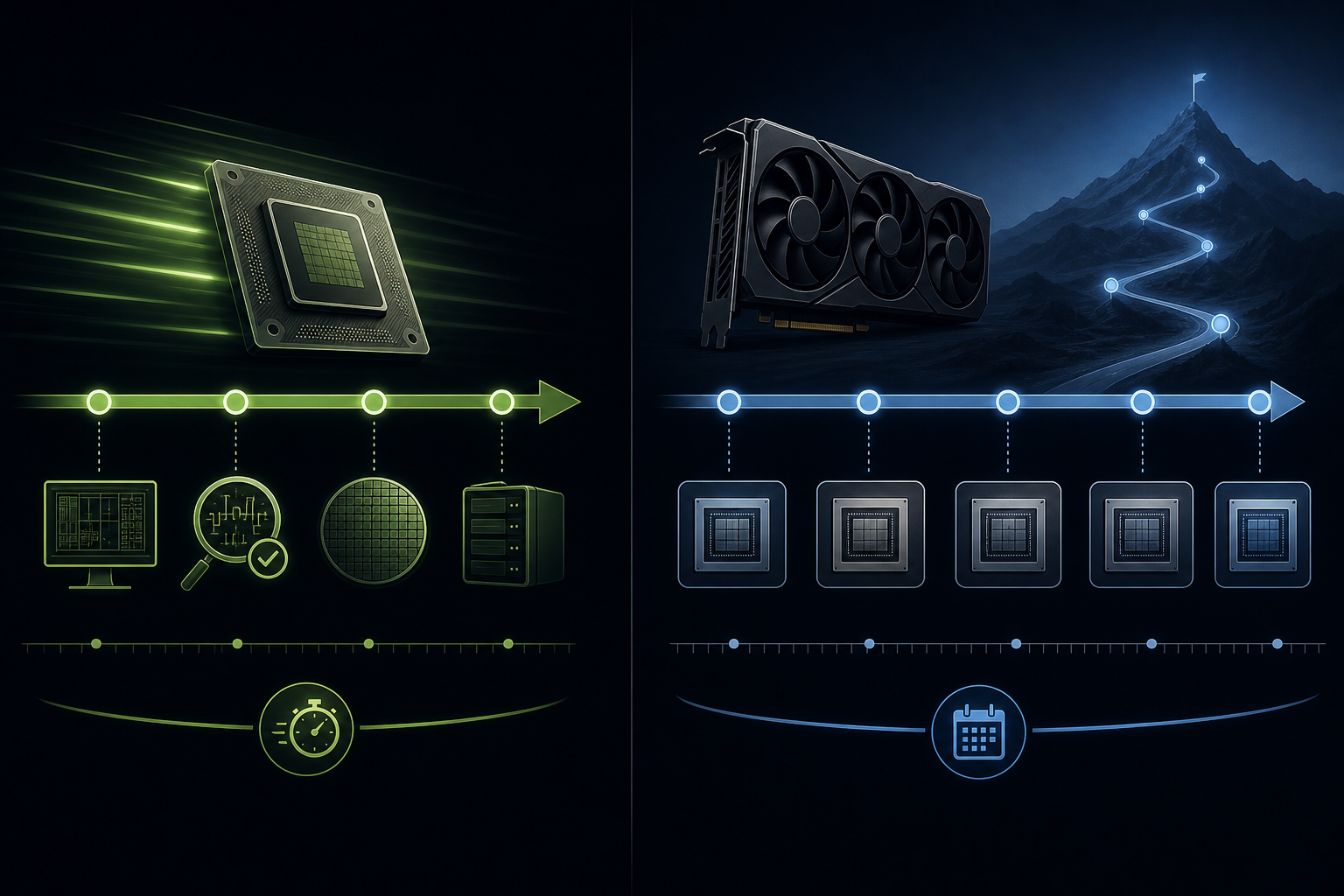
The headline number is the cycle time. Nine months from concept to tape-out is an ASIC sprint; Nvidia’s GPU generations unfold across two- to three-year horizons with established software stacks, developer ecosystems, and predictable upgrade paths. Jalapeño’s compressed timeline is a statement of urgency — and a single point of failure.
If the schedule holds, OpenAI claims roughly fifty percent inference cost reduction versus GPUs on targeted workloads — the difference between a viable subscription and a subsidized utility at gigawatt scale. If it slips, Microsoft’s end-2026 deployment becomes a paper date. OpenAI stays on Nvidia’s pricing curve while Google, Anthropic, and others capture the margin advantage custom silicon was meant to deliver. A slip also strands architectural commitments: inference-optimized halls, cooling profiles, and rack densities designed around a specific chip do not retool overnight.
Nvidia can ship Blackwell successors on a known cadence while Jalapeño generation two remains a design document. GPUs carry overhead — memory bandwidth for training, abstraction layers, margin on margin. A purpose-built inference ASIC trades flexibility for efficiency. The bet is whether OpenAI’s workload is stable enough to freeze that trade before the next architecture shift renders it obsolete.
Exclusive Weapon or Exportable IP
Every custom XPU program faces a fork: does the silicon remain captive to its designer, or does the intellectual property become licensable — a second ARM, a merchant ASIC for the inference age?
Jalapeño’s first generation almost certainly stays OpenAI-exclusive. A chip that cuts inference cost in half is not something you license to rivals while your API pricing depends on the advantage. Yet Broadcom already translates six hyperscaler designs into silicon. If Jalapeño’s innovations — memory hierarchy, sparsity handling, batching logic — migrate into Broadcom’s reusable blocks, exclusivity erodes by diffusion. A competitor’s next XPU might inherit Jalapeño’s tricks without ever holding the RTL.
Merchant inference ASICs would accelerate the industry-wide XPU rotation, weakening Nvidia’s pricing power but democratizing the advantage OpenAI is buying. For policymakers, exportable AI silicon sits beside lithography tools: dual-use assets where competitiveness and national security blur. An OpenAI-exclusive Jalapeño is a moat. An exportable IP portfolio is an industry standard — and a BIS conversation waiting to happen.
When Circular Finance Meets Physical Silicon
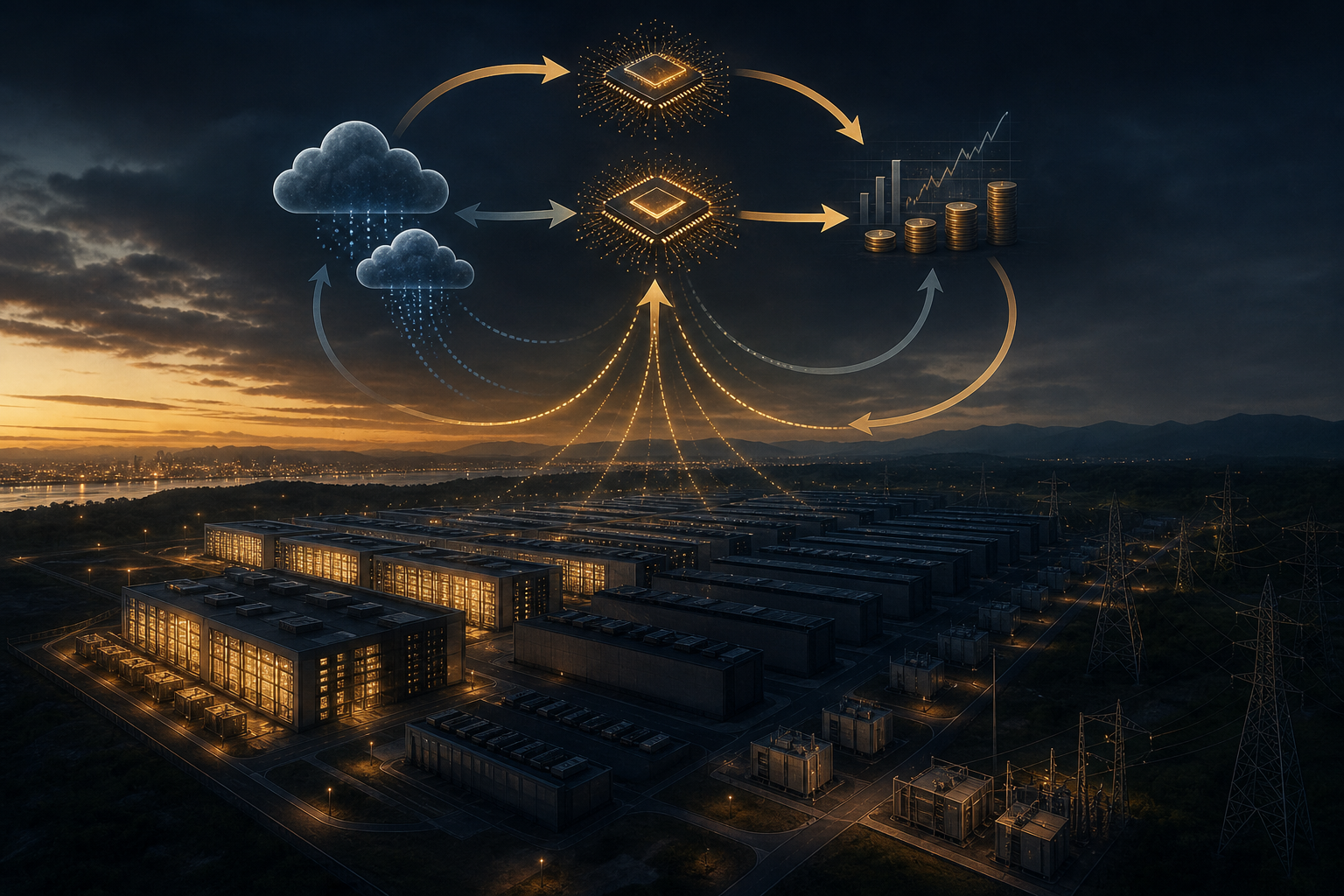
The Bank for International Settlements warned this month that disappointing AI returns could trigger sudden capital withdrawals — “circular finance” in which hyperscalers, chipmakers, and cloud providers recycle each other’s capex in a closed loop that looks like demand until someone asks who pays the power bill. Jalapeño lands directly in that tension.
A gigawatt of custom inference silicon is a civil-engineering project. Chips must be fabricated, racked, and — the binding constraint in 2026 — energized. Roughly twelve gigawatts of U.S. data center capacity sits in “power limbo,” buildings complete but awaiting transformers and grid interconnection. Jalapeño’s economics assume deployed watts, not ordered dies.
Who finances the gap? The Microsoft deployment implies hyperscaler balance sheets, project finance, and sovereign-adjacent credit — the same machinery behind LNG terminals. Private credit has flowed into AI infrastructure; the BIS warning is that the collateral chain may be circular rather than cash-generative. If inference revenue disappoints, depreciation clocks start and power purchase agreements bind. Fifty-percent cost advantage means nothing if the racks never spin up. Inference sovereignty without energization is a warehouse of depreciating futures.
The Second Silicon War
The custom-silicon wars began as a story about who builds the chips. Jalapeño reframes it as who commands inference — the always-on layer where models meet markets. OpenAI moved from renter to co-architect in nine months, betting that sovereignty over the inference stack is worth more than flexibility on someone else’s roadmap.
If the bet pays, Jalapeño becomes the physical substrate of a new compute nationalism: American-designed, Taiwanese-fabricated, hyperscaler-hosted silicon that does not ask Nvidia’s permission to serve a query. If it fails — schedule slip, stranded power, circular finance unwind — the same program becomes a cautionary exhibit in how fast architectural ambition can outrun the grid.
The actionable principle is blunt: watch watts, not waivers. Tape-out announcements are press releases; energized gigawatts are balance sheets. Inference sovereignty is not declared at a keynote. It is proven when the custom chip draws current from a grid that someone, somewhere, has already paid to expand.
Tags
Sources
OpenAI and Broadcom Jalapeño unveiling coverage, Broadcom Q1 FY2026 earnings, BIS circular-finance warnings at Sintra, hyperscaler capex disclosures, prior Culled analysis of custom silicon and AI infrastructure financing