

Brent jumped three percent and XLE gained one-point-four as U.S.–Iran diplomacy collapsed and Hormuz flared again. Markets still treat the move as a bounded oil shock—VIX at fifteen-point-five-nine—while soft-landing pricing ignores depleted buffers, defense spend, and permanent tariffs.
Brent’s three-percent surge on Wednesday did what hours of diplomatic rhetoric could not: it put the energy-inflation premium back on the ticker in unambiguous ink. Energy Select Sector SPDR Fund (XLE) rose one-point-four percent in sympathy. The United States Oil Fund (USO), still trading well below its fifty-day average, refused the invitation. That single lag is the board’s clearest confession — physical crude has repriced; the equity wrapper that claims to track it has not finished the sentence.
The catalyst is not ambient noise. President Trump declared the Islamabad memorandum of understanding with Iran “over” after tanker strikes near Hormuz, a CENTCOM response hitting more than eighty targets, and Tehran’s retaliation against U.S. sites in Bahrain and Kuwait. Treasury revoked the sixty-day license that had briefly allowed open Iranian oil sales. Markets that spent weeks fading war risk are staring at a waterway still contested by toll doctrine, route control, and depleted strategic buffers — roughly a billion barrels of wartime supply already absorbed.
Bounded Shock Pricing Meets Structural Supply Risk
The VIX sits at fifteen-point-five-nine despite nearly a dozen active high-severity geopolitical files. That number is not courage. It is taxonomy. Options markets are still labeling Hormuz as a bounded supply shock — a premium that fades when headlines cool — rather than the opening chapter of a stagflationary regime. Dollar modest strength and gold’s slight decline today look like positioning unwind, not restored confidence: yen stable, credit spreads still tight, no credit-market veto of the soft-landing script.
Energy equities deepen the contradiction. Crude’s geopolitical premium has widened; XLE’s catch-up remains incomplete. Traders floating the short-XLE thesis — that equities close the gap to the downside once transit “normalizes” faster than a seventy-dollar Brent print implies — are betting the premium dies before structural tightness reasserts. The opposite risk is cleaner on the fundamentals: if Hormuz throughput stays constrained, toll talk persists, and buffers stay thin, the equity lag is not overpricing optimism. It is underpricing scarcity.
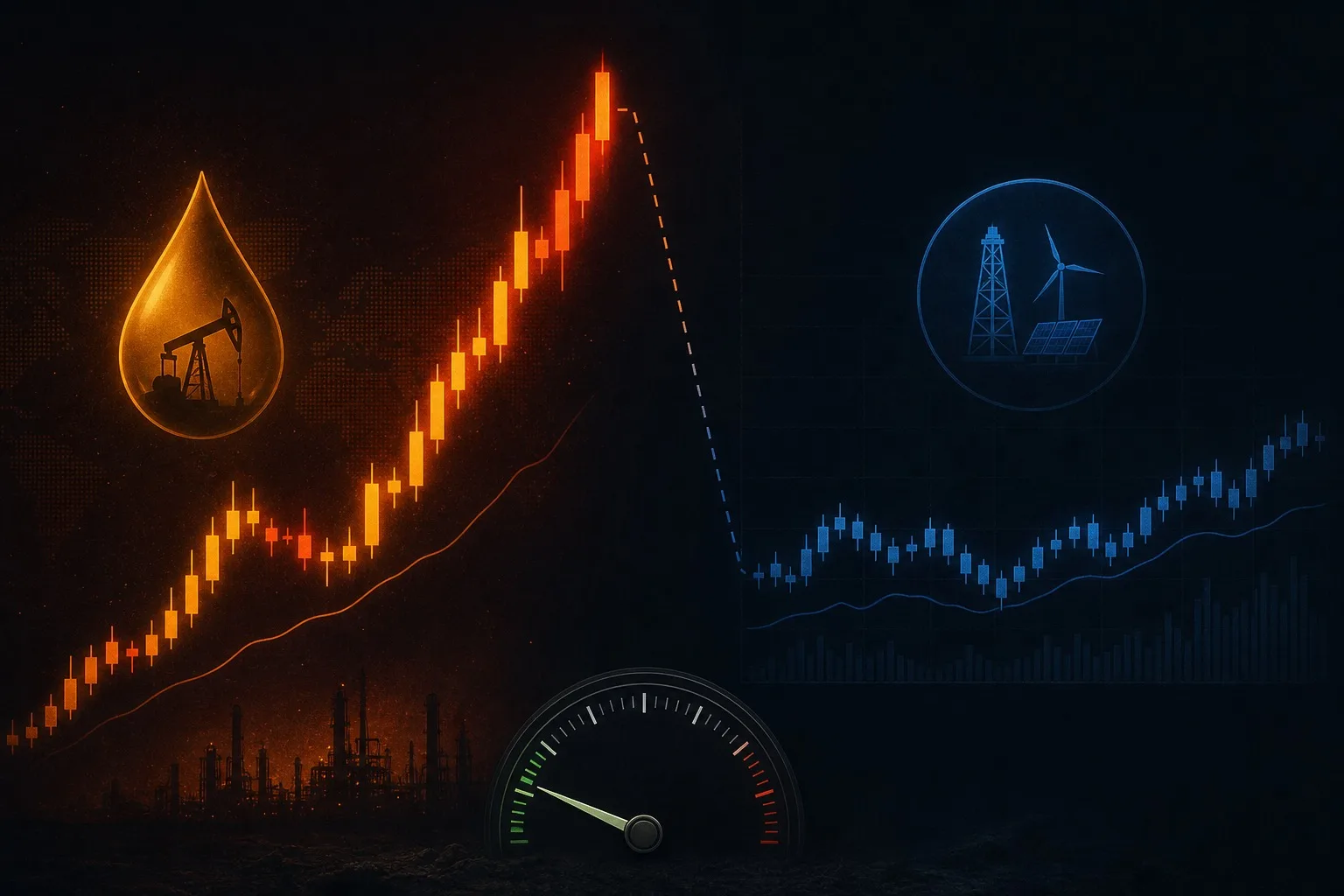
Soft Landing Is the Widest Gap
Price action still reflects more growth optimism than the ledger supports. Credit markets and small-cap resilience price Federal Reserve easing and continued expansion. The concurrent stack argues otherwise: Europe’s €70 billion annual defense support architecture for Ukraine, a permanent tariff framework replacing temporary surcharges, and compounding energy shocks that constrain central-bank optionality while compressing margins. Soft landing is the narrative furthest from its evidence base — and therefore the assumption with the most violent path to resolution.
The Korea–U.S. equity divergence sharpens the point. It arrived abruptly against elevated stress, a signal either that Korean markets are front-running a U.S. risk-off, or that regional pricing of China’s South Pacific SLBM test and defense escalation has simply not cleared the American tape. Resolution requires SPY catching down or Korean assets reversing on a U.S. resilience confirmation. Until then, the transpacific spread is another meter showing local risk absorbed abroad and politely ignored at home.
The Fragile Assumption Under AI Capex
The most fragile assumption on the board is that current oil moves are temporary geopolitical theater. If energy remains structurally elevated while growth slows and fiscal deficits widen with NATO rearmament, soft landing does not merely disappoint — it collapses. Equity multiples then face dual compression: margins from input costs, discount rates from stickier inflation and less room for the Fed to cut.
The AI capex supercycle’s resilience — even through OpenAI’s IPO delay chatter and a three-percent SMH drop — hinges on infrastructure spend decoupling from near-term monetization. That decoupling has a poor historical record once a true risk-off recession arrives. Capex can outrun revenue for a while. It rarely outruns a synchronized demand shock financed by wider deficits and dearer energy.

Final Compression
Wednesday’s tape did not invent the energy-inflation premium. It confirmed it. Brent and XLE moved together, if unequally; USO and the VIX still pretend this is a weather event over a shipping lane. Soft landing remains the market’s widest gap between story and substrate. The hypothesis worth testing is not whether oil can fade back toward pre-escalation levels if diplomacy miraculously reopens. It is whether portfolios priced for Fed easing can survive a world where Hormuz risk, European rearmament, and tariff permanence keep inflation sticky and growth uneven. Pattern recognition bought the last ceasefire. Regime recognition has to buy the next week.
Continue reading


Sources
July 8 market tape on Brent, XLE, USO, VIX; AP, BBC, CNN on U.S.–Iran MoU collapse, tanker strikes, CENTCOM response, oil waiver recall; NATO Ankara €70B Ukraine pledge reporting; prior Culled coverage of Hormuz and soft-landing pricing


