

Hormuz closure and Brent's 3.63% jump toward $80 make the energy-inflation premium dominant. Soft landing still prices growth intact even as Warsh's Fed is priced for tightening and SPR hits a 1983 low — a gap that resolves when shipping resumes or energy equities reprice higher.
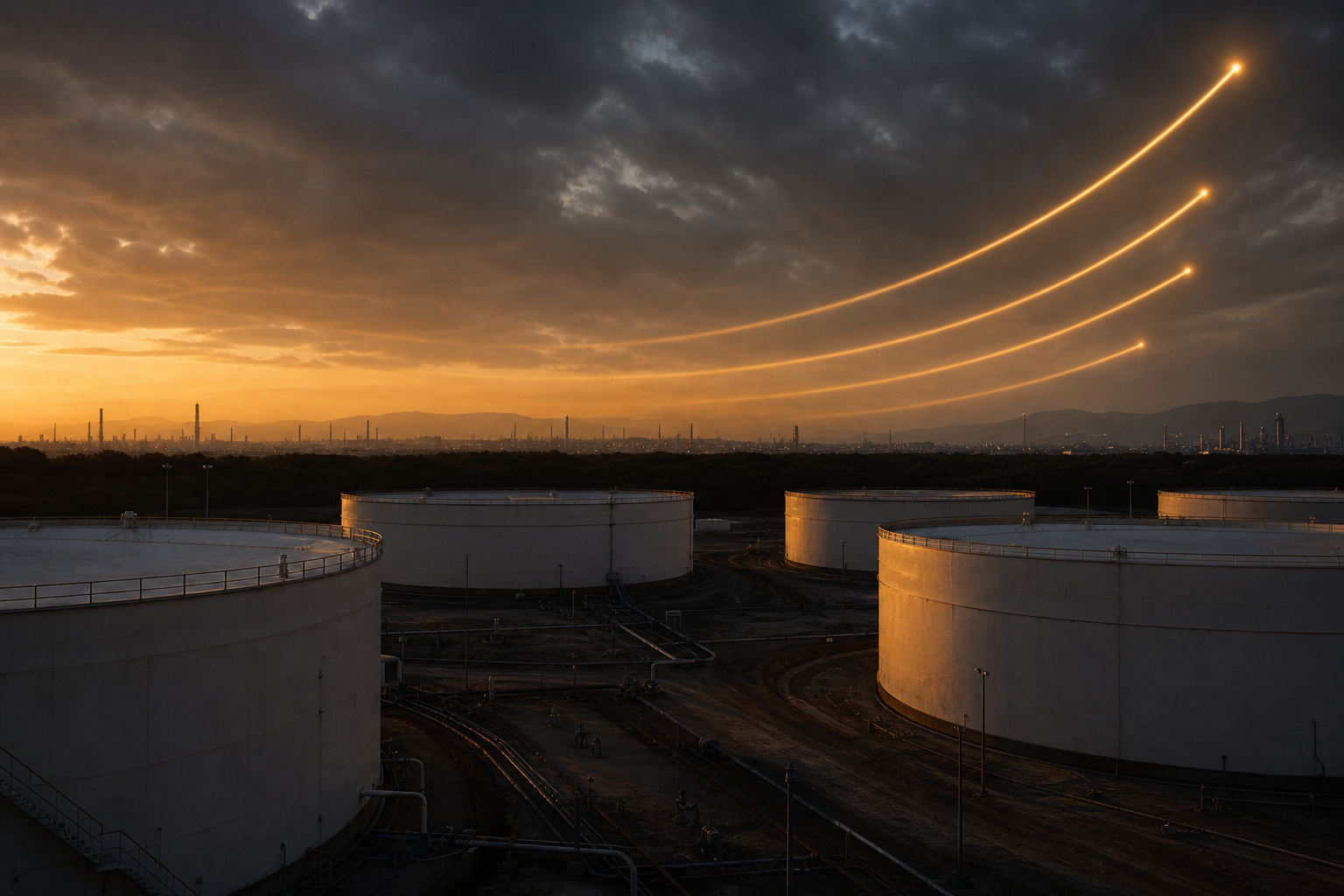
The energy-inflation premium is no longer a scenario. It is the board’s loudest narrative after Iran’s indefinite Hormuz claim, U.S. strike packages that answered shipping attacks, and Ukraine’s week-long campaign against roughly ninety Russian vessels in the Sea of Azov. Brent’s 3.63% jump toward $80, and war-risk premiums near 5% of vessel value, are the market’s first honest admission that supply risk is back. The second admission has not arrived.
USO remains about 12% below its fifty-day average. XLE rose only 2.47% on the session and still sits half a percent under that same moving average. Crude validated a choke point; energy equities priced a flicker. That is the Soft Landing hangover in one chart pair: investors still trading the June world, when a memorandum could reopen a strait and Strategic Petroleum Reserve releases could smooth the tape.
Soft Landing’s Widest Gap
The June peace trade assumed energy shocks were transitory. July’s facts refuse the assumption. The SPR now sits near 319.5 million barrels — the lowest since 1983 — and Treasury has revoked Iranian oil licenses entirely. There is less buffer and less diplomatic fiction. VIX’s rise into the mid-teens is not panic; it is recognition that stagflation risk has left the theoretical column.
Chair Kevin Warsh’s Fed is being priced for tightening rather than easing. That single shift dismantles Soft Landing’s monetary spine. Yet cyclicals and financials still behave as if growth remains intact and the reaction function will stay dovish when oil settles. Fundamentals and pricing have rarely diverged this cleanly: one tape treats energy as a supply shock; the other treats it as noise around a soft landing that no longer has a soft foundation.
The Korea Warning Shot
The Korea–U.S. equity contradiction sharpens the same point from the other side of the Pacific. Samsung’s record quarterly profit triggered circuit breakers and a Kospi break below 7,000 — sell-the-news behavior that suddenly doubts AI memory capex persistence precisely when energy costs and Fed tightening threaten to choke the infrastructure buildout. OpenAI and Broadcom’s custom inference ASIC only adds fracture to Nvidia’s monopoly pricing. The market that once assumed infinite hyperscaler spend is now asking whether power, rates, and silicon alternatives can all rise at once.
That is not a Korean idiosyncrasy. It is an early read on what happens when the energy premium meets the AI capital cycle: the soft-landing assumption that real rates and energy could stay friendly enough for multi-year fab and data-center bets starts to look like last quarter’s orthodoxy.
How the Contradiction Resolves
The fragile assumption is that energy equities will never catch the sustained bid fundamentals demand. If Hormuz stays closed beyond this week, or if SPR intervention proves exhausted, that disbelief evaporates quickly. The Oil–Energy Equities contradiction is muted in immediate price terms and loud in underlying stress. It resolves one of two ways: shipping resumes and Brent collapses back below $70, confirming the market’s skepticism — or inventory tightness forces XLE to reprice sharply higher as realized supply destruction overwhelms the dovish equity narrative.
Until then, Soft Landing owns the equity storyboard and Energy/Inflation owns the commodity print. One of them is wrong. Markets this week are still fighting the last war — the June war, where peace was a memorandum and reserves were a policy tool rather than a residual. The first war that matters now is whether a strait stays closed long enough for equities to notice.
Continue reading


Sources
July 13 Brent and war-risk premium prints; AIS Hormuz traffic reports; SPR inventory levels; Fed funds futures under Chair Warsh; XLE and USO relative to 50-day averages; Ukraine Unmanned Systems Forces Azov campaign tallies; Samsung Q2 preliminary earnings and Kospi circuit-breaker coverage


