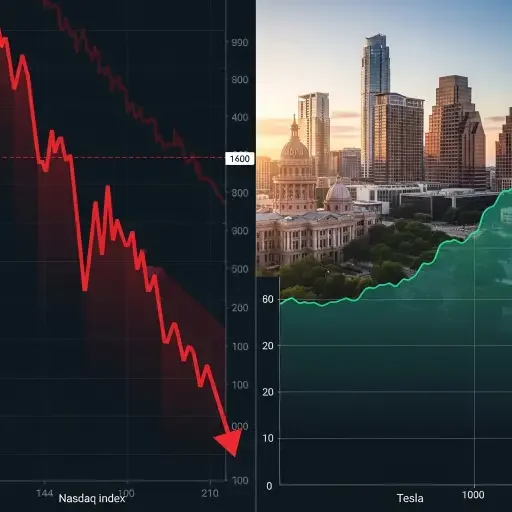
The arithmetic was brutal on Friday. The Nasdaq Composite declined 1.8%, while the S&P 500 fell 1.2%—a tech-led rout that erased gains and sent investors scrambling for explanations. But amid the carnage, one name refused to play along with the script. Tesla surged roughly 2.5%, climbing from around $448 to close near $460—a complete inversion of the broader market’s direction.
This wasn’t just relative outperformance. Tesla actually gained while its peers hemorrhaged value. In a market where the Nasdaq dropped 500 points, Tesla’s green candle stood alone—a 4+ percentage point divergence from its sector. The move poses a question that cuts to the heart of 2025’s investment thesis: why is the market still willing to bet on Tesla’s AI story when it’s actively fleeing everyone else’s?
The Margin Panic That Ate Silicon Valley
Friday’s selloff had a clear villain. Broadcom dropped 12% after warning of slimmer future margins on its AI system sales, despite projecting strong quarterly revenue. The message was toxic: AI revenue growth doesn’t automatically convert to AI profit growth. Oracle’s disappointment earlier in the week had already primed the market for skepticism, and Broadcom’s admission confirmed investors’ worst fears about the infrastructure buildout.
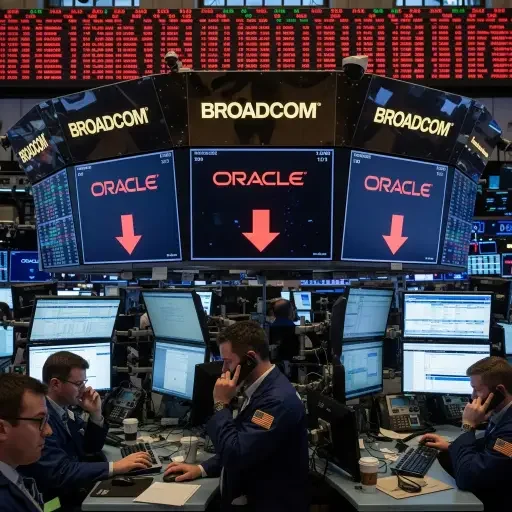
The S&P 500 fell about 1.3% from Thursday’s record level, with the biggest pressure concentrated in AI-linked stocks. Nvidia, AMD, Palantir—the usual suspects in the AI trade—all bled. The rotation was visceral and immediate. Money poured out of the companies building the picks and shovels of the AI revolution, seeking safety in financials, healthcare, and the dusty corners of value investing.
Yet Tesla, theoretically part of that same AI cohort, moved in the opposite direction entirely. The stock climbed to near $460, pushing higher through mounting pressure on its automotive business. Something had changed in how the market viewed Tesla’s exposure to AI infrastructure risk.
The Options Desk Sees Something Else Entirely
Before we get to robotaxis, there’s a mechanical story unfolding in the derivatives market that explains Tesla’s Friday resilience better than any narrative about autonomous vehicles. At 4:11 PM ET on December 12, with Tesla trading at $457.55, the options landscape revealed a market structure engineered for stability—not volatility.
The regime classification was unambiguous: Positive Gamma. Translation: dealers are long gamma, which means they buy dips and sell rallies, mechanically dampening price movements. This is the opposite of the violent negative gamma regimes that characterized Tesla’s wild swings earlier in 2024. The gamma flip level—the price where this dynamic reverses—sits at $392.50, a full 14% below spot. Meanwhile, max pain gravitates at $415, creating a magnetic pull about 9% lower. These dual anchors formed a structural floor beneath the stock.
But here’s where it gets interesting. The attractor constellation showed Tesla trapped in a narrow band between $455 and $460, with resistance walls of strength 7 (the system’s maximum) at both boundaries. Open interest at the $450 strike alone stood at 63,913 contracts—translating to $6.58 million in negative gamma exposure. This creates what options traders call a “call wall”: a ceiling of short call positions that dealers must hedge by selling stock as price approaches, creating mechanical resistance.
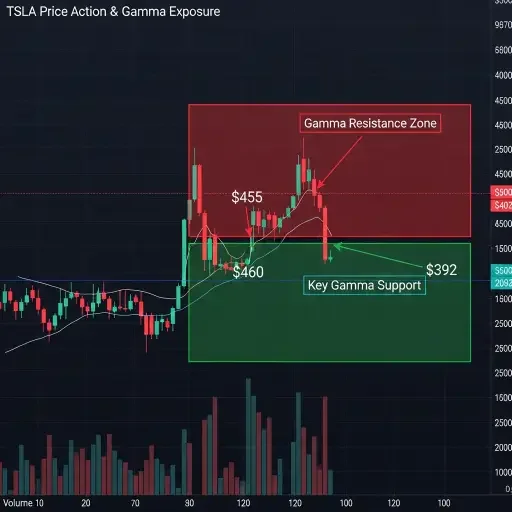
50 gamma flip level with color-coded bands.
The ATM gamma exposure in the $452.50 to $462.50 band totaled $171.4 million—an enormous concentration suggesting the market had essentially decided Tesla’s Friday closing range before the opening bell. Combined with net vanna of negative $11.75K (meaning dealers need to scale up hedges if IV rises), the setup was perfect for a stock that would neither soar nor collapse, regardless of what the Nasdaq did.
This wasn’t coincidence. It was architecture. While the Nasdaq plunged, Tesla’s options structure functioned like a mechanical stabilizer, absorbing selling pressure through gamma hedging and preventing the kind of cascading decline that hit Broadcom and Oracle. The dealer hedging forecast showed that breaking below $457.50 would trigger only $1.40 million in notional sell pressure—a rounding error for a stock with Tesla’s daily volume.
The Austin Bet: Robotaxis as a Different Species of AI
The narrative overlay arrived three weeks earlier, wrapped in Elon Musk’s characteristic blend of audacity and vagueness. On December 11, 2025, Musk announced that within three weeks, Tesla’s Model Y robotaxis in Austin would operate fully autonomously—no safety drivers, no passengers, no concessions. The timeline was aggressive, perhaps recklessly so. But the announcement reframed Tesla’s AI narrative in a way that insulated it from Friday’s infrastructure panic.
Here’s why that matters: The market is no longer automatically rewarding aggressive capex—especially when companies cannot clearly show when spending converts to revenue and margin. Broadcom, Oracle, and the data center builders are pouring billions into infrastructure with uncertain payback periods. Tesla’s robotaxi bet, by contrast, is capital-light and customer-facing. The vehicles already exist. The software is deployed. The question isn’t “will this ever make money?”—it’s “when does this start printing cash?”
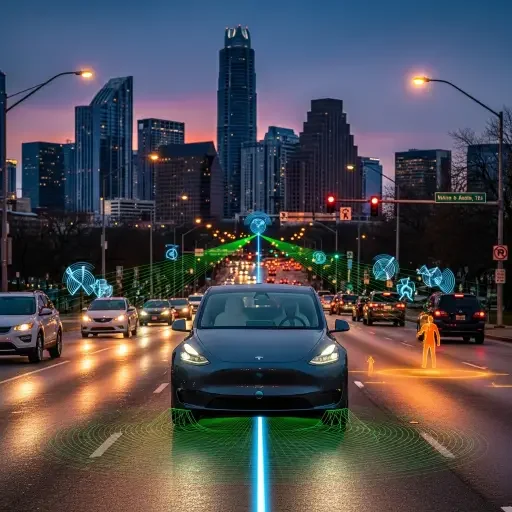
Tesla plans to have 60 robotaxis operating throughout Austin, along with an app where people can schedule rides. The fleet is small—embarrassingly small compared to Musk’s earlier promise of 500 vehicles by year-end—but scale isn’t the point yet. The point is demonstrating that unsupervised autonomy can work in a commercial context without the crutch of lidar, radar, or human supervision.
This is the narrative bifurcation that saved Tesla on Friday. While Broadcom and Oracle represent the “infrastructure AI” thesis—massive capital expenditure with distant, uncertain returns—Tesla represents “applied AI” that consumers can see, touch, and pay for. One is a multi-decade moonshot. The other is three weeks away from removing the safety drivers.
The Valuation Problem No One Wants to Discuss
Of course, none of this resolves Tesla’s fundamental valuation problem, which remains spectacular even by 2025’s inflated standards. Deutsche Bank analysis attributes $850 billion of the firm’s market capitalization directly to robotaxis and robotics. With Tesla’s current market cap around $1.5 trillion and a forward P/E ratio near 200, the company is priced for perfection in autonomy, robotics, energy storage, and several other moonshots simultaneously.
The analyst community has noticed. Morgan Stanley downgraded Tesla to an “Equal Weight/Hold” stance on December 8, citing valuation concerns, even while maintaining a constructive view on the technology itself. The median 12-month price target sits at $393—roughly 12% below Friday’s closing price. Wall Street is essentially saying: we believe the story, but we can’t justify the current price.
Yet the stock refuses to crack. Tesla has delivered strong returns over the past year, maintaining remarkable resilience for a stock trading at extreme valuations in a rising rate environment. The stock standing at approximately $458 on December 12 represents the market’s continued willingness to pay for optionality.
When Narrative Trumps Numbers
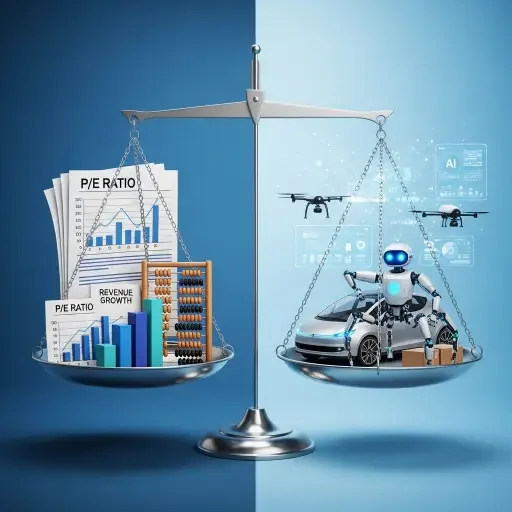
Friday’s action exposes something uncomfortable about how AI stocks are valued in late 2025. Traditional financial analysis—revenue growth, margin expansion, capital efficiency—no longer adequately explains price movements in this segment. Investors weigh a fresh demand warning in the U.S. against continued enthusiasm for Tesla’s autonomy and “AI platform” narrative, and somehow the narrative keeps winning.
This creates a strange market topology where Tesla can simultaneously be “overvalued” by every conventional metric and “fairly priced” by the logic of optionality. The company isn’t being valued on what it earns from selling cars today. It’s being valued on the probability-weighted expected value of a dozen different futures: robotaxis scaling to millions of rides per day, Optimus robots working in factories, energy storage dominating the grid, software subscriptions reaching Tesla’s entire fleet.
Each of these futures has a low probability of occurring as bulls imagine. But the combined probability that something transformative emerges from Tesla’s portfolio of bets is high enough to justify—in the minds of holders—a valuation that would be insane for Ford or GM.
The Rotation That Wasn’t
Over the last couple of weeks, the S&P 500 Equal Weight Index has started to make progress against the S&P 500 index and the Nasdaq 100, reflecting rotation out of tech and mega caps into smaller and more cyclical names. This rotation narrative has dominated market commentary for weeks, with strategists pointing to rising Treasury yields and broadening leadership as signs that the “Magnificent Seven” era is ending.
Friday seemed to confirm this thesis. The Dow hit new highs while the Nasdaq bled. Financials and industrials outperformed. Value beat growth. But Tesla’s resilience suggests the rotation story is more nuanced than the simple “tech to value” framing implies. The market isn’t abandoning all AI-related names. It’s discriminating—fleeing infrastructure plays with murky unit economics while maintaining exposure to applications with clearer paths to monetization.
This matters because it reveals the real fear driving Friday’s selloff. A margin warning at Broadcom and a fresh round of Oracle-related AI infrastructure questions were enough to pull the S&P 500 and Nasdaq away from record territory. The concern isn’t that AI won’t work. It’s that the current crop of infrastructure investments won’t generate returns commensurate with their valuations.
Three Weeks and Counting

The clock is now running on Musk’s latest promise. Three weeks from December 11 puts us at early January 2026—right around the time when those 60 Model Ys in Austin should theoretically be operating without human supervision. Musk claims unsupervised Full Self-Driving is “pretty much solved at this point” and that Tesla is just going through validation.
Whether this deadline is met will determine if Friday’s relative strength was justified or just another example of the market’s willingness to give Tesla infinite second chances. The credibility of Elon Musk’s autonomous driving promises faces another high-stakes examination, marking the fourth such announcement in 2025.
But here’s the thing about Tesla’s persistent ability to defy gravity: it doesn’t require Musk to hit every deadline. It only requires him to hit enough of them—or come close enough—to keep the narrative alive. A successful Austin deployment, even at limited scale, would validate the vision-only approach and create a template for expansion. A failure would be explained away as a “validation issue” with a new timeline attached.
This isn’t cynicism. It’s pattern recognition. Tesla has survived blown deadlines before—many times—by demonstrating just enough progress to prevent the valuation from collapsing entirely. The robotaxi deployment in Austin is already live, even if supervised. The technology exists, even if it’s not yet fully autonomous. The app is built. The regulatory path, while uncertain, has proven navigable in Texas.
The Market’s Real Message
Friday’s divergence between Tesla and the broader tech sector sends a clear message: Wall Street is done paying premiums for AI infrastructure companies that can’t articulate a path to profitability, but it’s still willing to bet—aggressively—on customer-facing AI applications with real revenue models. Data centers and GPU clusters are necessary but insufficient. The market wants to see robots and cars that regular people can use and pay for.
Tesla represents that thesis—for better or worse—in its purest form. The company’s valuation assumes multiple breakthroughs occurring simultaneously, which is unlikely. But the stock’s 2.5% rally on a day when the Nasdaq plunged reveals that investors haven’t given up on the possibility. They’ve just become more selective about which AI bets they’re willing to fund at current levels.
The Nasdaq fell 500 points. Tesla gained 2.5%. In the brutal arithmetic of relative performance, that’s not just defying gravity—it’s a complete reversal of the sector’s trajectory.
Tags
Related Articles
Sources
Market data from Reuters, CNBC, Bloomberg; analyst commentary from Morgan Stanley, Deutsche Bank; Tesla announcements via company filings and Elon Musk statements