The Aroma of Dissent
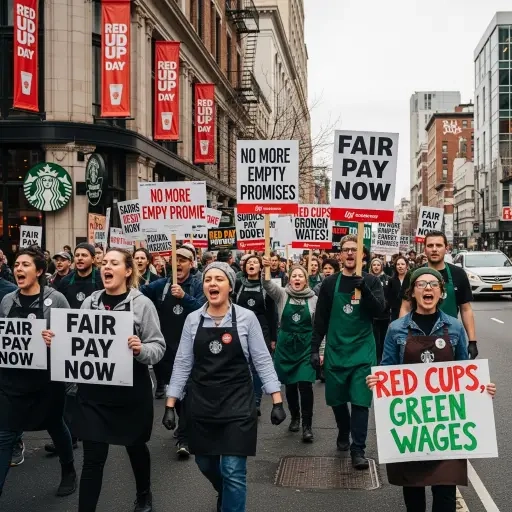
Before sunrise, the scent of roasted beans met the chill of picket signs. Across more than twenty-five American cities, Starbucks baristas traded aprons for placards, turning their espresso stations into stages for protest. Their timing was immaculate — and merciless. Red Cup Day, the company’s annual carnival of caffeine and consumer loyalty, became the theater of revolt.
For the workers, it was strategy. For management, heresy. For investors, something subtler: the sound of sentiment shifting in real time.
From Counter Culture to Counter-Power
Starbucks long mastered the art of moral capitalism. “Partners,” not employees. “Third Place,” not store. The chain sold not just coffee, but belonging — a $120 billion experiment in monetized warmth.
Now, the warmth is cooling. Since 2021, a barista-led organizing wave has unionized roughly 550 stores — about 4 percent of U.S. units, covering an estimated 9,500 workers. Their complaints read like a case study in late-pandemic labor fatigue: erratic scheduling, thin staffing, and wages lagging both inflation and aspiration.

Corporate insists it pays “above industry norms,” claiming average hourly compensation near $30 including benefits. Both sides can be correct, and still, the tension holds — the distance between the narrative of care and the lived experience of labor.
The Economics of Espresso
Starbucks isn’t merely a retailer; it’s a mood engine. Every venti latte represents a small act of trust — a belief in consistency, civility, and caffeine on demand. Break that spell, and the whole model trembles.
Operationally, a prolonged strike strains throughput and foot traffic; financially, it tests the company’s cost elasticity. CEO Brian Niccol’s turnaround blueprint depends on precision: store rationalization, digital integration, tighter inventories. Add wage escalation, and the margin equation frays.
Analysts whisper about a “labor headwind.” In marketspeak, that’s code for shrinking leverage in a tightening macro. But beneath the jargon lies an older truth: the human hand behind the machine still sets the rhythm of return.

The Price of Your Latte
Will your coffee cost more? Possibly — though not immediately, and perhaps not overtly. Starbucks could absorb part of the hit, or re-engineer it through stealthier channels: fewer promotions, thinner loyalty perks, “limited-edition” upsells. The brand has long excelled at monetizing narrative as margin.
Yet every deferred increase has a reckoning. A 5 to 10 percent wage concession, analysts estimate, would require a parallel price lift to defend EBIT targets. For a $6 latte, that’s 30 to 60 cents — imperceptible alone, inflationary in aggregate.
The real risk is not the price tag but the perception. Once customers sense they’re subsidizing corporate diplomacy, the latte loses its innocence.
Labor as Asset Class
Across the service economy, organized labor has become the new volatility index. What began at Amazon warehouses and Chipotle kitchens now percolates into Starbucks’ espresso empire — proof that wage pressure is no longer a line item but a sentiment metric.
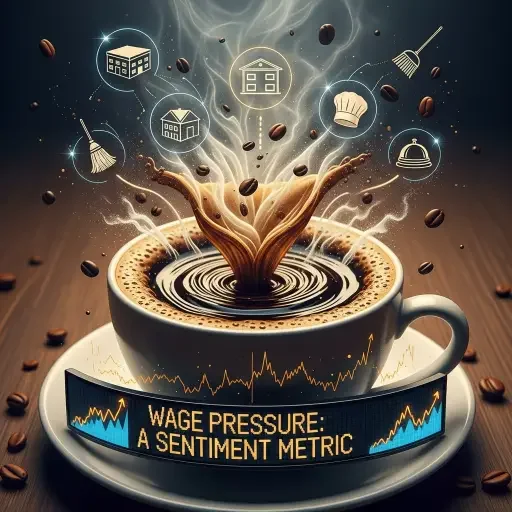
For the investor, this means reassessing risk through a moral lens. Labor unrest can no longer be siloed under “operational disruption.” It influences brand equity, ESG scores, even bond spreads. A company’s treatment of its lowest-paid workers now radiates into its market multiple — an irony not lost on the same institutions that once prized efficiency over empathy.
If Starbucks yields ground, competitors will feel the gravitational pull. Dunkin’, Peet’s, even McDonald’s — each will confront its own version of the Red Cup reckoning. The result: mild upward pressure on service-sector inflation, mild downward pressure on the fantasy of frictionless growth.
Narrative Risk
Starbucks insists that fewer than 1 percent of stores are affected. Statistically true. But markets trade on stories, not spreadsheets. The optics — picket lines wrapped around seasonal cups — are cinematic. Investors understand: narrative risk is contagious.
A brand once synonymous with ethical aspiration now risks being filed under “corporate contradiction.” If the strike fades quickly, the damage will be cosmetic. If it lingers, the company’s myth of mutuality — the notion that a coffee chain could also be a conscience — may never taste quite the same.
For Holders and Watchers
The fundamentals remain robust: global diversification, high customer stickiness, a balance sheet that can weather a storm. Yet labor friction introduces a new variable — the social cost of convenience.
If you hold SBUX, this is not a sell signal. It’s a sensitivity test. Watch management tone, not just metrics. Listen for whether Starbucks frames its employees as costs to control or communities to court. That language, more than any financial ratio, will predict its cultural and capital trajectory.
The Final Brew
Every empire faces a moment when the narrative that built it begins to billow back as question. For Starbucks, that moment smells faintly of espresso and dissent. The strikes may lift soon, but the conversation they ignite — about value, virtue, and the economics of comfort — will linger far longer.
Yes, your coffee may cost more. But what’s really being repriced is belief: that a $6 latte can still buy not just caffeine, but conscience.
Tags
Related Articles
Sources
Draws from November 2025 reporting and financial analysis in Reuters, AP News, The Guardian, Business Chief, and Newsweek, cross-referenced with Starbucks investor disclosures.