
Two Cleveland Guardians pitchers now face federal charges after allegedly selling pitch information to gamblers—a scheme that netted bettors $450,000 and threatens to end two professional careers. The indictment reads like a digital-age replay of baseball’s original sin, complete with text messages instead of hotel room conspiracies.
The Federal Case: Four Counts, 65 Years
Emmanuel Clase and Luis Ortiz were indicted Sunday on wire fraud conspiracy, honest services fraud, sports bribery conspiracy, and money laundering. The 23-page Brooklyn federal indictment details how the pitchers coordinated with Dominican Republic gamblers to rig proposition bets on individual pitches during MLB games.
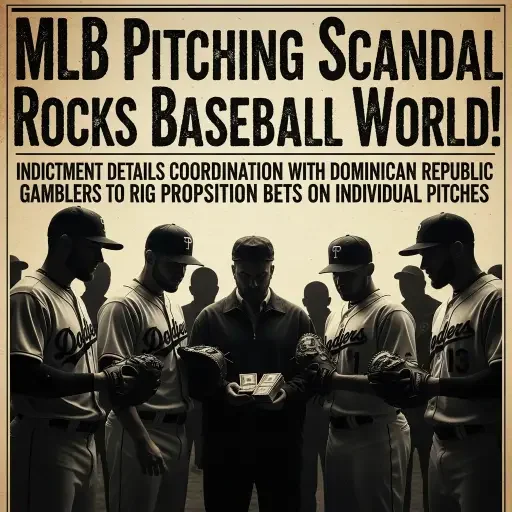
The architecture was simple: pitchers pre-agreed on pitch type, speed, and whether the result would be a ball or strike. Co-conspirators then wagered on online sportsbooks armed with this inside information. To guarantee certain pitches registered as balls, Clase threw them in the dirt—sometimes landing five feet in front of home plate, far enough to eliminate any ambiguity.
The stakes match the audacity. Each defendant faces maximum sentences totaling 65 years across all charges—20 years each for wire fraud conspiracy, honest services fraud, and money laundering conspiracy, plus five years for sports bribery. Federal prosecutors structured the charges this way because the scheme involved multiple criminal elements: defrauding betting platforms through false pretenses (wire fraud), betraying the duty of honest performance owed to their employer and fans (honest services fraud), attempting to fix sporting event outcomes for payment (sports bribery), and moving the proceeds to conceal their illegal source (money laundering).
The Money: A Two-Way Street
Prosecutors allege bettors won $400,000 on Clase’s rigged pitches and $60,000 from Ortiz’s participation—a total of roughly $460,000 that flowed from betting platforms to the conspiracy’s inner circle. But the financial relationships were more complex than simple bribe-taking. Clase received $5,000-$7,000 per rigged game, yet also funded bettors, creating a partnership structure rather than a pure pay-for-information scheme. In one instance, he withdrew $50,000 cash and gave $15,000 to a co-conspirator wagering on Ortiz’s pitch—essentially investing in the fraud’s success.

This dual role explains why prosecutors included money laundering charges: Clase wasn’t merely receiving bribes but actively cycling funds through the betting ecosystem to obscure their origin and maximize returns.
The coordination left a digital trail that became the prosecution’s roadmap. Text messages documented real-time adjustments during games—itself an MLB rules violation even without gambling involvement. The tone varied from businesslike planning to dark humor. After one bettor lost $4,000 when a rigged pitch failed because the batter unexpectedly swung at a ball (turning it into a strike rather than the guaranteed ball), he texted Clase an image of a man hanging himself. Clase responded with a sad puppy emoji—gallows humor that now appears as evidence in a federal indictment.
The payouts could be staggering for individual pitches. On June 7, 2023, a bettor received advance information that Clase would throw slower than 94.95 mph to a Boston batter. The pitch landed five feet in front of home plate—a deliberate spike that left no doubt about the outcome. Single-pitch payout: $58,000, more than twice what some MLB rookies earn per month.

Two Careers at the Breaking Point
The indictment represents a precipitous fall from dramatically different career trajectories, which makes the risk calculation all the more puzzling.
Clase, 27, is a three-time All-Star and two-time Mariano Rivera Award winner who finished third in 2024 AL Cy Young voting and 11th in MVP consideration. He’s widely regarded as one of baseball’s five best closers, with a fastball that routinely exceeds 100 mph and career earnings exceeding $10 million. The alleged scheme began in May 2023, when Clase was already established as an elite pitcher with financial security. His motivation remains unclear—though prosecutors suggest the arrangement evolved from simply taking bribes to actively investing in the fraud’s returns, implying a progression from opportunistic corruption to calculated partnership.
Ortiz, 26, joined Cleveland in December 2024 via trade from Pittsburgh, where he’d struggled to establish himself as a reliable starter. His participation spanned just two June 2025 games but generated $60,000 in fraudulent winnings—notable because his annual salary was only $782,600. For a player on the margins of MLB success, the temptation was arguably more comprehensible: a single rigged game could net nearly 1% of his annual income for a few deliberately placed pitches. The desperation math of fringe players has always been gambling’s easiest target.
Both have been on non-disciplinary paid leave since July, when Ohio Casino Control Commission officials flagged abnormal betting patterns on Ortiz’s games. The detection mechanism worked as designed: sophisticated algorithms identified statistically improbable betting volumes and win rates on obscure proposition bets involving Ortiz’s pitch characteristics. This triggered an MLB investigation, which found similar patterns around Clase’s appearances stretching back two years.
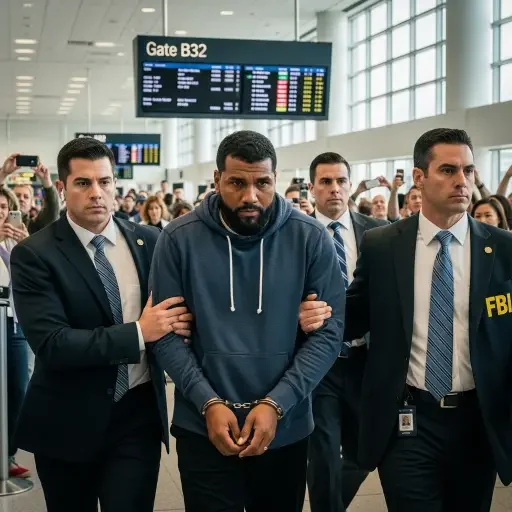
Ortiz was arrested Sunday morning at Boston Logan Airport by FBI agents and appeared in federal court Monday, where he was released on conditions pending arraignment. Clase remains outside U.S. custody, presumably in the Dominican Republic, which has no extradition treaty with the United States for most offenses—though both countries cooperate on serious criminal cases. Federal prosecutors will likely coordinate with Dominican authorities for his arrest and transfer, a process that could take weeks or months.
Baseball’s Longest Shadow
Baseball gambling scandals carry unique historical weight because the sport’s institutional identity was forged in response to its greatest betrayal. The 1919 Black Sox scandal—eight Chicago White Sox players conspiring with gamblers to throw the World Series—didn’t just create baseball’s first commissioner’s office; it established the existential principle that gambling corruption represents an unforgivable sin requiring lifetime banishment. The reasoning was pragmatic: if fans suspect outcomes are predetermined, they stop watching, and the entire commercial enterprise collapses.
Pete Rose accepted a lifetime ban in 1989 for betting on baseball games while managing the Cincinnati Reds. Crucially, Rose bet on his own team to win, not against them—yet baseball’s ban was absolute. The logic: any gambling involvement creates conflicts of interest that corrupt competitive judgment. A manager betting on his team today might overuse his best reliever to win that game, damaging the pitcher’s arm and hurting the team’s chances in future games he didn’t bet on. The incentive structure becomes poisoned regardless of whether specific games are thrown.
Until 2024, no active player had received a gambling-related ban since 1924—a 100-year clean streak that reflected both effective deterrence and limited gambling access. That changed when San Diego Padres infielder Tucupita Marcano was permanently banned for placing nearly 400 bets on baseball games, including some on games involving his own team. The sheer volume suggested compulsive behavior rather than calculated fraud, but baseball’s rules don’t distinguish: any betting on baseball in connection with professional involvement means permanent ineligibility, enforced independently of criminal proceedings.
Clase and Ortiz now face this same institutional death penalty regardless of what happens in Brooklyn federal court.
A Pattern Emerges Across Professional Sports
This indictment didn’t arrive in isolation. Weeks earlier, the same Brooklyn federal prosecutor’s office charged multiple NBA figures—including Portland Trail Blazers head coach Chauncey Billups and Miami Heat guard Terry Rozier—in separate gambling investigations involving similar schemes of inside information trading. The near-simultaneous timing and shared jurisdiction suggest a coordinated federal enforcement push rather than coincidental discoveries.
This wave traces directly to a 2018 Supreme Court decision that struck down the Professional and Amateur Sports Protection Act, which had effectively limited legal sports betting to Nevada since 1992. The Court’s ruling opened the floodgates for state-by-state sports betting legalization, leading to rapid expansion of online sportsbooks across most of the United States. Within five years, roughly 80% of Americans gained access to legal sports gambling through smartphone apps.

The expansion created new corruption pathways that didn’t exist in the Nevada-only era. Traditional sports betting focused on game outcomes—who wins, final scores, point spreads. These are difficult to manipulate because they require coordinated corruption of multiple players. But online sportsbooks, competing for market share, began offering thousands of “proposition bets” on granular game elements to attract customers: individual pitch speed and type, whether specific at-bats would be balls or strikes, player performance statistics in narrow time windows.
These micro-bets are vulnerable precisely because they involve actions single players directly control. A pitcher can guarantee his next fastball stays under 95 mph by simply not throwing it at maximum effort—a choice impossible to detect from normal performance variation. The betting platforms unwittingly created opportunities for atomized corruption: rigging single pitches rather than entire games.
The Investigation and What Comes Next
Both players are presumed innocent until proven guilty through trial or plea agreement. Ortiz will be arraigned in the Eastern District of New York within the next few weeks. Clase’s arraignment timeline depends on whether he voluntarily returns to the United States or requires extradition from the Dominican Republic.
Beyond criminal prosecution, both face MLB disciplinary proceedings that operate on parallel tracks. Baseball’s investigative arm can impose lifetime bans based on evidence that wouldn’t necessarily meet criminal trial standards, and the league isn’t required to wait for court verdicts before acting. Pete Rose was banned despite never facing criminal charges; Marcano was banned before any criminal investigation began. The standard is whether the player violated baseball’s gambling rules, not whether prosecutors can prove criminal intent beyond reasonable doubt.
U.S. Attorney Joseph Nocella framed the betrayal in public trust terms: “Professional athletes hold a position of trust—not only with their teammates and leagues, but with fans who believe in fair play. As alleged, the defendants sold that trust to gamblers by fixing pitches. They defrauded the online betting platforms where the bets were placed. And they betrayed America’s pastime.” The statement emphasizes three distinct victims: the sport’s integrity, the betting companies who paid fraudulent winnings, and fans whose belief in authentic competition was exploited.
The scheme allegedly ran for more than two years before Ohio regulators detected the patterns in 2025—a troubling timeline that reveals the inadequacy of current monitoring systems. Betting platforms use algorithms to flag unusual patterns, but these focus primarily on protecting the house from sharp bettors with legitimate edges, not detecting internal corruption. The delay suggests platforms need to redesign detection systems specifically for insider fraud, focusing not just on who wins too often but on whether betting patterns correlate suspiciously with specific players’ involvement in games.
The Deeper Corruption: Trust as the Currency

The final damage exceeds any prison sentence or career ban. Baseball, more than most sports, sells certainty—the comfort that every pitch represents an authentic test of skill, every at-bat an honest confrontation between hurler and batter. It’s a game measured in fractions: 0.001 seconds of bat speed, one inch of break on a curveball, two miles per hour on a fastball. Fans watch knowing these microscopic margins are genuine.
When an elite closer like Clase—someone trusted to protect one-run leads in the ninth inning, the highest-leverage moments in baseball—throws a ball in the dirt, it now carries an asterisk of doubt. Did it miss by accident, by design, or because he was paid $7,000 to miss? That uncertainty metastasizes backward through every pitch of his career, every save converted or blown, every postseason appearance. If he could be bought for two games, could he have been bought for twenty? The questions multiply infinitely because trust, once broken, can’t be surgically repaired.
This is why baseball’s punishment for gambling corruption has always been absolute and permanent. The sport can survive a pitcher with a drug problem, a manager with anger issues, even an owner with criminal convictions for unrelated crimes. But it cannot survive the suspicion that games aren’t real, that the competition is theater, that outcomes were pre-negotiated between athletes and gamblers before the first pitch.
The Clase-Ortiz indictment doesn’t just threaten two careers—it deposits a permanent residue of doubt across every proposition bet, every unusual pitch sequence, every moment when a player’s performance deviates from expectation. The scandal’s true cost is measured not in court verdicts but in the accumulated micro-doubts of millions of fans, each wondering whether what they’re watching is sport or script.
The final accounting won’t occur in Brooklyn federal court, but in baseball’s collective memory—where Clase and Ortiz now join the roster of those who gambled on America’s game and lost everything, taking a small piece of the sport’s credibility with them.
Tags
Related Articles
Sources
Federal indictment documents from Eastern District of New York, statements from U.S. Attorney's Office, MLB official statements, sports betting regulatory filings, historical baseball gambling records