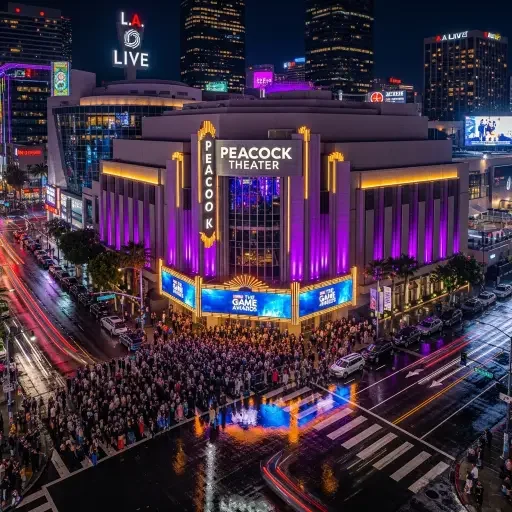
The mathematics of desire are simple tonight: 154 million people will watch three hours of programming where the actual awards occupy maybe thirty minutes of airtime. The rest? Pure, uncut marketing—trailers, world premieres, celebrity appearances—all choreographed around gilded trophies that winners hold for approximately forty-five seconds before the music swells and ushers them offstage. This is the Game Awards 2025, and it represents something far more consequential than who takes home Game of the Year.
It’s a referendum on where power concentrates in an industry now generating somewhere between $290 billion and $522 billion annually—figures that vary wildly depending on whether you count mobile gaming’s in-app purchases, console hardware sales, or the burgeoning subscription economy. By any accounting, gaming has eclipsed both film and music combined. Tonight’s ceremony, streaming free across YouTube, Twitch, Amazon Prime Video, and two dozen other platforms, is less celebration than coronation—a three-hour demonstration of who commands attention in the world’s largest entertainment medium.
The Auction Block
Here’s the number that crystallizes everything about tonight’s event: $1 million. That’s what publishers reportedly pay for a three-minute trailer slot during the main show. Sixty seconds costs $450,000. These figures, sourced from industry insiders speaking to Kotaku, represent a doubling from Keighley’s other major event, Summer Game Fest’s Opening Night Live, where similar slots run around $500,000.
The pricing isn’t arbitrary. Last year’s Game Awards drew 154 million livestreams globally—a viewership that dwarfs the 2025 Super Bowl’s 128 million audience. Yet a thirty-second Super Bowl ad costs approximately $8 million. By that metric, the Game Awards’ million-dollar ask for three minutes appears almost reasonable, a kind of blue-light special in the attention economy.
But the comparison misleads. Super Bowl viewers arrive for the game; Game Awards viewers arrive for the trailers. The ceremony has engineered a perfect inversion—awards become the interstitial content, the brief pauses between the real attraction. This creates a peculiar dynamic where publishers aren’t buying interruption space but rather fulfilling the core product promise. It’s as if movie trailers preceded the Oscars, and the Academy Awards became brief interruptions in an otherwise continuous reel of coming attractions.
Some publishers get editorial placements at no cost—Keighley curates free slots for “what he personally wants to champion,” according to the reporting. This creates a two-tier system: the brands with seven-figure marketing budgets, and the anointed few who catch Keighley’s eye. For everyone else, it’s pay to play or watch from home.
The Record-Breaker
At the center of tonight’s ceremony sits Clair Obscur: Expedition 33, a French-developed turn-based RPG that has rewritten the award show’s record books before a single trophy changes hands. With thirteen total nominations spanning twelve categories—including three separate nods in Best Performance alone—it stands as the most-nominated game in Game Awards history, surpassing The Last of Us Part II’s previous record of eleven.
The game’s trajectory reads like a masterclass in modern game economics. Developed by Sandfall Interactive, a team of thirty-three former Ubisoft developers, Expedition 33 launched simultaneously on PC, PlayStation 5, Xbox Series, and—critically—Xbox Game Pass on April 24, 2025. Within thirty days, it became the best-performing third-party launch in Game Pass history, measured by unique players.
This isn’t just good press. Game Awards nominations trigger quantifiable economic effects. Industry analysis suggests nominations spike digital sales by 30 to 50 percent in subsequent weeks, with indie studios benefiting most dramatically. When Hades won Best Independent Game in 2018, it moved over 700,000 copies in the following months, transforming Supergiant Games’ financial trajectory. For Expedition 33, already riding critical acclaim and a Golden Joystick sweep (seven categories, seven wins), tonight’s potential haul could double its lifetime earnings—the kind of money that funds entire sequel development cycles.
What makes Expedition 33’s dominance more remarkable is its genre. Turn-based RPGs—even those infused with real-time parrying mechanics and Belle Époque French aesthetics—rarely command this level of recognition. The Game Awards typically coronates massive single-player epics or innovative indie darlings. Last year, Astro Bot claimed the top prize, marking only the second time a 3D platformer won Game of the Year (the first being 2021’s It Takes Two). Before that, sprawling RPGs like Baldur’s Gate 3 (2023) and Elden Ring (2022) wore the crown.

Last Year’s Coronation
The 2024 ceremony belonged to Astro Bot, Team Asobi’s love letter to PlayStation’s thirty-year history. The game swept four awards—Game of the Year, Best Game Direction, Best Action/Adventure, and Best Family Game—in a year where the competition included heavyweights like Final Fantasy VII Rebirth, Black Myth: Wukong, and Metaphor: ReFantazio.
Astro Bot’s victory represented something culturally significant beyond its technical achievements. In an industry increasingly dominated by live-service games, battle passes, and monetization-first design, here was pure, distilled fun—a platformer where the primary objective was collecting robots dressed as Crash Bandicoot and Nathan Drake. Studio Director Nicolas Doucet’s acceptance speech thanked Nintendo without naming them directly, acknowledging the design lineage that stretches from Super Mario 64 through Astro’s Playroom and into the game that just beat several $200 million productions for the industry’s top honor.
The other big winner was Balatro, the indie card-battler that swept three categories: Best Debut Indie, Best Independent Game, and Best Mobile Game. LocalThunk’s poker-meets-deck-building concept proved that innovation still scales—even when it comes from a solo developer competing against studios with hundreds of employees.
The 2024 ceremony also featured Amazon’s Fallout series winning Best Adaptation, Harrison Ford awkwardly presenting an award, and the Muppets providing meta-commentary on the show’s endemic problems. “It was like the game commercials with award interruptions!” Statler and Waldorf quipped, articulating the criticism that trails every Game Awards broadcast like a persistent notification.

The Balancing Act
Geoff Keighley occupies a peculiar position in gaming culture—part journalist, part curator, part carnival barker. After producing the Spike Video Game Awards for over a decade, he launched the Game Awards in 2014 with backing from Microsoft, Sony, Nintendo, and major publishers. The pitch: create gaming’s equivalent of the Oscars while solving the fundamental problem that killed every previous attempt—nobody watches awards shows unless there’s additional entertainment value.
His solution was elegant and controversial in equal measure: sandwich the awards between world premiere trailers, celebrity appearances, and live musical performances. The formula works—viewership has grown from 2.3 million in 2014 to 154 million in 2024. But it creates perpetual tension between honoring developers and serving publishers’ marketing needs.
The criticism follows a predictable pattern each year. Winners receive thirty seconds of stage time before exit music drowns their gratitude. Celebrity guests receive several minutes for banter. The show stretches toward four hours while most awards zip past in rapid-fire succession. Developers at nominated studios receive exactly two complimentary tickets to the ceremony; if their team wants more members present for their potential moment of recognition, they buy tickets at $300-700 each from the same public pool as fans.
Keighley’s response remains consistent: it’s a balancing act. The trailers attract viewers, which elevates the awards, which validates the whole enterprise. Remove the marketing spectacle, and you’re back to the Game Developers Choice Awards—important, respected, and watched by roughly no one outside the industry itself.
This year introduces a new wrinkle: Amazon’s deeper partnership brings the ceremony to Prime Video for the first time, alongside limited-time deals on nominated games and gaming hardware that will drop throughout the broadcast. It’s a logical evolution—if the show is fundamentally a marketing vehicle, why not integrate shopping directly into the experience?
What Victory Requires
Winning Game of the Year at the Game Awards depends on a specific alchemy. An advisory committee comprising Microsoft, Sony, Nintendo, AMD, and major publishers selects over 130 outlets that nominate and vote on winners. These outlets—a mix of mainstream gaming press, specialist publications, and content creators—determine 90% of the outcome. The remaining 10% comes from public voting, where millions cast ballots in the weeks preceding the ceremony.
This structure theoretically balances expert assessment with popular sentiment. In practice, it tends to reward games that achieve both critical consensus and broad cultural penetration. Baldur’s Gate 3 won in 2023 because it united critics and players in rare agreement—here was a sprawling RPG that honored genre traditions while implementing systems previously considered too complex for mainstream success. Elden Ring won in 2022 through similar convergence: FromSoftware’s punishing-but-fair design philosophy married to an open world structure that made “difficult” games accessible to wider audiences.
The voting body’s composition matters. Gaming journalism in 2025 skews younger, more diverse, and more internationally distributed than it was even five years ago. This creates fascinating tensions in categories like Best Narrative or Best Art Direction, where games reflecting non-Western aesthetics (like Black Myth: Wukong’s Chinese mythology) compete directly with Western productions. The outcome often reveals which voices hold sway in the current critical moment.
For Expedition 33 tonight, the math looks favorable. It leads in nominations, swept the Golden Joysticks, dominated Game Pass metrics, and earned universal critical acclaim. The French studio also benefits from timing—their Belle Époque-meets-JRPG aesthetic feels fresh in a year where several nominees follow more conventional genre templates. Whether that’s enough to overcome competition from established franchises remains the evening’s central question.

The Machinery Exposed
The real story of tonight’s Game Awards isn’t who wins Game of the Year—predictable discourse will dominate social media regardless of the outcome. The real story is the machinery itself: how a three-hour ceremony became the most valuable marketing real estate in interactive entertainment, and what that reveals about power distribution in an industry generating more revenue than most nations’ GDPs.
Publishers spend a million dollars for three minutes of audience attention because nowhere else offers equivalent reach to the exact demographic most likely to buy their products. This creates cascading effects. Indie developers who can’t afford entry face higher barriers to visibility. Games that don’t generate trailer-worthy spectacle struggle for recognition. The awards themselves become secondary to the commercial breaks masquerading as content.
Yet the ecosystem persists because it serves multiple functions. Publishers need centralized marketing events. Developers want recognition. Fans crave shared cultural moments in an era of fragmented media consumption. Keighley provides the infrastructure that connects these desires, extracting value at each connection point.
The Game Awards succeeds because it’s fundamentally honest about what it is—a commercial enterprise dressed in awards-show formalwear. The pretense of being gaming’s Oscars remains just thin enough to maintain plausible deniability while thick enough to preserve gravitas. It’s dinner theater where everyone knows they’re watching a performance, but the meal is good enough that nobody complains too loudly about the acting.
Tonight, that performance will unfold across three hours of carefully orchestrated chaos. Celebrities will mispronounce game titles. Orchestras will perform medleys nobody asked for. Winners will attempt gratitude speeches while exit music swells like rising water. Publishers will unveil trailers that cost more to produce than many full games. And 154 million people will watch, because in gaming’s attention economy, this is where everyone agrees to look simultaneously.
The industry will crown its champions. The machinery will prove its value. And next year, the cycle begins again—only the price of admission will have increased.
Tags
Related Articles
Sources
Analysis based on Kotaku industry reporting, Newzoo market data, The Game Awards official announcements, and multiple gaming industry publications